The Black Wealth Landscape: Deep South States at a Glance

The Black Wealth Landscape:
Deep South States at a Glance

The Deep South is home to some of the largest Black populations in the United States—and some of the deepest racial wealth disparities.

This section compares key indicators of Black wealth across nine states: Alabama, Arkansas, Florida, Georgia, Louisiana, Mississippi, North Carolina, South Carolina, and Tennessee.

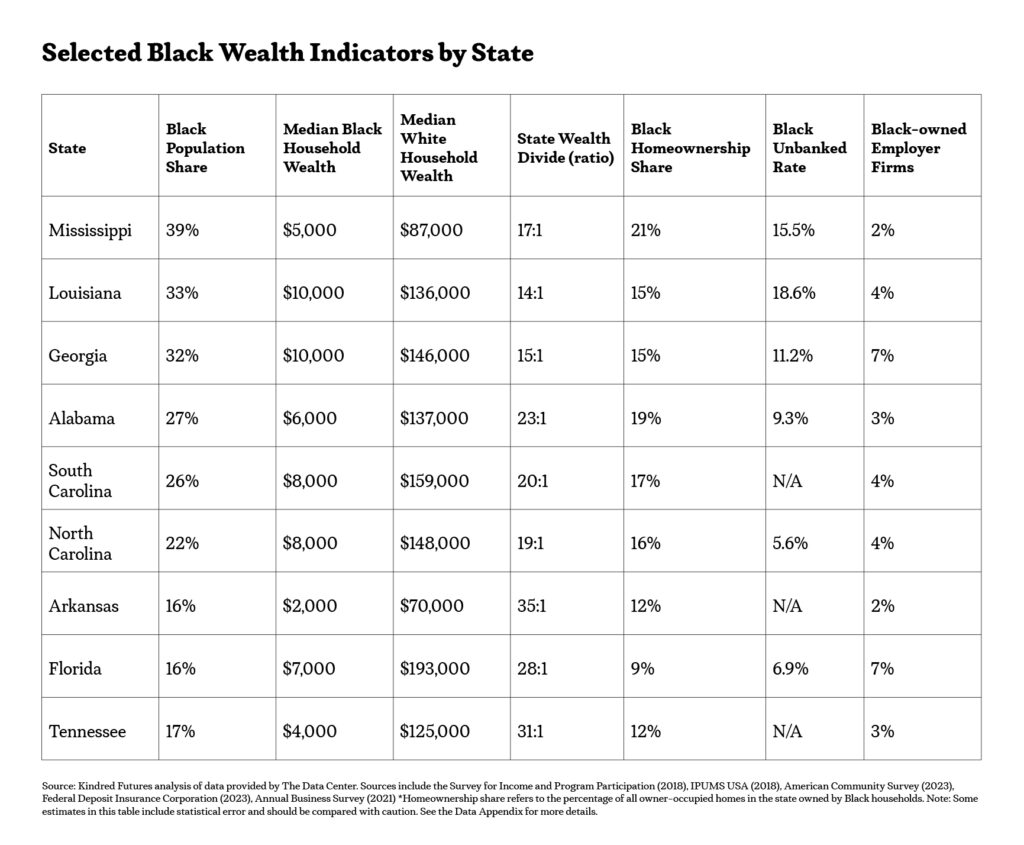
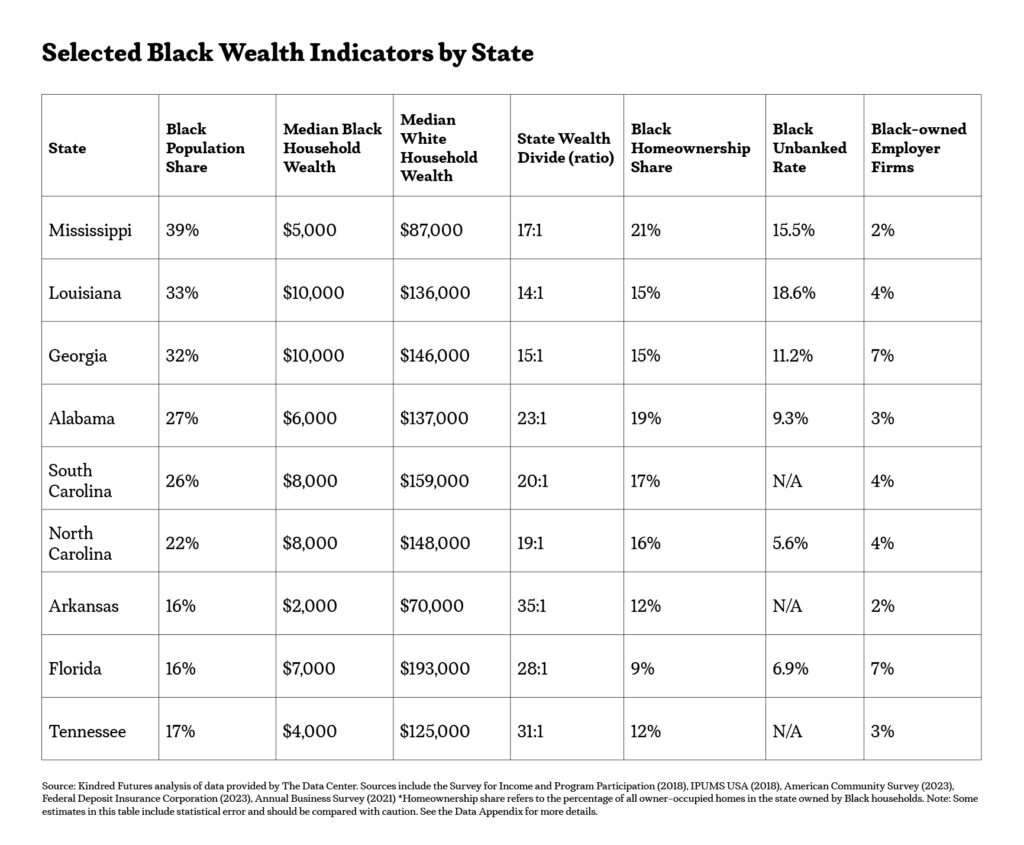
While each state has a unique history, the data reveals common challenges: low Black wealth, lagging homeownership, high debt and unbanked rates, and underrepresentation in business ownership. These are also important variations that can inform state-specific strategies. The table below provides a snapshot of the Black–White wealth divide by state, followed by highlights:
Mississippi:

The state with the largest Black population share (nearly 4 in 10 Mississippians) paradoxically has one of the South’s lowest median wealth figures for Black households ($5,000). White households in Mississippi hold roughly 17 times more wealth. Mississippi also has one of the highest rates of Black families lacking basic bank accounts (15.5% unbanked) and one of the highest Black home loan denial rates (36% denial). These indicators reflect deep, persistent exclusion despite the state’s large Black population.

Louisiana:

Louisiana is another Black plurality state (33% Black) where median Black wealth is extremely low ($10,000). Only about 1 in 5 homeowners in Louisiana are Black, down from nearly 25% in 1980 due to foreclosures and economic stagnation post-2008. Louisiana has one of the highest recorded Black unbanked rate in the South (18.6%). Black women’s labor participation in Louisiana is among the highest, reflecting their role as breadwinners (63% of Black women employed vs 56% of Black men).

Georgia:

Georgia boasts one of the region’s highest estimated median Black wealth figures (around $10,000) and the largest share of Black-owned businesses (7% of employer firms). These achievements owe much to Metro Atlanta’s robust Black professional class. However, the wealth divide remains vast—White median wealth in Georgia is about 15 times Black median wealth. Black Georgians also carry heavy student debt loads that eat into wealth gains. Roughly 29% of Black adults in Georgia hold a bachelor’s degree (highest in Deep South), yet education has not translated to proportional gains in wealth.

Florida:

Florida’s Black population (about 3.8 million people) has relatively high employment and entrepreneurship in some metro areas, but the typical Black household’s wealth is only about $7,000. Whereas White households in Florida hold 28 times more wealth (median $193,000. Florida’s Hispanic communities have attained higher business ownership (18% of firms) and homeownership than its Black communities, pointing to different structural barriers. Black Floridians also face one of the largest mortgage denial rates (30%).

Alabama & South Carolina:

Both states have Black populations around 25–27%, Black homeownership shares around 15–20%, and Black median wealth at approximately $6,000 and $8,000, respectively. Black Alabamians have made some progress in education (i.e. college attainment has improved), but wealth remains very low. For instance, Alabama’s Black middle class holds a fraction of White wealth at similar levels of education. South Carolina’s Black Belt regions remain plagued by high poverty, and the state has seen only modest recovery in Black homeownership post-recession.

North Carolina:

With booming finance/tech hubs, North Carolina has seen rising overall wealth, but its racial wealth divide persists. Black households have a median wealth of $8,000 (and many younger households have zero or negative net worth). Notably, North Carolina has the one of the lowest Black unbanked rates (5.6%), thanks in part to urban centers like Charlotte with better banking access. Still, only about 6% of NC businesses are

Black-owned.

Tennessee & Arkansas:

These states have the smallest Black population shares in the Deep South and some of the lowest Black wealth metrics. Tennessee’s median Black wealth ($4,000) is one of the lowest reported. However, Tennessee offers an interesting case where rural Black wealth (around $6,000) may slightly exceed urban Black wealth ($4,000), perhaps due to a few Black landowners or lower cost of living in rural areas. Arkansas similarly shows rural Black households may be doing marginally better than urban ($3,000 vs $1,000), but overall Black wealth is extremely low and Black business ownership is only 2%. This underscores the need for basic financial infrastructure and investment in Black communities that have been long neglected.

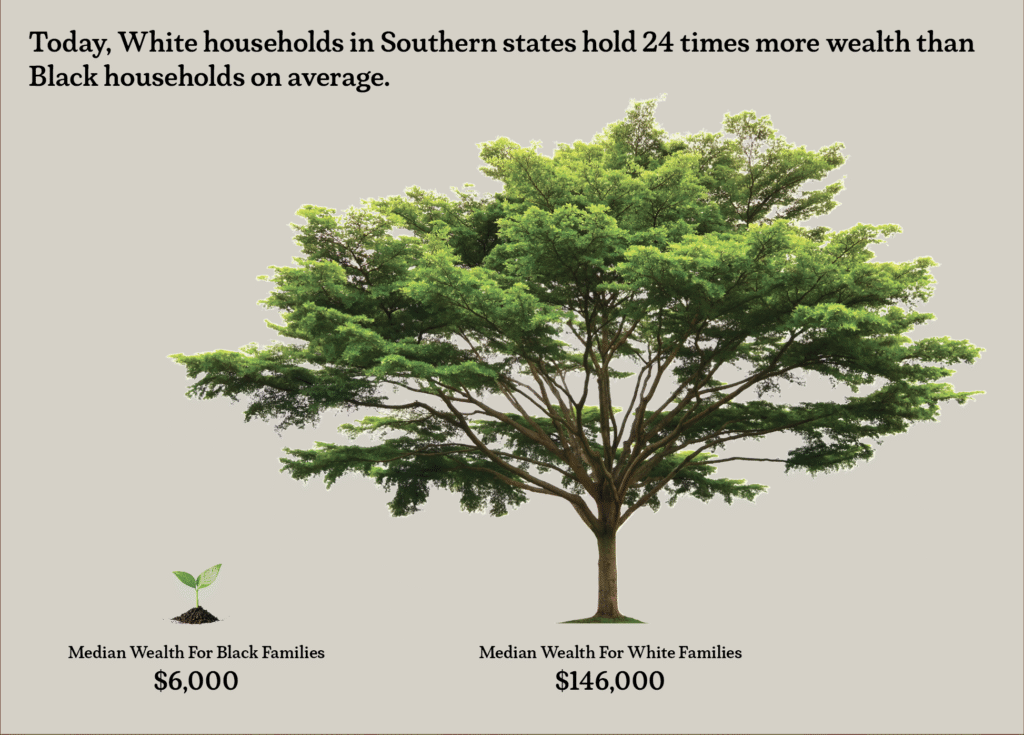
Overall, this snapshot paints a picture of entrenched disadvantage: Black communities across the South hold vastly less wealth and are underrepresented in key wealth-building domains (homeownership, business ownership) despite in many cases comprising a large portion of the population. This is not due to individual choices or deficits in financial literacy—it is the result of structural barriers. As the next section details, common factors such as limited access to capital, housing inequality, labor market segregation, and debt burdens continue to hold back Black wealth accumulation in all of these states. By understanding these structural issues, policymakers can design interventions that target the root causes rather than the symptoms.

Place-based solutions are critical. Investing in rural Black communities can improve the foundation for wealth creation where it’s needed most.

View All References

Read More Of The Report

The Roots of the Racial Wealth Divide in the South

The Roots of the Racial
Wealth Divide in the South

More than any other region, the American South was built on Black labor and Black exclusion. Centuries of enslavement and extraction laid the groundwork for a racial wealth divide that remains stark in 2025. The institution of slavery provided a secure foundation for the accumulation of vast fortunes among southern slaveholders.8 By stripping enslaved Black people of any assets and then barring freedmen and freedwomen from landownership, education, and capital, the post-Civil War South entrenched White wealth and Black poverty.9

Twentieth-century policies—from New Deal programs that excluded Black farmers and domestic workers, to redlining that denied mortgages in Black neighborhoods—furthered the divide. Unlike European immigrant groups who eventually gained broader access to American wealth-building, Black Southerners faced a “baked-in” system of racial exclusion that compounded across generations.10 Several historical turning points had particularly devastating effects on Black wealth in the South:

Land Dispossession (1920–1940):

By 1910—half a century after Emancipation—Black farmers in the South had accumulated an estimated 16 to 19 million acres of land. But over the next few decades, Black landownership collapsed due to discriminatory lending by the USDA, forced sales of heirs’ property (land passed without wills), depression-era farm foreclosures, and racial violence.

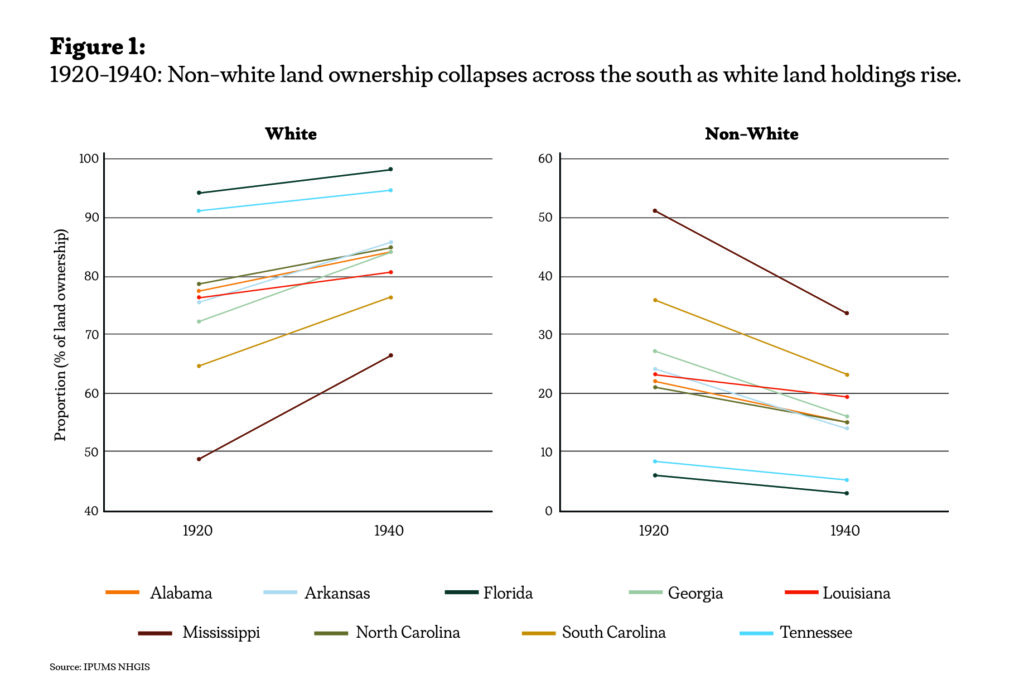
Across Southern states, the non-White share of land ownership plummeted between 1920 and 1940. In Mississippi, non-White farmers owned 51% of land in 1920, but only 33% by 1940; White ownership rose commensurately. Other states saw similar declines (Georgia’s non-White land share fell from 28% to  less than 20%).11 By 1997, Black Americans nationwide had lost 90% of the land they owned in 1910.12 A recent study estimates the present value of Black land lost in the 20th century at $326 billion—wealth that would have passed to Black families had they been allowed to keep and develop their property.13

Urban Renewal and Displacement (1950s–1960s):

Mid-20th century development programs devastated many historic Black communities under the guise of slum clearance and highway construction. In Southern cities like Atlanta, Birmingham, and Memphis, the vast majority of families displaced were Black.14

In Atlanta, for example, 92% of the 5,285 families uprooted by urban renewal were Black. Similar patterns played out across the region (e.g. 100% of those displaced in Savannah were Black).15 This wholesale removal—often called Negro removal at the time—destroyed Black-owned homes and businesses, ruptured social networks, and halted intergenerational wealth transfer.16 Many displaced families were forced into overcrowded public housing or low-opportunity neighborhoods, cementing cycles of poverty.17

Segregation and Credit Exclusion:

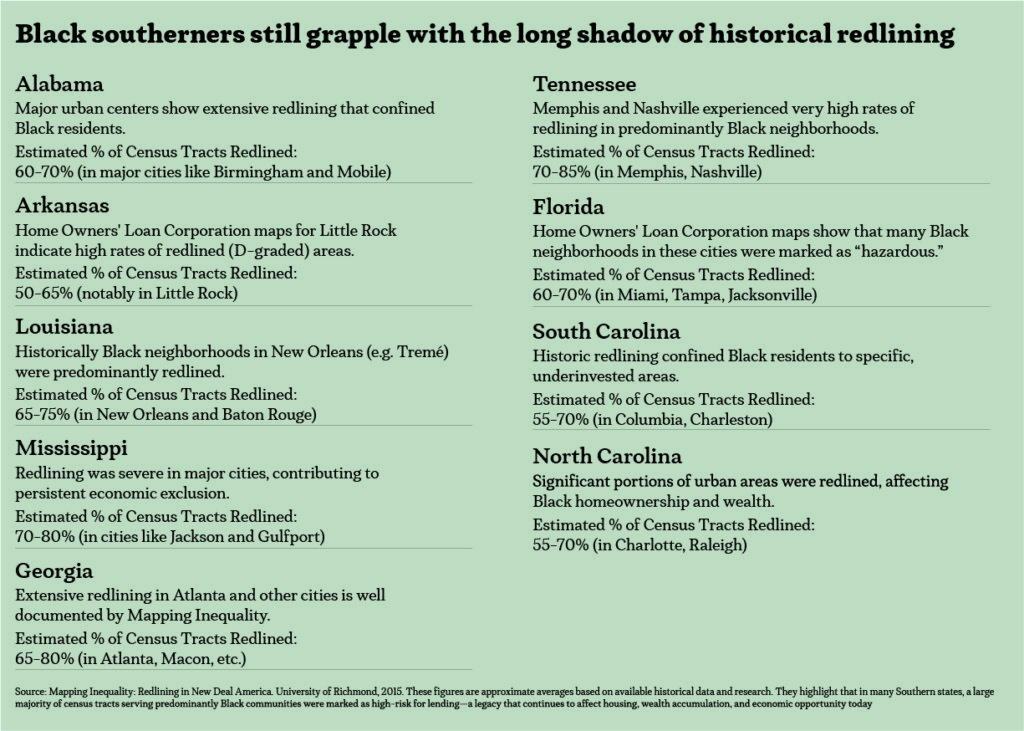
Jim Crow laws enforced racial segregation in housing, education, and employment well into the 1960s, denying Black families the most common avenues of wealth accumulation. Black workers were largely kept out of higher-paying jobs and faced systemic pay discrimination. Federal homeownership programs, such as VA/FHA loans in the post-WWII era, often excluded Black applicants or steered them into subprime loans, a practice known as redlining.18

The effects were stark: by 1980, White households owned more than three-quarters of all owner-occupied homes in every Deep South state.19

The late 2000s subprime mortgage crisis hit Black communities especially hard—Black homeownership rates in states like Georgia and Mississippi fell by 5–10 percentage points after 2008 and have only partially recovered.20

These housing inequities helped lock in the racial wealth divide: home equity is the largest source of wealth for most American families, but Black homeownership has lagged and even declined in the 21st century.

At Kindred Futures, we recognize that wealth means more than money. Wealth is security, opportunity, and freedom—the power to shape one’s future.

Wealth-Stripping Policies:

A host of other practices further sapped Black wealth. Predatory lending and high-interest debt traps (from Reconstruction-era sharecropping contracts to modern payday loans) have drained resources from Black communities.21 In recent decades, mass incarceration and court-imposed fines/fees have also acted as a ‘tax’ on Black wealth, especially in the South. Black Americans—particularly Black men—lost billions in income and assets due to the war on drugs and prison boom from the 1970s–2000s, which hit Southern states hard.22 Discriminatory hiring and workplace segregation meant Black workers often lacked benefits like pensions, further widening wealth disparities in retirement.

The cumulative result of these compounding injustices is a deeply stratified economy in which Black Southerners as a group started the 21st century with far fewer assets than their White counterparts. Wealth begets wealth: without access to collateral or inherited capital, Black families have struggled to catch up even as overt discrimination was outlawed. Today’s racial wealth divide in the South is the tangible legacy of enslavement, legalized segregation, and public and private discrimination. Understanding these roots is essential—because policies that destroyed Black wealth were intentionally created, the solutions to build Black wealth must be as intentional and far-reaching.

At Kindred Futures, we recognize that wealth means more than money. Wealth is security, opportunity, and freedom—the power to shape one’s future. As Fannie Lou Hamer said, “Nobody’s free until everybody’s free.”23 In that spirit, this report centers community wealth-building: transforming the systems of capital to empower Black communities that have been marginalized. Before turning to solutions, we first assess where the South stands today through a Black Wealth Scorecard, and then dissect the structural factors currently affecting Black wealth creation in the region.

Read More Of The Report

Roots of Wealth Report Executive Summary

Black families in the Deep South face a vast and persistent wealth divide rooted in centuries of systemic racism and disinvestment.1 In Arkansas, for example, the median White family has about $70,000 in wealth—thirty-five times the $2,000 of the median Black family.2 Across the South, nearly 2 million Black households have zero or negative net worth, underscoring the urgency of reversing these compounding inequities.3

This report details the historical roots of the racial wealth divide in the South, compares key Black wealth indicators across Southern states, and outlines structural policy strategies to unearth Black prosperity—ensuring that growth is shared equitably among all southern households. Major findings include:

  • Deep South Wealth Divide: Despite large Black populations in the Deep South, economic growth centers like Atlanta hold only a fraction of White wealth. Wealth divides persist across urban and rural areas, and even higher education has not closed the divide (White college-educated households have 3–8 times the wealth of Black college-educated households).4
  • Rural Opportunities: In several Southern states, Black households in non-metro counties hold median wealth that equals—or sometimes modestly surpasses—their metro peers, whereas White households consistently build more wealth in cities, underscoring that geography alone cannot close racial divides.5
  • Structural Barriers: Historic injustices—enslavement, Jim Crow segregation, discriminatory federal policies, and asset-stripping practices like land theft and urban renewal—severely curtailed Black wealth-building.6 Today, unequal homeownership rates, lower access to credit, wage disparities, and debt burdens perpetuate inequality. For instance, Black homebuyers are denied mortgages at roughly double the rate of White buyers across the Deep South, and over 50% of Black households in each state have delinquent debt (versus ~30% of White households).7
  • Community Wealth-Building Solutions: The report frames solutions in terms of community wealth-building, focusing on systemic changes rather than individual behavior. Recommended interventions include: “baby bonds” or trust accounts for children, down payment assistance and enforcement of fair housing laws to boost Black homeownership, expansion of Community Development Financial Institutions (CDFIs) and Black-owned banks to increase credit access, student debt relief, higher minimum wages, and targeted investments in Black-owned businesses and shared ownership opportunities. These strategies could substantially narrow the wealth divide; for example, housing equity gains and student debt cancellation would cut the divide by tens of thousands of dollars per family.

In sum, building the wealth of Black families in the South is both a moral imperative and an economic opportunity. By addressing the roots of wealth—the policies and structures that determine who owns assets, accesses capital, and inherits opportunity—we can cultivate broadly shared prosperity. Centering Black communities in wealth-building policy will not only benefit those long-denied access but will strengthen the entire region’s economy. This report offers a roadmap for Southern policymakers, community leaders, and partners to move from acknowledgement to action, ensuring that Black prosperity is integral to the South’s future.

View All References

Read More Of The Report

Trapped by Design Report References

  1.  Karger, Howard. “Predatory Financial Services: The high cost of being poor in America.” In The Routledge Handbook of Poverty in the United States, pp. 75-82. Routledge, 2014.
  2.  Bethea, Jarryd, and Alex Camardelle. “Building a Beloved Economy: A Baseline and Framework for Building Black Wealth in Atlanta.” Atlanta: Atlanta Wealth Building Initiative, 2023.
  3.  Baradaran, Mehrsa. The color of money: Black banks and the racial wealth gap. Harvard University Press, 2017.
  4.  Ibid.
  5.  Grable, John, Kristy Archuleta, Kimberly Watkins, and Eun Jin Kwak. “To bank or not to bank: describing the banking status of black households.” International Journal of Bank Marketing (2024).
  6. Beckert, Sven, and Seth Rockman, eds. Slavery’s Capitalism: A New History of American Economic Development. Philadelphia: University of Pennsylvania Press, 2016.
  7.  The Color of Money: Black Banks and the Racial Wealth Gap. Cambridge, MA: Harvard University Press, 2017.
  8.  Massey, Douglas S., and Nancy A. Denton. American Apartheid: Segregation and the Making of the Underclass. Cambridge, MA: Harvard University Press, 1993.
  9. Immergluck, Dan. Foreclosed: High-Risk Lending, Deregulation, and the Undermining of America’s Mortgage Market. Ithaca: Cornell University Press, 2009.
  10. “Aetna Inc. Issues an Apology for Slavery Ties.” The New York Times, March 11, 2000. https://www.nytimes.com/2000/03/11/business/aetna-inc-issues-an-apology-for-slavery-ties.html; Johnson, Walter. Soul by Soul: Life Inside the Antebellum Slave Market. Cambridge, MA: Harvard University Press, 1999.
  11.  Baradaran, Mehrsa. The Color of Money: Black Banks and the Racial Wealth Gap. Cambridge, MA: Harvard University Press, 2017.
  12.  Rugh, Jacob S., and Douglas S. Massey. “Racial Segregation and the American Foreclosure Crisis.” American Sociological Review 75, no. 5 (2010): 629–51.
  13.  Kochhar, Rakesh, Richard Fry, and Paul Taylor. “Wealth Gaps Rise to Record Highs Between Whites, Blacks, Hispanics.” Pew Research Center, July 26, 2011. https://www.pewresearch.org/social-trends/2011/07/26/wealth-gaps-rise-to-record-highs-between-whites-blacks-hispanics.
  14.  Servon, Lisa. The Unbanking of America: How the New Middle Class Survives. Boston: Houghton Mifflin Harcourt, 2017.
  15.  Faber, Jacob William. “Segregation and the cost of money: Race, poverty, and the prevalence of alternative financial institutions.” Social Forces 98, no. 2 (2019): 819-848.
  16.  Baradaran, Mehrsa. The Color of Money: Black Banks and the Racial Wealth Gap. Harvard University Press, 2017.
  17.  Bethea, Jarryd, and Alex Camardelle. “Building a Beloved Economy: A Baseline and Framework for Building Black Wealth in Atlanta.” Atlanta: Atlanta Wealth Building Initiative, 2023. https://www.atlantawealthbuilding.org.
  18.  Ibid.
  19.  Servon, Lisa. The Unbanking of America: How the New Middle Class Survives. Boston: Houghton Mifflin Harcourt, 2017.
  20.  Turunen, Elina, and Heikki Hiilamo. “Health effects of indebtedness: a systematic review.” BMC public health 14 (2014): 1-8.
  21. Sweet, Elizabeth, Christopher W. Kuzawa, and Thomas W. McDade. “Short-term lending: Payday loans as risk factors for anxiety, inflammation and poor health.” SSM-population health 5 (2018): 114-121.
  22.  Federal Reserve Banks. 2021 Report on Employer Firms: Small Business Credit Survey. Washington, D.C.: Federal Reserve Banks, 2021. https://www.fedsmallbusiness.org/survey/2021/report-on-employer-firms.
  23. Rubin, Julia Sass, ed. Financing low income communities. Russell Sage Foundation, 2007.
  24. Georgia General Assembly, Georgia Industrial Loan Act, O.C.G.A. § 7-3-1 et seq. (1955).
  25.  North Carolina General Assembly. North Carolina General Statutes § 53-173: Maximum Rates of Interest and Fees for Consumer Loans. Raleigh: North Carolina General Assembly, 2024. https://www.ncleg.gov/Laws/GeneralStatutes.
  26. FindLaw. “Arkansas Interest Rates Laws.” FindLaw, June 20, 2016. https://www.findlaw.com.
  27.  National Consumer Law Center. “50-State Survey: State Predatory Lending Laws Show Significant Changes.” National Consumer Law Center, June 22, 2022. https://www.nclc.org.
  28. “Georgia Watch Releases: ‘Making Small-Dollar Lending Safer for Georgians.’” Georgia Watch, 23 Aug. 2018, https://georgiawatch.org/georgia-watches-releases-making-small-dollar-lending-safer-for-georgians/.
  29. Bethea, Jarryd, and Alex Camardelle. “Building a Beloved Economy: A Baseline and Framework for Building Black Wealth in Atlanta.” Atlanta: Atlanta Wealth Building Initiative, 2023.

Read More Of The Report

Policy Context and Solutions to Combat Predatory Lending

Policy Context and Solutions
to Combat Predatory Lending

Although Georgia banned payday lending in 2004, title loans and high-cost installment loans continue to operate in the state. These lenders thrive in areas that lack traditional banking services and use high-interest loans to keep residents in debt and financial insecurity. Despite the payday lending ban, Georgia still allows interest rates of up to 60% annual percentage rates (APR) on small-dollar loans under the Georgia Industrial Loan Act.24

Georgia law permits high rates and fees on installment loans, while title loan providers are misclassified as pawn brokers and are allowed to charge triple-digit interest rates up to 300%.

Efforts to reform these practices have been minimal, even though neighboring states like North Carolina25 and Arkansas26 have passed stronger consumer protection laws, such as interest rate caps and bans on certain predatory practices. These inconsistencies create an uneven playing field where some states offer far more protection than others.27

Strict regulation aims to protect consumers from the predatory practices that often exploit financially vulnerable individuals. However, without complementary policies that expand access to safe, affordable financial products such regulations can inadvertently create a credit gap. Many individuals, particularly those in banking deserts or with poor credit histories, may have limited access to mainstream financial services and turn to these high-cost lenders out of necessity. When these options are restricted without alternatives, it leaves people with few or no options to cover emergency expenses, deepening financial instability.

To prevent this outcome, policies must be paired with solutions like expanded access to community-based lending programs, credit unions or other fair financial services that can meet the needs of low-income borrowers. The key is balancing consumer protection with access to affordable credit, ensuring that viable alternatives that promote long-term financial security accompany the removal of harmful financial products.

We join Georgia’s leading consumer advocacy organization, Georgia Watch, in recommending a comprehensive reform package that includes several critical changes. First, lenders should be required to assess a borrower’s ability to repay loans by evaluating both income and expenses, helping prevent borrowers from falling into debt traps. Additionally, car title lenders must be mandated to return any surplus generated from the sale of repossessed vehicles, ensuring that borrowers receive funds beyond what they owe. Furthermore, Georgia should rename the Industrial Loan Act as the “Small Consumer Finance Loan Act” and move car title lending under its jurisdiction, making these loans subject to state usury laws. Oversight of small-dollar lending, including car title loans, should be transferred to the Department of Banking and Finance to ensure more effective regulation. More detail on these recommendations can be found in Georgia Watch’s report titled, “Making Small-Dollar Lending Safer for Georgians.”28

The City of Atlanta and the State of Georgia should take up the following additional policy recommendations:

  1. Cap interest rates on title and installment loans. Implement a statewide interest rate cap of 36% APR or lower on all title loans and installment loans, aligning with successful reforms in Colorado and Illinois. Georgia Watch advocates for a 36% APR cap on title loans, which would protect borrowers from excessive interest rates that can exceed 180% APR. Justification: States like Colorado have implemented similar caps, reducing the cycle of debt for low-income borrowers, particularly in Black and underserved communities. The Georgia General Assembly can pass legislation to cap interest rates, providing critical consumer protections to vulnerable communities.
  2. Use zoning laws to limit the concentration of predatory institutions. Introduce zoning regulations in Atlanta and other municipalities to limit the density of predatory lenders in low-income neighborhoods. Zoning has been used successfully in cities like College Park to expressly prohibit title lender and check-cashing services in certain districts. This prevents predatory businesses from clustering in vulnerable areas, reducing their harmful impact. The Atlanta City Council should establish zoning ordinances that restrict the number of predatory institutions in certain areas and encourage businesses that offer healthier financial services, such as credit unions.
  3. Create a statewide Community Development Financial Institution Fund. Establish a Georgia Community Development Financial Institution (CDFI) Fund to provide affordable, low-interest loans to underserved communities. CDFIs offer responsible lending and financial services, filling the gap left by traditional financial institutions. Successful models exist in states like New York, which has expanded access to CDFIs to reduce reliance on predatory lenders. The Georgia Department of Banking and Finance can create a CDFI fund, encouraging local financial institutions to expand into low-income areas. Georgia already operates a CDFI program with a narrow focus on small businesses.
  4. Create a City of Atlanta-run Community Development Financial Institution expansion program. The CFDI should offer tax breaks, grant funding and provide low-cost loans to encourage CDFIs to open brick-and-mortar branches in historically redlined neighborhoods. This policy will attract mission-driven financial institutions that serve low-income and minority communities, providing critical access to affordable financial services. By incentivizing CDFIs to move into these areas, the city can help close the financial access divide while promoting local economic growth. CDFIs are proven to support underserved communities by offering low-interest loans, business financing and financial counseling. This approach mirrors successful initiatives like the New Markets Tax Credit (NMTC), which has helped finance CDFIs in economically distressed areas across the U.S..
  5. Strengthen enforcement against exploitative out-of-state and tribal lender loopholes. Tribal lenders often operate under a complex legal framework that allows them to claim sovereign immunity, meaning they are not always subject to state lending laws. This sovereignty stems from the federal recognition of Native American tribes as independent nations, which allows tribe-affiliated businesses to operate outside of state regulations. While some tribal lending operations are legitimate, others partner with non-tribal entities to skirt state usury laws and offer high-interest loans through online platforms. These relationships, sometimes referred to as “rent-a-tribe” schemes, can exploit both borrowers and the legal protections meant for tribes.

Conclusion

In conclusion, predatory institutions in Atlanta’s Black communities continue to perpetuate financial instability and widen the racial wealth divide.29 Installment lenders, title lenders and pawn shops actively extract wealth from vulnerable residents, limiting their economic mobility and trapping them in cycles of debt. These exploitative practices disproportionately target low-income communities and communities of color, deepening systemic inequities. To address this crisis, Georgia must take bold steps, such as capping interest rates on predatory loans, using zoning laws to reduce the concentration of predatory businesses and expanding access to affordable financial alternatives through CDFIs.

View All References

Read More Of The Report

The Impact of Predatory Institutions

Wealth-stripping mechanisms

Our research highlights that predatory debt mechanisms are actively stripping opportunities to build wealth from Black communities in Atlanta. Title loans, payday loans and other high-interest financial products are marketed as short-term financial solutions, but they often lead to cycles of debt where borrowers repeatedly renew loans, accruing more interest each time. This not only results in the loss of valuable assets, such as vehicles or even homes, but it also severely damages credit scores.19 With compromised creditworthiness, borrowers are locked out of traditional wealth-building opportunities like homeownership, small business loans or lower-interest credit products. The compounded effects of these practices reinforce financial instability and perpetuate exclusion from the mainstream economy.

Health and well-being effects

The stress induced by financial predators does not stop at finances; it also has far-reaching effects on the health and well-being of families. Our qualitative interviews revealed that individuals experience heightened stress, anxiety and even depression as a result of dealing with debt collectors, late fees and the fear of losing essential assets. These health impacts further perpetuate financial instability, creating a cycle of economic and emotional distress.

Research shows that individuals who rely on payday loans and other high-cost lending products are at a greater risk for both mental and physical health issues. For example, a systematic review found that indebtedness — particularly from high-interest loans — leads to higher rates of depression, anxiety, and psychological distress, as well as poorer physical health outcomes.20 Another study from Northwestern University found that payday loans are associated with elevated stress markers, which can contribute to long-term health risks, such as cardiovascular disease.21

Small businesses

Small-dollar lenders often prey on small businesses by offering loans with high costs and exploitative terms. These lenders target small businesses, especially those with limited access to traditional financing. While these loans may appear convenient or necessary in the short term, they typically impose heavy financial burdens and long-term debt. The promise of quick cash lures in many small businesses because of the limited fair options in mainstream financial services. But business that use these short-term solutions ultimately find themselves in worse financial positions, sometimes facing insolvency, losing assets or shutting down.

Predatory lending disproportionately affects Black entrepreneurs, exacerbating existing challenges they face in accessing credit. Studies show that Black business owners face greater difficulty securing traditional business loans, forcing many to turn to predatory lenders. For instance, the 2021 Small Business Credit Survey reported that only 13% of Black-owned businesses received the financing they applied for, compared to 40% of white-owned businesses, highlighting significant disparities in access to capital.21

Predatory lending limits Black businesses’ ability to grow, innovate or survive economic downturns. Many Black-owned firms that rely on these loans struggle under unsustainable debt, which impairs their operations, and in some cases, leads to closure.23 Predatory lending creates barriers that hinder the ability of Black-owned businesses to build wealth and contribute to economic growth within their communities.

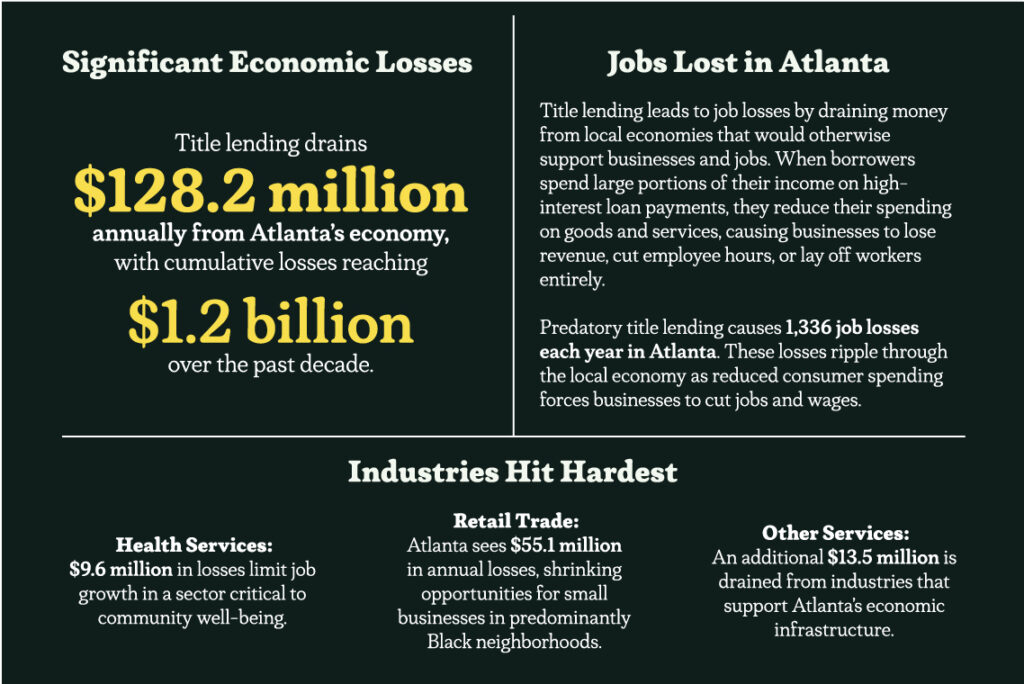
Atlanta’s Economic Losses at a Glance: 

The Economic Impact of Title Lending

Title lending is one of the more visible forms of predatory lending in Atlanta that disproportionately harms Black neighborhoods in Atlanta, draining wealth and destabilizing families. Despite being marketed as short-term financial solutions, these loans strip resources from communities, create cycles of debt, and reduce economic opportunities. Predatory lenders cluster in Atlanta’s majority-Black neighborhoods, intensifying financial harm in areas already burdened by systemic exclusion.

Atlanta loses far more than money to title lending—it loses jobs, opportunities, and pathways to build wealth for its residents. These loans systematically extract wealth from Black neighborhoods, widening the racial wealth divide and undermining economic stability for all. Addressing these practices through policy reform is critical to building a thriving, equitable city.

The data presented here on the economic impact of title lending in Atlanta was sourced from The Economic Consequences of Predatory Auto Title Loans to Georgia and the Atlanta Area by The Perryman Group. Their analysis used the US Multi-Regional Impact Assessment System, a comprehensive economic modeling tool. This method evaluates direct losses from title lending and calculates broader effects, including reduced consumer spending, strained local businesses, and job losses across multiple industries.

View All References

Read More Of The Report

How Predatory Financial Institutions Are Targeting Black Neighborhoods

How Predatory Financial Institutions
Are Targeting Black Neighborhoods

Predatory financial institutions have long targeted communities affected by structural racism in the United States, especially Black households.15 Payday lenders, title loan providers and high-interest installment lenders often step in where mainstream institutions fall short, offering short-term financial relief at excessive costs. For instance, banks systematically close branches in predominantly Black neighborhoods or avoid opening them altogether. The lack of banks makes it harder for residents to access essential financial services and forces them to rely on predatory alternatives.16

In Atlanta, the disproportionate reliance on predatory lending financial products and the prevalence of banking deserts in predominantly Black neighborhoods are problems. These issues are interconnected as the absence of traditional banking institutions forces residents to turn to non-bank financial products, such as payday loans, pawn shop loans and title loans, which often come with exorbitant interest rates and unfavorable terms.

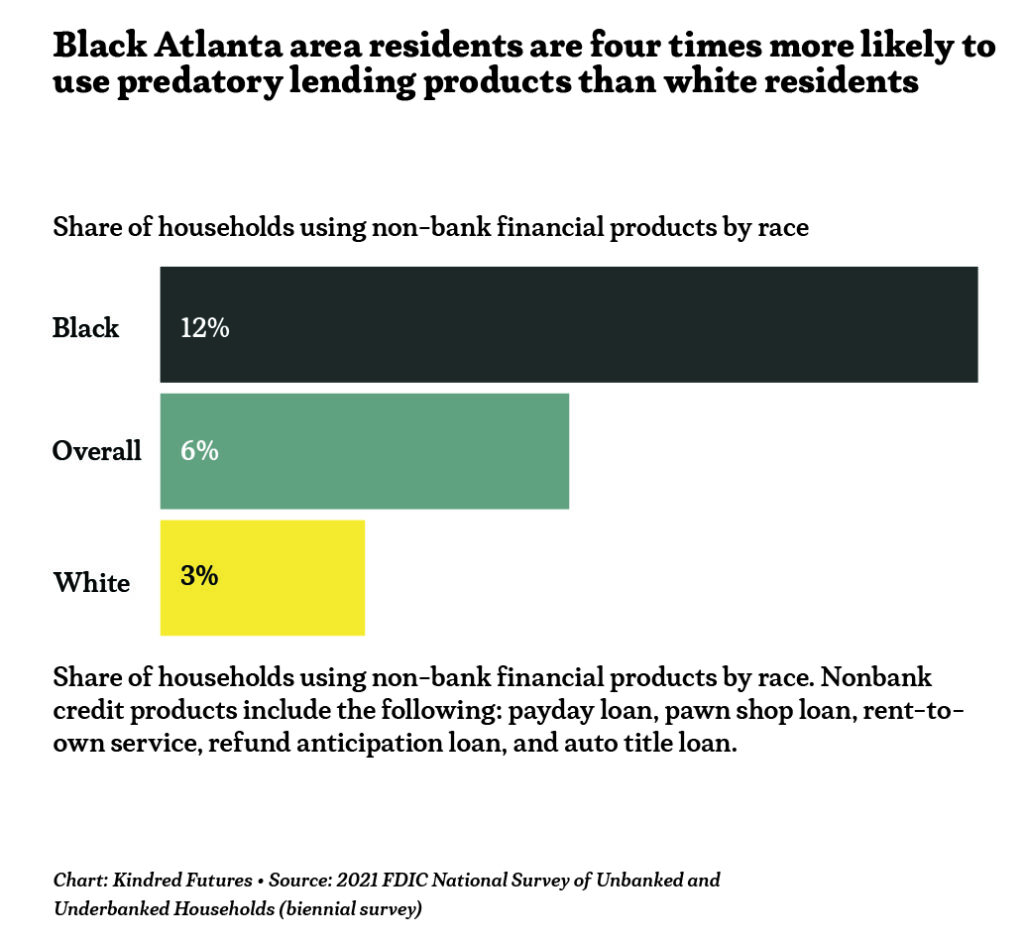
Due to the chronic economic exploitation of historically Black neighborhoods, Black Atlanta residents are four times more likely to use predatory lending products than their white counterparts, with 12% of Black households relying on non-bank financial services compared to just 3% of white households. This stark contrast underscores the racial disparities in access to safe and affordable financial products. The overall 6% reliance on predatory lending across all racial groups suggests a broader issue of financial exclusion, but the disparity between Black and white households results from the historical and systemic factors that limit their access to traditional banking services.17

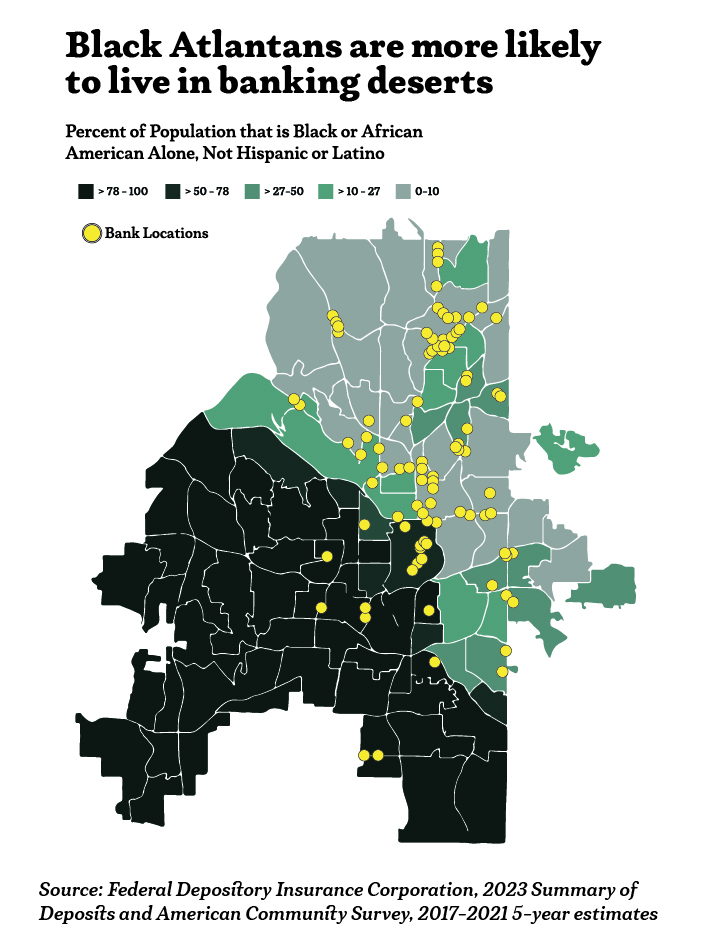
Approximately 37,102 Black Atlantans live in banking deserts, which means they live in census tracts that contain no bank branches within a two-mile radius. There are 14 total banking deserts in Atlanta, and all of these tracts are majority-Black, demonstrating the intentional systemic exclusion of Black Atlantans from equitable banking access.18 All of Atlanta’s banking deserts are in majority-Black neighborhoods. The map below illustrates the geographic concentration of banking deserts in Atlanta.

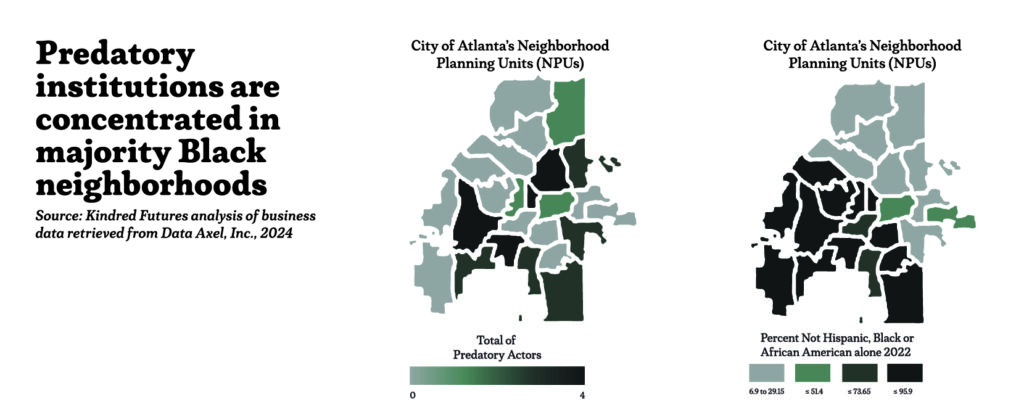
The maps below show a troubling concentration of predatory institutions in specific areas of Atlanta. Darker regions on the right-hand map represent areas that have the highest density of these financial institutions, which are largely located in majority-Black neighborhoods in the southern parts of the city. This clustering demonstrates the systemic financial exclusion imposed on Atlanta’s Black residents, many of whom lack access to traditional banking services and are forced to rely on high-interest, short-term loans to meet their financial needs.

Predatory institutions in these neighborhoods have significant impacts on the residents. Black communities, already facing lower median household incomes and limited access to wealth-building resources, experience further hardship due to these exploitative practices. Payday and title loans with high interest rates and fees trap many borrowers in cycles of debt, draining household wealth and contributing to long-term financial instability. This geographic pattern not only exacerbates economic and racial disparities but also systematically targets Black neighborhoods, allowing institutions to extract wealth instead of creating it.

Predatory lenders generally target the most economically vulnerable, regardless of race

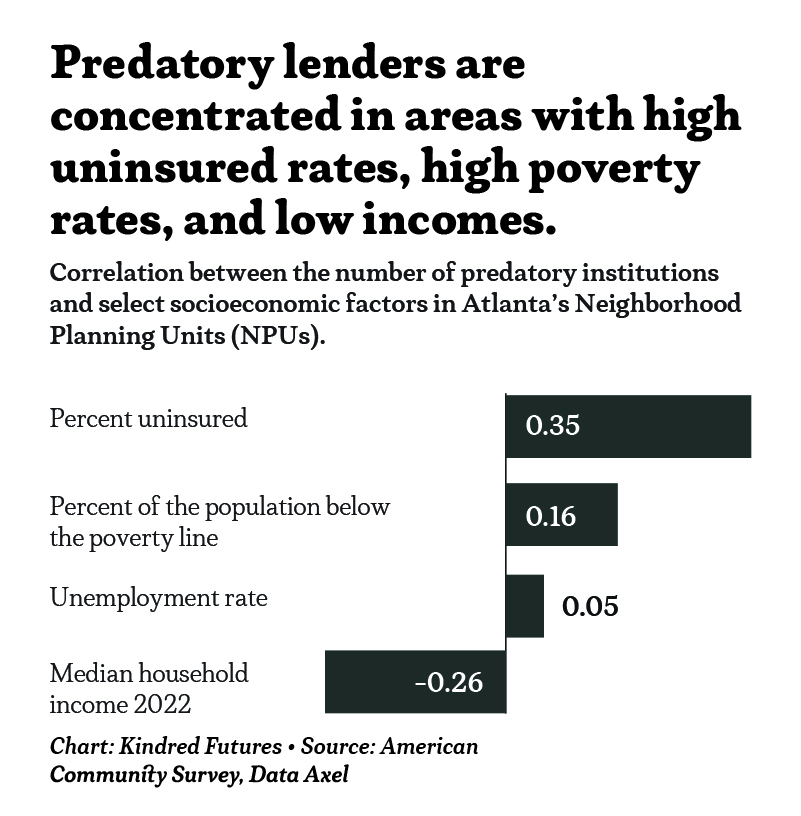
Our research shows that there is a clear link between the number of predatory businesses and the overall financial and social health of neighborhoods in Atlanta. We noticed that a larger portion of people who live in neighborhoods with more predatory businesses don’t have health insurance. We also saw that neighborhoods where there are more predatory businesses have higher poverty and unemployment rates. Furthermore, we discovered that as the number of these predatory businesses increases, household incomes decrease. This shows that the presence of predatory businesses is linked to even worse financial conditions, such as having less access to healthcare and earning less money.

View All References

Read More Of The Report

A Brief History of Banks and Black People

A Brief History of Banks and Black People

The legacy of discriminatory practices, like redlining and Jim Crow laws, systematically excluded Black people from accessing traditional banking services, fostering a deep mistrust in financial institutions³. For generations, Black communities were denied loans and subjected to predatory lending, leaving them without the same wealth-building opportunities afforded to white communities. The history of bank closures in Black neighborhoods and outright refusal of services reinforced the perception that banks were not designed to serve or protect Black wealth. Exploitative practices, from subprime mortgage lending to exorbitant fees, have left Black people economically marginalized and wary of financial institutions that prioritize profit over their well-being⁵.

A Brief History of Banks and Black People

18th-19th Century: Slavery and Banking

  • Mid-1700s-1800s: Banks in the South, such as the Bank of Louisiana, allowed enslaved Black people to be used as collateral for loans, effectively commodifying human lives to support plantation expansion and profits for banks.⁶
  • 1820s-1860s: Insurance companies like Aetna and New York Life issued policies on the lives of enslaved Black people, allowing slave owners to collect payouts in the event of an enslaved person’s death.¹⁰

 1865: Emancipation and Post-Civil War

  • 1865: Following the Civil War, Black people continued to face economic exploitation through sharecropping and debt peonage. Mainstream banks denied access to fair credit, forcing Black farmers to rely on exploitative informal credit systems.
  • 1865-1874: The Freedman’s Savings Bank was established to provide newly emancipated Black Americans a place to deposit savings. However, mismanagement and corruption led to its collapse in 1874, causing significant financial loss for thousands of Black depositors.

Late 19th Century-Early 20th Century: Jim Crow Era

  • 1890s-1960s:  Redlining and segregation laws effectively barred Black people from mainstream banking services. Systematic denial of loans and mortgages prevent wealth accumulation in Black neighborhoods. Black-owned banks, like the Citizens Trust Bank in Atlanta, were founded to provide alternatives, though these institutions faced capital constraints and systemic challenges.7

1960s: Civil Rights Movement

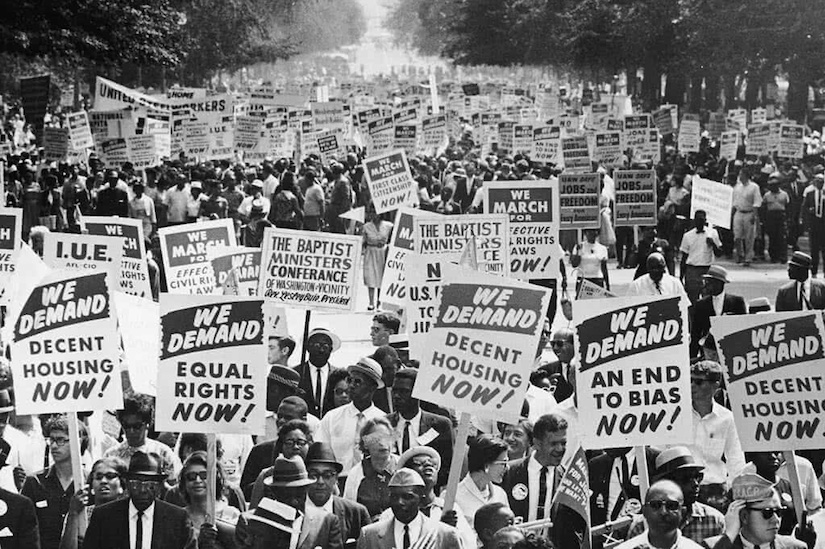
  • 1968: The Fair Housing Act was passed to address discrimination in housing, including in banking and mortgage lending. However, discrimination persisted in less overt forms, with banks continuing to deny loans to Black applicants or steering them toward high-cost products.8

1980s-1990s: Deregulation of the Banking Industry and the Rise of Subprime Lending

  • The Garn-St. Germain Depository Institutions Act of 1982 and other deregulatory measures removed caps on interest rates, making it easier for lenders to offer high-interest loans and engage in risky lending practices. This set the stage for subprime mortgage lending, particularly targeting minority communities.9

  • The 1990s: As financial institutions sought to increase profits, subprime lending (high-interest, high-risk loans for borrowers with low credit scores) became widespread. Black borrowers were disproportionately targeted for these loans, even when they qualified for better terms.12

2000s: Subprime Mortgage Crisis

  • 2000s: Black communities were disproportionately targeted with subprime mortgages, even when they qualified for conventional loans.

  • The 2008 financial crisis led to widespread foreclosures in Black neighborhoods, causing significant wealth loss. Black households lost approximately 53% of their total wealth during the Great Recession.13

2000s: Subprime Mortgage Crisis

  • 2010s: Despite anti-discrimination laws, Black people continue to face barriers to accessing traditional banking services. Banks charge higher fees, offer worse loan terms, and close branches in predominantly Black neighborhoods, exacerbating financial inequality.

  • Following the 2008 financial crisis, many Black communities were left with few options for traditional banking due to branch closures. This led to an increase in the reliance on predatory payday lenders and check-cashing services, which charge exorbitant interest rates and fees.14

View All References

Read More Of The Report

Trapped by Design Report: Introduction

Installment lenders, title lenders and rent-to-own companies – also known as predatory institutions – maintain a strong grasp on Atlanta’s predominantly-Black neighborhoods. These businesses trap residents in cycles of debt by offering financial products and services that are difficult to escape. By targeting Black residents with high-interest loans and substandard products, these institutions extract wealth from communities already facing systemic injustice.

Kindred Future’s detailed analysis of Neighborhood Planning Units (NPUs) in the City of Atlanta shows a clear pattern:

67% of predatory institutions are concentrated in neighborhoods with the highest Black populations, while only 33% are in wealthier, non-majority Black neighborhoods where residents have better access to traditional financial services such as banks.

This geographic division in financial services makes it harder for Black communities to build wealth and break free from financial hardship, reinforcing Atlanta’s vast racial wealth divide, where the net worth of white households ($238,355) is 46x more than the net worth of Black households ($5,180)².

This policy brief explores the effects of predatory institutions on Atlanta’s Black neighborhoods and offers specific policy recommendations. By capping interest rates, addressing the concentration of predatory businesses and supporting access to affordable credit, local and state decisionmakers can begin to dismantle these harmful practices. Atlanta can implement smart policy solutions that create pathways to financial stability for communities confronting economic exploitation.

Defining predatory institutions:

Kindred Futures defines predatory institutions as businesses or financial entities that exploit communities affected by structural racism by offering goods, services or financial products under terms that disproportionately harm consumers. These institutions thrive by targeting individuals or businesses with limited access to mainstream financial services or competitive markets, often imposing excessive costs, fees or interest rates. The result is a cycle of debt and financial insecurity that deepens inequality, strips wealth and undermines the well-being of communities.

To View All Sources and Subscripts

Read More Of The Report