The Roots of the Racial
Wealth Divide in the South

More than any other region, the American South was built on Black labor and Black exclusion. Centuries of enslavement and extraction laid the groundwork for a racial wealth divide that remains stark in 2025. The institution of slavery provided a secure foundation for the accumulation of vast fortunes among southern slaveholders.8 By stripping enslaved Black people of any assets and then barring freedmen and freedwomen from landownership, education, and capital, the post-Civil War South entrenched White wealth and Black poverty.9
Twentieth-century policies—from New Deal programs that excluded Black farmers and domestic workers, to redlining that denied mortgages in Black neighborhoods—furthered the divide. Unlike European immigrant groups who eventually gained broader access to American wealth-building, Black Southerners faced a “baked-in” system of racial exclusion that compounded across generations.10 Several historical turning points had particularly devastating effects on Black wealth in the South:
Land Dispossession (1920–1940):
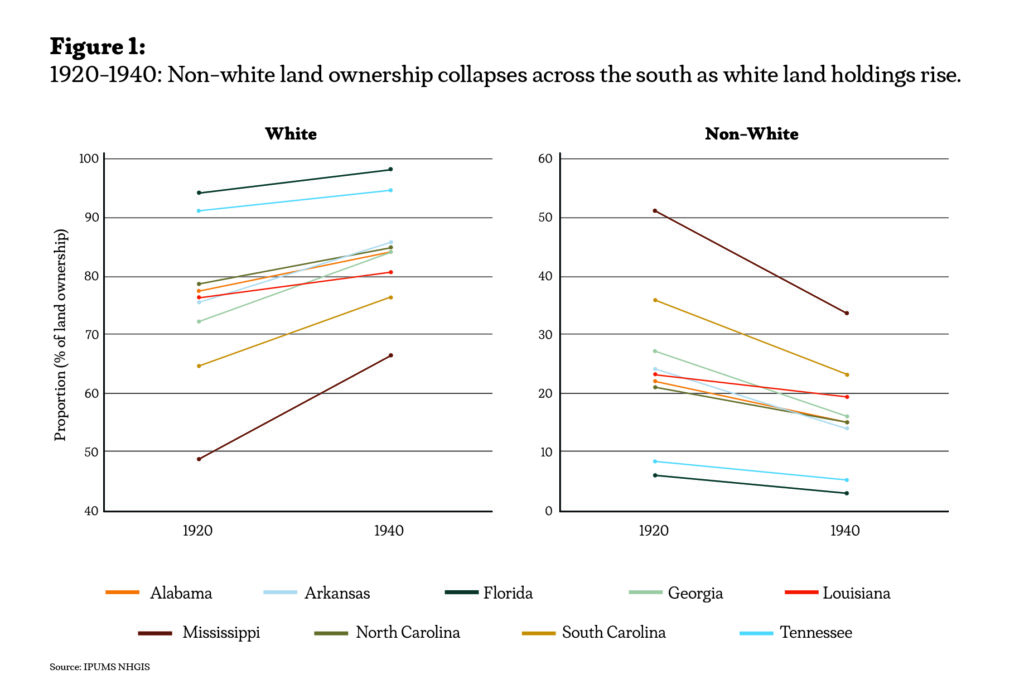
By 1910—half a century after Emancipation—Black farmers in the South had accumulated an estimated 16 to 19 million acres of land. But over the next few decades, Black landownership collapsed due to discriminatory lending by the USDA, forced sales of heirs’ property (land passed without wills), depression-era farm foreclosures, and racial violence.
Across Southern states, the non-White share of land ownership plummeted between 1920 and 1940. In Mississippi, non-White farmers owned 51% of land in 1920, but only 33% by 1940; White ownership rose commensurately. Other states saw similar declines (Georgia’s non-White land share fell from 28% to less than 20%).11 By 1997, Black Americans nationwide had lost 90% of the land they owned in 1910.12 A recent study estimates the present value of Black land lost in the 20th century at $326 billion—wealth that would have passed to Black families had they been allowed to keep and develop their property.13
Urban Renewal and Displacement (1950s–1960s):
Mid-20th century development programs devastated many historic Black communities under the guise of slum clearance and highway construction. In Southern cities like Atlanta, Birmingham, and Memphis, the vast majority of families displaced were Black.14
In Atlanta, for example, 92% of the 5,285 families uprooted by urban renewal were Black. Similar patterns played out across the region (e.g. 100% of those displaced in Savannah were Black).15 This wholesale removal—often called Negro removal at the time—destroyed Black-owned homes and businesses, ruptured social networks, and halted intergenerational wealth transfer.16 Many displaced families were forced into overcrowded public housing or low-opportunity neighborhoods, cementing cycles of poverty.17
Segregation and Credit Exclusion:
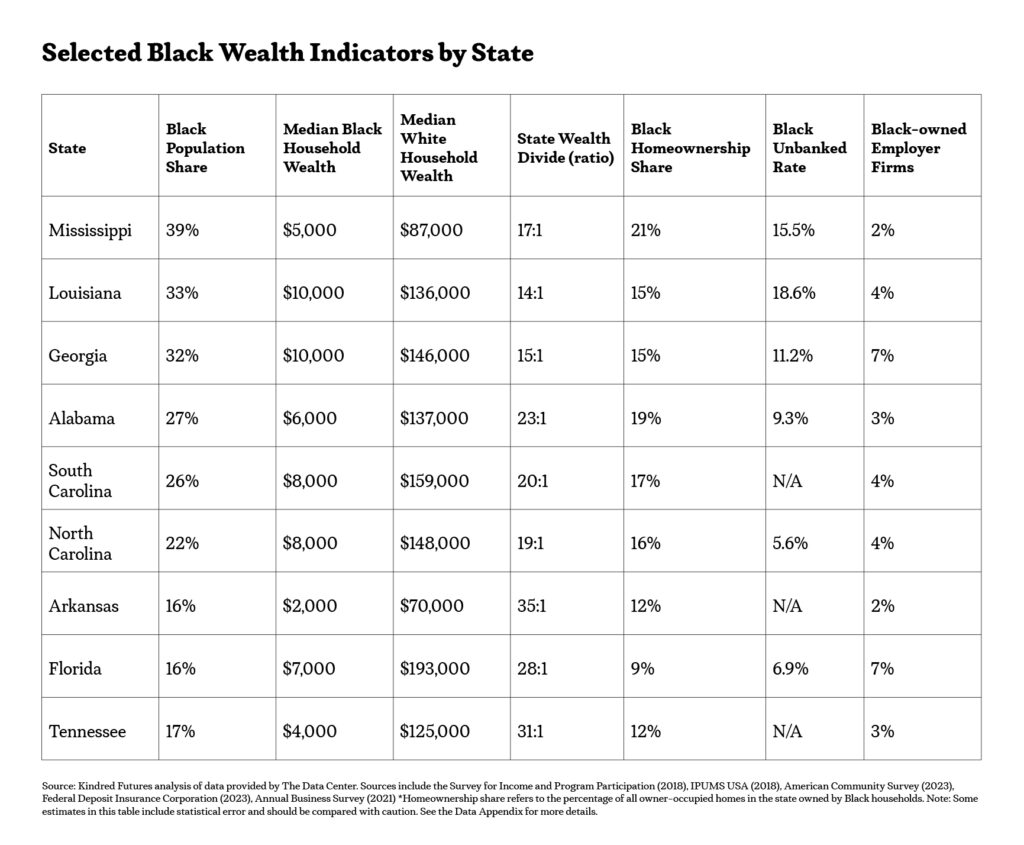
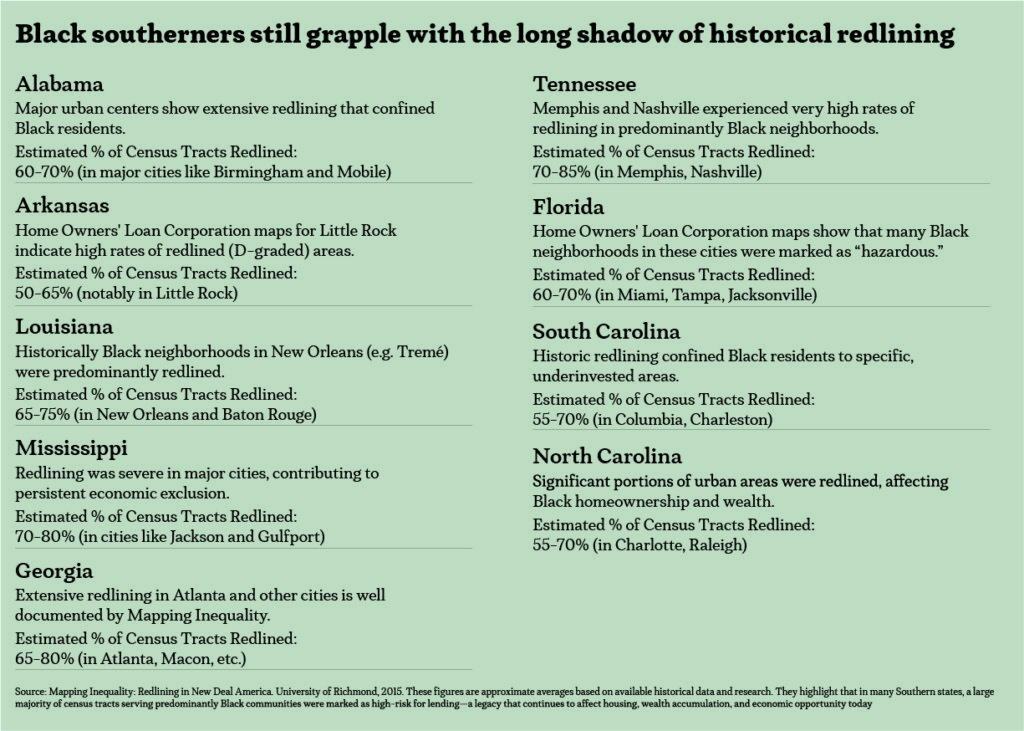
Jim Crow laws enforced racial segregation in housing, education, and employment well into the 1960s, denying Black families the most common avenues of wealth accumulation. Black workers were largely kept out of higher-paying jobs and faced systemic pay discrimination. Federal homeownership programs, such as VA/FHA loans in the post-WWII era, often excluded Black applicants or steered them into subprime loans, a practice known as redlining.18
The effects were stark: by 1980, White households owned more than three-quarters of all owner-occupied homes in every Deep South state.19
The late 2000s subprime mortgage crisis hit Black communities especially hard—Black homeownership rates in states like Georgia and Mississippi fell by 5–10 percentage points after 2008 and have only partially recovered.20
These housing inequities helped lock in the racial wealth divide: home equity is the largest source of wealth for most American families, but Black homeownership has lagged and even declined in the 21st century.
At Kindred Futures, we recognize that wealth means more than money. Wealth is security, opportunity, and freedom—the power to shape one’s future.
Wealth-Stripping Policies:
A host of other practices further sapped Black wealth. Predatory lending and high-interest debt traps (from Reconstruction-era sharecropping contracts to modern payday loans) have drained resources from Black communities.21 In recent decades, mass incarceration and court-imposed fines/fees have also acted as a ‘tax’ on Black wealth, especially in the South. Black Americans—particularly Black men—lost billions in income and assets due to the war on drugs and prison boom from the 1970s–2000s, which hit Southern states hard.22 Discriminatory hiring and workplace segregation meant Black workers often lacked benefits like pensions, further widening wealth disparities in retirement.
The cumulative result of these compounding injustices is a deeply stratified economy in which Black Southerners as a group started the 21st century with far fewer assets than their White counterparts. Wealth begets wealth: without access to collateral or inherited capital, Black families have struggled to catch up even as overt discrimination was outlawed. Today’s racial wealth divide in the South is the tangible legacy of enslavement, legalized segregation, and public and private discrimination. Understanding these roots is essential—because policies that destroyed Black wealth were intentionally created, the solutions to build Black wealth must be as intentional and far-reaching.
At Kindred Futures, we recognize that wealth means more than money. Wealth is security, opportunity, and freedom—the power to shape one’s future. As Fannie Lou Hamer said, “Nobody’s free until everybody’s free.”23 In that spirit, this report centers community wealth-building: transforming the systems of capital to empower Black communities that have been marginalized. Before turning to solutions, we first assess where the South stands today through a Black Wealth Scorecard, and then dissect the structural factors currently affecting Black wealth creation in the region.