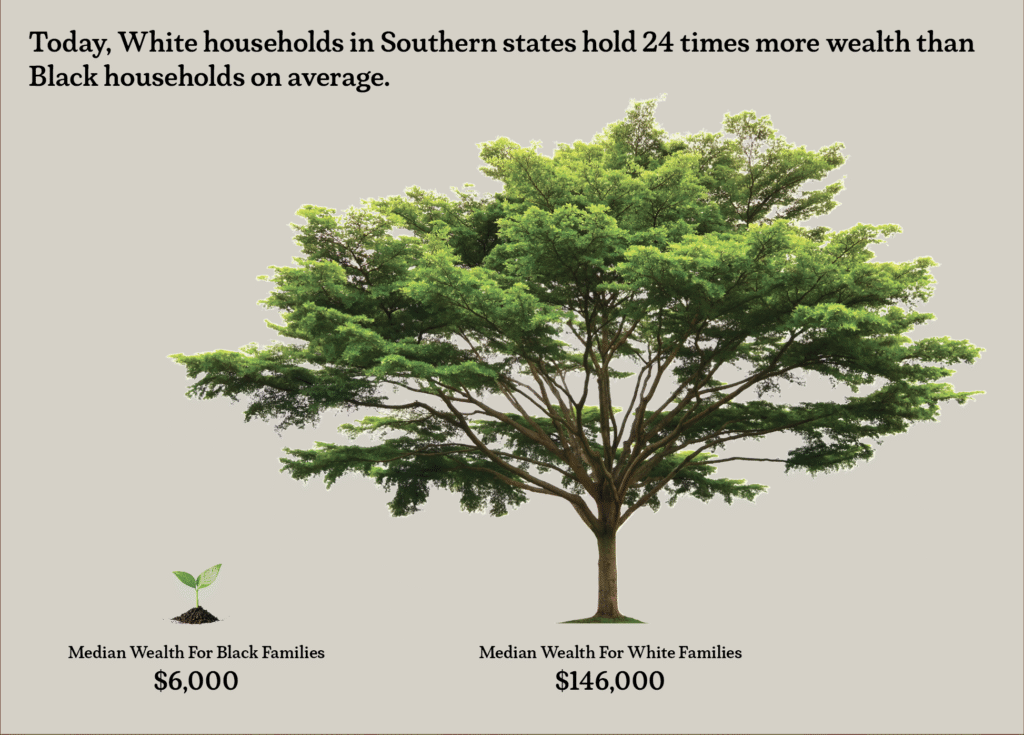
Black families in the Deep South face a vast and persistent wealth divide rooted in centuries of systemic racism and disinvestment.1 In Arkansas, for example, the median White family has about $70,000 in wealth—thirty-five times the $2,000 of the median Black family.2 Across the South, nearly 2 million Black households have zero or negative net worth, underscoring the urgency of reversing these compounding inequities.3
This report details the historical roots of the racial wealth divide in the South, compares key Black wealth indicators across Southern states, and outlines structural policy strategies to unearth Black prosperity—ensuring that growth is shared equitably among all southern households. Major findings include:
Deep South Wealth Divide: Despite large Black populations in the Deep South, economic growth centers like Atlanta hold only a fraction of White wealth. Wealth divides persist across urban and rural areas, and even higher education has not closed the divide (White college-educated households have 3–8 times the wealth of Black college-educated households).4
Rural Opportunities: In several Southern states, Black households in non-metro counties hold median wealth that equals—or sometimes modestly surpasses—their metro peers, whereas White households consistently build more wealth in cities, underscoring that geography alone cannot close racial divides.5
Structural Barriers: Historic injustices—enslavement, Jim Crow segregation, discriminatory federal policies, and asset-stripping practices like land theft and urban renewal—severely curtailed Black wealth-building.6 Today, unequal homeownership rates, lower access to credit, wage disparities, and debt burdens perpetuate inequality. For instance, Black homebuyers are denied mortgages at roughly double the rate of White buyers across the Deep South, and over 50% of Black households in each state have delinquent debt (versus ~30% of White households).7
Community Wealth-Building Solutions: The report frames solutions in terms of community wealth-building, focusing on systemic changes rather than individual behavior. Recommended interventions include: “baby bonds” or trust accounts for children, down payment assistance and enforcement of fair housing laws to boost Black homeownership, expansion of Community Development Financial Institutions (CDFIs) and Black-owned banks to increase credit access, student debt relief, higher minimum wages, and targeted investments in Black-owned businesses and shared ownership opportunities. These strategies could substantially narrow the wealth divide; for example, housing equity gains and student debt cancellation would cut the divide by tens of thousands of dollars per family.
In sum, building the wealth of Black families in the South is both a moral imperative and an economic opportunity. By addressing the roots of wealth—the policies and structures that determine who owns assets, accesses capital, and inherits opportunity—we can cultivate broadly shared prosperity. Centering Black communities in wealth-building policy will not only benefit those long-denied access but will strengthen the entire region’s economy. This report offers a roadmap for Southern policymakers, community leaders, and partners to move from acknowledgement to action, ensuring that Black prosperity is integral to the South’s future.