How Predatory Financial Institutions Are Targeting Black Neighborhoods
Predatory financial institutions have long targeted communities affected by structural racism in the United States, especially Black households.15 Payday lenders, title loan providers and high-interest installment lenders often step in where mainstream institutions fall short, offering short-term financial relief at excessive costs. For instance, banks systematically close branches in predominantly Black neighborhoods or avoid opening them altogether. The lack of banks makes it harder for residents to access essential financial services and forces them to rely on predatory alternatives.16
In Atlanta, the disproportionate reliance on predatory lending financial products and the prevalence of banking deserts in predominantly Black neighborhoods are problems. These issues are interconnected as the absence of traditional banking institutions forces residents to turn to non-bank financial products, such as payday loans, pawn shop loans and title loans, which often come with exorbitant interest rates and unfavorable terms.
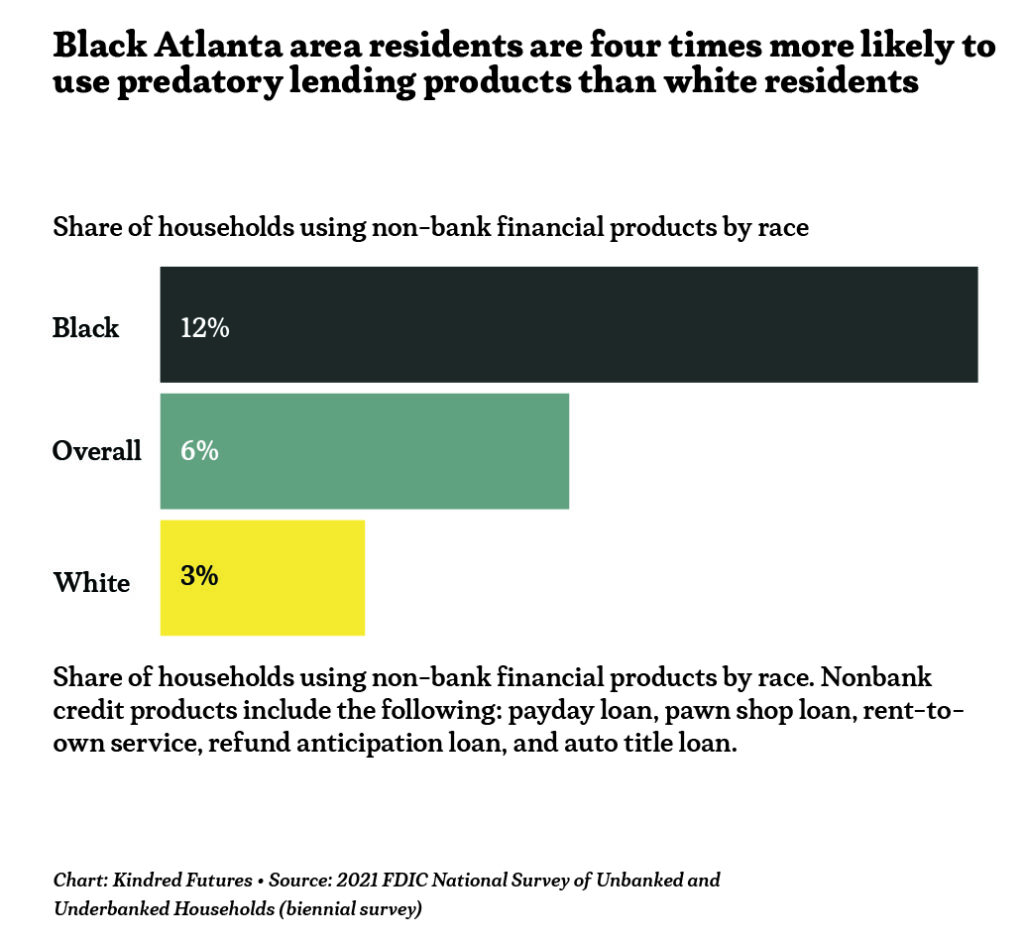
Due to the chronic economic exploitation of historically Black neighborhoods, Black Atlanta residents are four times more likely to use predatory lending products than their white counterparts, with 12% of Black households relying on non-bank financial services compared to just 3% of white households. This stark contrast underscores the racial disparities in access to safe and affordable financial products. The overall 6% reliance on predatory lending across all racial groups suggests a broader issue of financial exclusion, but the disparity between Black and white households results from the historical and systemic factors that limit their access to traditional banking services.17
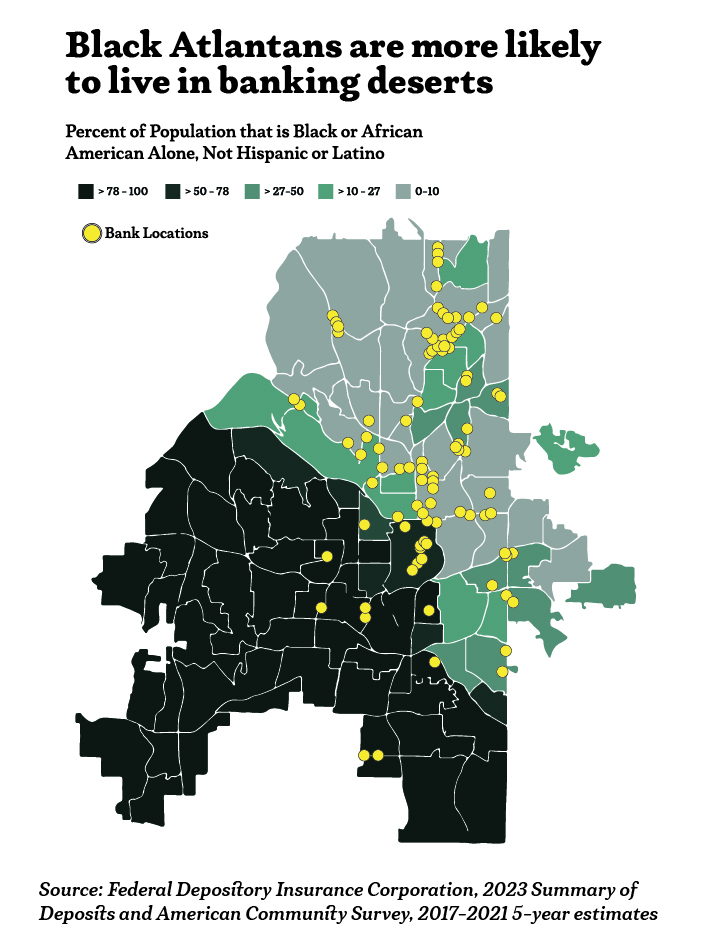
Approximately 37,102 Black Atlantans live in banking deserts, which means they live in census tracts that contain no bank branches within a two-mile radius. There are 14 total banking deserts in Atlanta, and all of these tracts are majority-Black, demonstrating the intentional systemic exclusion of Black Atlantans from equitable banking access.18 All of Atlanta’s banking deserts are in majority-Black neighborhoods. The map below illustrates the geographic concentration of banking deserts in Atlanta.
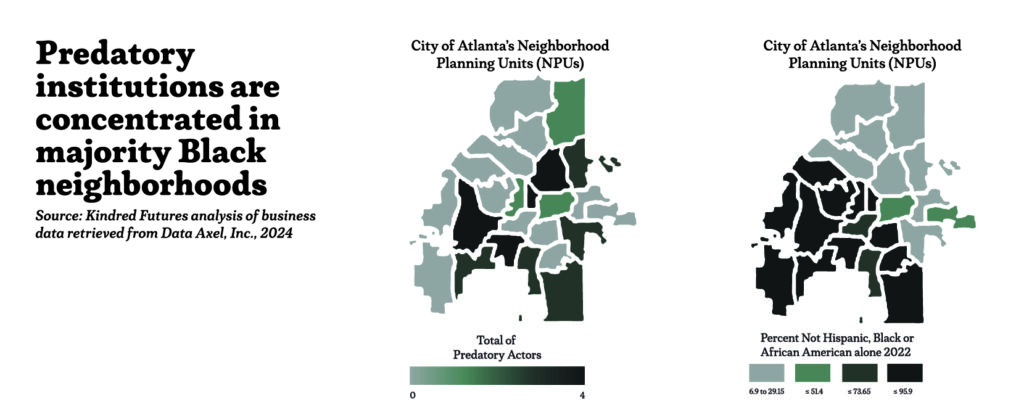
The maps below show a troubling concentration of predatory institutions in specific areas of Atlanta. Darker regions on the right-hand map represent areas that have the highest density of these financial institutions, which are largely located in majority-Black neighborhoods in the southern parts of the city. This clustering demonstrates the systemic financial exclusion imposed on Atlanta’s Black residents, many of whom lack access to traditional banking services and are forced to rely on high-interest, short-term loans to meet their financial needs.
Predatory institutions in these neighborhoods have significant impacts on the residents. Black communities, already facing lower median household incomes and limited access to wealth-building resources, experience further hardship due to these exploitative practices. Payday and title loans with high interest rates and fees trap many borrowers in cycles of debt, draining household wealth and contributing to long-term financial instability. This geographic pattern not only exacerbates economic and racial disparities but also systematically targets Black neighborhoods, allowing institutions to extract wealth instead of creating it.
Predatory lenders generally target the most economically vulnerable, regardless of race
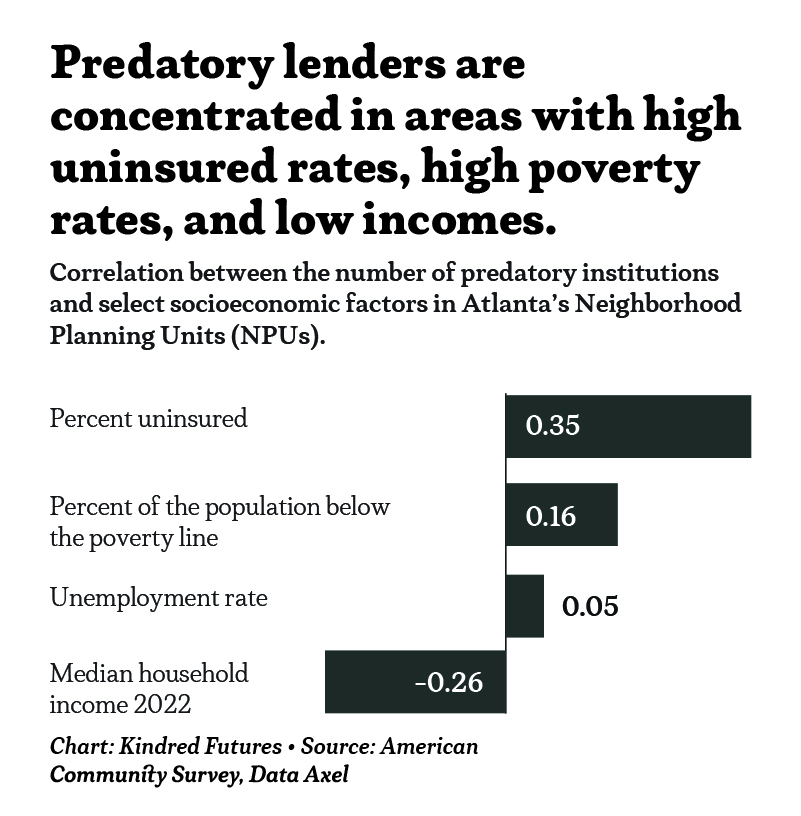
Our research shows that there is a clear link between the number of predatory businesses and the overall financial and social health of neighborhoods in Atlanta. We noticed that a larger portion of people who live in neighborhoods with more predatory businesses don’t have health insurance. We also saw that neighborhoods where there are more predatory businesses have higher poverty and unemployment rates. Furthermore, we discovered that as the number of these predatory businesses increases, household incomes decrease. This shows that the presence of predatory businesses is linked to even worse financial conditions, such as having less access to healthcare and earning less money.