Introduction

Atlanta holds an enduring reputation as the center of Black political power and Black professional class succeed. In 1971, Ebony magazine referred to Atlanta as the “Black mecca,” citing the city’s relatively inclusive environment for Black entrepreneurs and politicians.1 Today, Atlanta is still referred to as the Black mecca, as it houses some of the nation’s most well-known Black educational institutions, increased its population of the Black middle-class, and has been a model of Black mayoral power since the 1970s.

Despite the city’s record economic growth, stubborn racial and economic inequities have persisted. Courting businesses and using extractive economic development practices as the superior growth model has stifled opportunities for all Black residents to success economically. When attention is given to the challenges facing Atlanta’s Black households, more than a third of which have zero or negative net worth, the assumption is that the challenges can be solved by programs focused on financial literacy, job training, and anti-poverty services. While these efforts are critical, they have not fixed Atlanta’s reputation as the number one place for income inequality,2 a title the city has held for more than 30 years.

“To me, it’s like, I feel like I’m in quicksand here in Atlanta.”

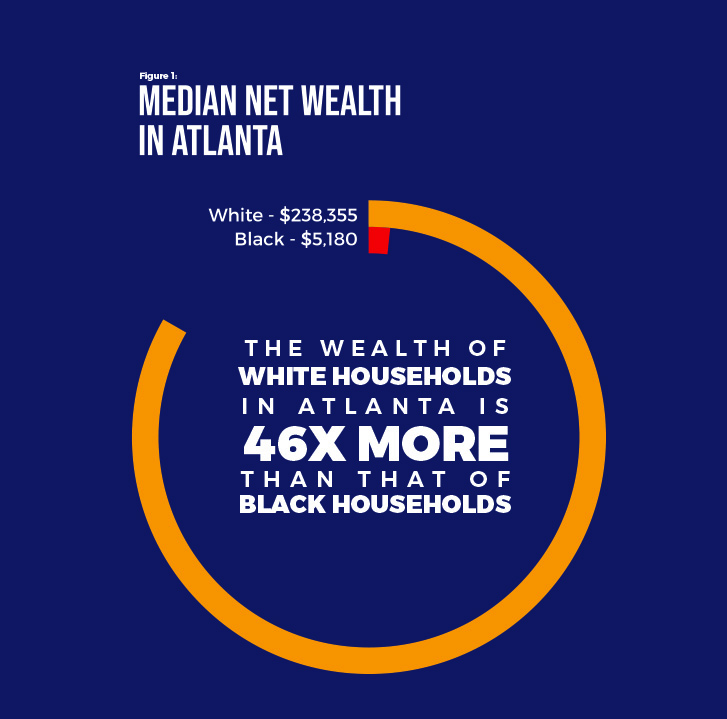
While the income inequality picture is bleak, it doesn’t capture the magnitude of economic injustice in the city. But one data point does: the wealth of white households in Atlanta is 46 times more than that of Black households.

This report proposes a new framework for understanding and confronting the massive racial wealth divide and its impact on Black Atlantans. Using what we describe as the structural determinants of Black wealth framework, this report interrogates data, narratives, and policies that drive Black wealth outcomes. The framework also enables community organizers, researchers, policymakers, practitioners, investors, and others to advance race-conscious solutions that seek to build Black wealth while pursuing a just world for all. This framework is necessary to build a beloved economy, which is essential for creating a beloved community in Atlanta.

Public policies, market pressures, and other factors that erode wealth-building opportunities for everyone are deeply connected to Atlanta’s relentless pursuit of economic growth at the expense of its current residents. Given these trends, we use administrative data, policy analysis, and narrative insights provided by Atlanta residents to explore the historical and current state of Black wealth in Atlanta and the policy choices that shape Black wealth outcomes. Specifically, this report finds that leaders in Atlanta and beyond can help build Black wealth by pursuing the following solutions:

  1. Support local efforts to launch a baby bonds program bonds program.
  2. Establish a publicly-funded guaranteed income program.
  3. Establish community accountability for strict enforcement of the Community Reinvestment Act (CRA).
  4. Provide free access to checking accounts at trusted banks.
  5. Establish a city-led initiative to address predatory lending.
  6. Eliminate the use of wealth-based punishment through fines, fees, and cash bail.
  7. Increase transparency in procurement outcomes for Black-owned businesses in the City.
  8. Strengthen affordable commercial space opportunities in the City.
  9. Invest in employee ownership.
  10. Launch an Atlanta delegation and campaign committed to repealing state preemption.
  11. Use public dollars to hold companies accountable for the creation of asset-building jobs.
  12. Prioritize inclusionary zoning regulations with a racial equity lens.
  13. Invest in community land trusts.
  14. Commit to more deeply affordable housing goals.
  15. Expand housing affordability strategies to include a complementary approach to promote economic mobility.
  16. Commit to opportunities for Black-owned businesses in infrastructure spending.
  17. Codify a commitment to reparations.
  18. Establish the Office of Community Wealth Building.
The Structural Determinants of Black Wealth

Structural determinants of Black wealth are the root causes of wealth inequities. The determinants capture the historical systems of oppression that have established downstream racial wealth outcomes for Black Atlantans. We explicitly name political and economic systems in the framework because they have reinforced the policies, programs, investments, and other decisions that erode Black wealth. Moreover, these systems command structural change, and without a structural analysis of what has led to Atlanta’s current Black wealth outcomes, we continue to maintain these systems and fail to confront the roadblocks to building Black wealth using structural reform. Failure to acknowledge and address the structural determinants enables policymakers and other leaders to default to narratives of personal responsibility to explain why the racial wealth divide exists. In other words, the framework helps us “move beyond the goal of closing the racial wealth gap and concentrate on undoing its root causes,” a necessary effort, as argued by Dr. Anne Price.3

We also propose this framework for understanding Black wealth outcomes because it is race-explicit. Historically, race-neutral policies have reproduced rather than mitigated inequities in Atlanta and across the South. Our race-explicit and holistic framework for grappling with Black wealth outcomes does not mean race-exclusive. We firmly believe investing in solutions to address the barriers blocking prosperity for Black people improves outcomes for everyone.

Lastly, the structural determinants of Black wealth framework not only centers the outcomes of Black people; it is developed in consultation and deep collaboration with Black Atlantans. Over the past year, the Atlanta Wealth Building Initiative has engaged in deep listening with Atlanta residents to understand the material impacts of the various dimensions in the framework on the lives of Black people.

As a starting point, it was essential to ground the creation of this framework in a clear definition of wealth. The typical definition of wealth is a person or household’s assets minus their debts. For Black Atlantans, wealth is so much more. The most popular definition of wealth for Black Atlantans was freedom. Working backward from this definition, we can identify the structural determinants of Black wealth by identifying what has historically and continues to stand in the way of the full freedom of Black people.

In order to visualize the structural determinants of Black wealth, we use an ecological approach that captures the ways that a variety of systems interact with one another to affect Black wealth outcomes. We envision a river that, when unblocked from reinforced, human-made structural forces that act like a dam, feeds and nurtures a thriving environment that supports the development of policies and programs that promote the complete freedom of Black people to grow and maintain wealth.
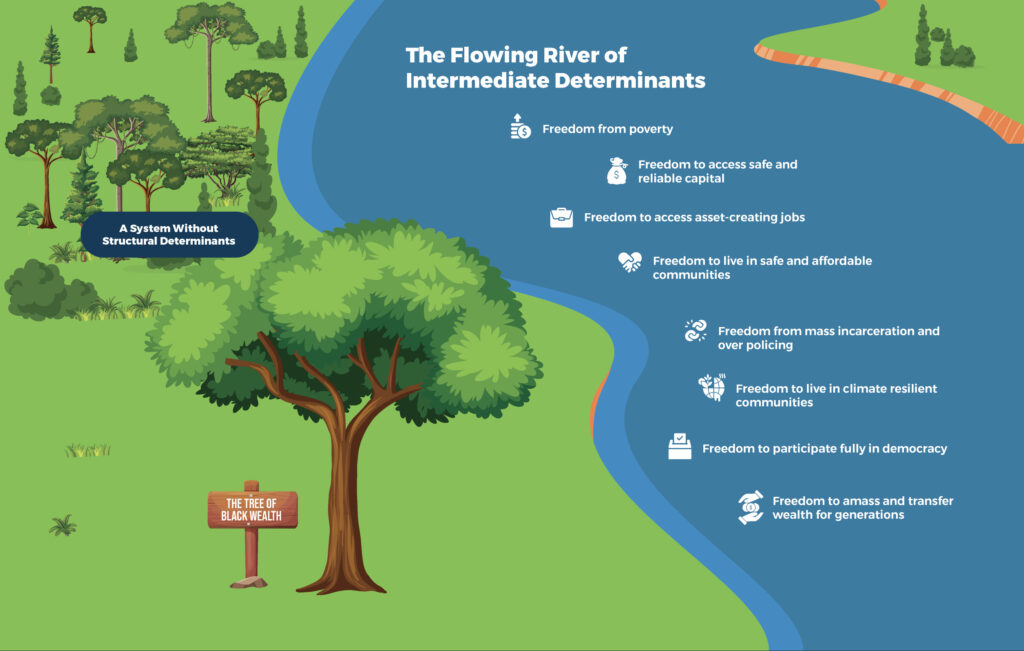

This report examines administrative data using the structural determinants of Black wealth framework. Where possible, data was collected and analyzed along the various dimensions included in the framework. Throughout the report, narratives from focus group participants are shared to help put the data into context. We recognize that wealth is dynamic, and so must be the way that we measure what affects it.

For instance, it addresses the role of mass incarceration on Black wealth. The following sections address various dimensions of the framework, offer indicators to measure those dimensions, and concludes with recommendations for Atlanta leaders to repair the harms caused by the structural determinants.

View All References

Read More Of The Report

Securing Georgia’s Future: References

  1. Median net worth estimates were derived from Esri’s 2023/2028 Updated Demographics dataset. See Esri, Methodology Statement: 2023/2028 Esri Updated Demographics (Redlands, CA: Esri, June 2023), https://www.esri.com/data/esri_data.
  2. Chetty, Raj, Nathaniel Hendren, Patrick Kline, and Emmanuel Saez. Where is the Land of Opportunity? The Geography of Intergenerational Mobility in the United States. Quarterly Journal of Economics 129, no. 4 (2014): 1553-1623. https://doi.org/10.1093/qje/qju022.
  3. Ibid.
  4. This report builds on findings from the Georgia Budget & Policy Institute, Baby Bonds in Georgia: Creating a Universal Savings and Investment Account Program for Children, which also outlines a universal savings program under House Bill 284. Both analyses find that such a policy could yield over $16,000 in wealth for eligible young adults by age 18, while helping close longstanding racial and regional gaps in economic opportunity.
  5. Kindred Futures analysis of a universal-progressive model.
  6. Ibid.
  7. Georgia General Assembly. 2025. House Bill 284, Georgia Baby Bond Savings Plan.
    https://www.legis.ga.gov/bills/hb284.
  8. Georgia General Assembly. 2025. House Resolution 99. Accessed March 9, 2025. https://www.legis.ga.gov/legislation/69674.
  9. Shapiro, Thomas M., and Edward N. Wolff, eds. Assets for the poor: The benefits of spreading asset ownership. Russell Sage Foundation, 2001.
  10. Kindred Futures analysis of Survey of Income and Program Participation (SIPP), 2023.
  11. Himmelstein, Kathryn E. W., Jourdyn A. Lawrence, Jaquelyn L. Jahn, Joniqua N. Ceasar, Michelle Morse, Mary T. Bassett, Bram Wispelwey et al., 2022. “Association between racial wealth inequities and racial disparities in longevity among us adults and role of reparations payments, 1992 to 2018”, Jama Network Open (11), 5:e2240519.
    https://doi.org/10.1001/jamanetworkopen.2022.40519.
  12. Kindred Futures analysis of Survey of Income and Program Participation (SIPP), 2025.
  13. Kindred Futures analysis of American Community Survey, 2023.
  14. 2024 kids count data book. (n.d.). The Annie E. Casey Foundation. Retrieved March 9, 2025, from
    https://www.aecf.org/resources/2024-kids-count-data-book.
  15. Darity, William, 2008. “Forty acres and a mule in the 21st century*”, Social Science Quarterly (3), 89:656-664.
    https://doi.org/10.1111/j.1540-6237.2008.00555.x.
  16. Kindred Futures analysis of Survey of Income and Program Participation (SIPP), 2023.
  17. Kindred Futures analysis of county-level net worth estimates provided by Esri, 2024.
  18. Derenoncourt, Ellora, Chi Hyun Kim, Moritz Kuhn, and Moritz Schularick. “The racial wealth gap, 1860-2020.” Manuscript, Princeton University and University of Bonn (2021).
  19. Cassidy, Christa, Rachel Heydemann, Anne Price, Nathaniel Unah, and William Darity Jr. “Baby bonds: A universal path to ensure the next generation has the capital to thrive.” Available from Samuel Dubois Cook Center on Social Equity at Duke University and the Insight Center for Community Economic Development website at https://insightcced. org/wp- content/uploads/2019/12/ICCED-Duke_BabyBonds_December2019-Linked. pdf (2019).
  20. Georgia General Assembly. 2025. House Resolution 99. Accessed March 9, 2025.
    https://www.legis.ga.gov/legislation/69674.
  21. U.S. Census Bureau, Survey of Income and Program Participation, Survey Year 2023, Public Use Data, Project No. P- 7516454, Dataset D-0000004561, Approval CBDRB-FY24-0222.
  22. Ibid.
  23. Darity, William, 2008. “Forty acres and a mule in the 21st century*”, Social Science Quarterly (3), 89:656-664. https://doi.org/10.1111/j.1540-6237.2008.00555.x; Collins, William and Robert A. Margo, 2011. “Race and home ownership from the end of the civil war to the present”, American Economic Review (3), 101:355-359.
    https://doi.org/10.1257/aer.101.3.355.
  24. Vekemans, Marie-Cécile, Gianna Short, Charles B. Dodson, and Bruce L. Ahrendsen. “Loan survival: Are Black farmers more likely to default?.” Applied Economic Perspectives and Policy 46, no. 1 (2024): 137-153.
  25. Signe-Mary McKernan and others, “Private Transfers, Race, and Wealth” (Washington: Urban Institute, 2011), available at https://www.urban.org/sites/default/files/alfresco/publication-pdfs/412371-Private-Transfers-Race-and-.
  26. Kindred Futures analysis of county-level net worth estimates, Esri, 2024.
  27. Ibid.
  28. Sherman, Jennifer. Dividing paradise: Rural inequality and the diminishing American dream. Univ of California Press, 2021.
  29. U.S. Census Bureau, Survey of Income and Program Participation, Survey Year 2023, Public Use Data, Project No. P- 7516454, Dataset D-0000004561, Approval CBDRB-FY24-0222.
  30. Ibid.
  31. Jones, John Bailey, and Urvi Neelakantan. “Portfolios Across the US Wealth Distribution.” Richmond Fed Economic Brief 23, no. 39 (2023).
  32. Kindred Futures analysis of data from the Opportunity Atlas, county-level estimates of average income among the 1992 birth cohort.
  33. Chetty, Raj, Will S. Dobbie, Benjamin Goldman, Sonya Porter, and Crystal Yang. Changing opportunity: Sociological mechanisms underlying growing class gaps and shrinking race gaps in economic mobility. No. w32697. National Bureau of Economic Research, 2024.
  34. Fry, R. (2014, May 14). Young adults, student debt and economic well-being. Pew Research Center. https://www.pewresearch.org/social-trends/2014/05/14/young-adults-student-debt-and-economic-well-being/.
  35. Kindred Futures analysis of data provided by the Georgia Department of Public Health, 2024.
  36. Medicaid coverage by race/ethnicity: Georgia, 2021-2023 average. (n.d.). March of Dimes | PeriStats. Retrieved March 9, 2025, from
    https://www.marchofdimes.org/peristats/data?reg=99&top=11&stop=653&lev=1&slev=4&obj=1&sreg=13.
  37. Cramer, Reid, and David Newville. Children’s Savings Accounts: The Case for Creating a Lifelong Savings Platform at Birth as a Foundation for a “Save-and-Invest” Economy (Washington, DC: New America Foundation, 2009).
  38. Kindred Futures analysis of a universal-progressive model.
  39. Ibid.
  40. Raising capital for startups: 8 statistics that will surprise you – fundera ledger. (n.d.). Retrieved March 9, 2025, from https://www.fundera.com/resources/startup-funding-statistics.
  41. Zewde, Naomi. 2020. “Universal Baby Bonds Reduce Black-White Wealth Inequality, Progressively Raise Net Worth of All Young Adults.” Review of Black Political Economy 47 (1): 3-19.
    https://doi.org/10.1177/0034644619885321.
  42. Jones-Layman, Amanda. “Educationalizing Assets: Framing Children’s Savings Accounts as an Educational Solution.” PhD diss., University of Pennsylvania, 2021.
  43. Save for college. (2024, September 9). Office of Financial Empowerment.
    http://sfgov.org/ofe/save-college.
  44. Huang, Jin, Michael Sherraden, and Jason Q. Purnell. “Impacts of Child Development Accounts on maternal depressive symptoms: Evidence from a randomized statewide policy experiment.” Social Science & Medicine 112 (2014): 30-38.
  45. Connecticut baby bonds. (n.d.). CT.Gov – Connecticut’s Official State Website. Retrieved March 9, 2025, from
    https://portal.ct.gov/ott/debt-management/ct-baby-bonds.
  46. Cosic, Damir, Madeline Brown, Amalie Zinn, Sonia Torres Rodríguez, and Ofronama Biu. Modeling the Impact of a Federal Baby Bonds Program: Impacts on Financial Wealth, College Attainment, Student Debt, Home Equity, and Retirement Savings. Urban Institute, 2024.
  47. Georgia General Assembly. House Bill 284, Georgia Baby Bond Savings Plan. 2025.
    https://www.legis.ga.gov/bills/hb284.
  48. To calculate the total wealth increase for one birth cohort under HB 284, we first estimate the annual state investment per child (initial deposit + recurring contributions) and project its growth using a 5% annual return. We categorize recipients into two groups: standard recipients receiving $250 at birth and annually, and low-income recipients receiving $1,000 at birth and $500 annually. Using Georgia’s estimated 125,951 births per year (with 55% qualifying for the higher-tier contributions), we apply compound interest formulas to project individual account balances at age 18 ($7,000 for standard recipients, roughly $15,000 for low-income recipients). Multiplying by the number of children in each category gives the total projected wealth for the cohort, which amounts to $1.44 billion in accumulated assets by adulthood.
  49. How does a 529 plan work in Georgia? (n.d.). Retrieved March 9, 2025, from
    https://www.path2college529.com/learn/how-does-a-529-plan-work/.

Read More Of The Report

Securing Georgia’s Future: Implementation Steps and Conclusion

Implementation Steps

To implement a baby bonds program in Georgia, several practical steps need consideration. First, the state would need to establish a Georgia Baby Bonds Trust Fund through legislation that defines the program’s parameters (eligibility, contribution schedule, allowable uses of funds, and administrative authority). HB 284 and HR 99 already lay the groundwork, proposing a constitutional trust fund to protect the funds. The program could be administered by a state agency like the Office of the State Treasurer to manage the investments.

One advantage is that verifying eligibility is straightforward if tied to existing programs like Medicaid or other safety net programs administered by the Georgia Department of Human Services. The state can automatically enroll every Medicaid-born child, and if universal base deposits are included, every birth can be registered via birth certificate records. The funds would be invested likely in a diversified portfolio (much like the state’s pension fund or 529 college savings plan49 ) to earn returns above inflation. Over 18 years or more, even conservative investments could roughly double the initial principal (as assumed 5 percent growth in our estimates).

Conclusion

Georgia stands at a crossroads: we can either accept the status quo of widening wealth inequality – with all the social and economic costs it entails – or we can boldly invest in a future of broadly shared prosperity. Baby Bonds offer a practical, forward-looking strategy to do the latter. By investing modestly now in every Georgia child’s future, we reap a more secure and thriving state later. The economic case is compelling. Closing the racial and rural-urban wealth divide would boost Georgia’s GDP and expand the state’s tax base. Wealth inequality is a policy choice. It has been created (or at least permitted) by collective policy decisions over time. Georgia can choose a different path by enacting baby bonds, signaling that we value every child’s potential.

In crafting baby bonds legislation, Georgia’s leaders should ensure the program is universal, inclusive, and adequately funded to make a difference. The recommendation of this report is to implement a universal-with-progressivity baby bonds program: provide a base trust for all newborns and larger contributions for those from low-wealth families. This design maximizes political viability and equity. Funding should be secured through a sustainable mechanism – for example, dedicate a fraction of annual surplus revenues or close a special interest tax loophole to fund the trust. Over time, as the program proves its worth, it could be expanded or adjusted, and perhaps federal support might augment it if a national program comes to fruition. 

A statewide baby bonds policy is an investment in our collective future that we cannot afford to pass up. The time to act is now, so that every child born tomorrow in the Peach State will one day take part in Georgia’s prosperity as an owner, investor, or entrepreneur.

View All References

Read More Of The Report

Georgia is poised to be a leader in state-level Baby Bonds policy

Georgia is poised to be a leader
in state-level Baby Bonds policy

Building on proposed legislation (2025 House Bill 284 and HR 99, 202547 ), this section outlines how a Georgia Baby Bonds program could work, compares design options, and evaluates their costs and benefits. The overarching goal is to maximize the program’s impact on narrowing the racial wealth gap and uplifting low-wealth communities, while ensuring financial and political feasibility.

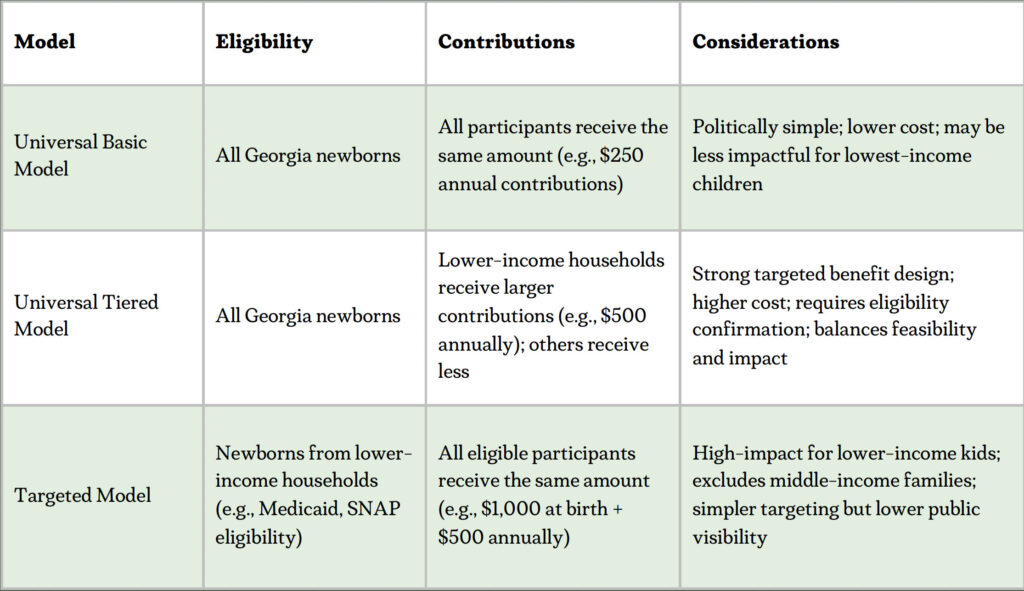
The core of baby bonds is simple: the state would deposit a sum of money into a trust fund for each eligible newborn, invest those funds until the child reaches adulthood, then allow the young adult to withdraw the money for approved uses. Within this policy, however, there are key design choices. Options range from a one-time deposit at birth to ongoing contributions throughout childhood. This report compares three models:

In evaluating the available baby bonds models for Georgia, we recommend a hybrid approach that combines universal eligibility with income-based tiered contributions, as proposed in GA House Bill 284. 

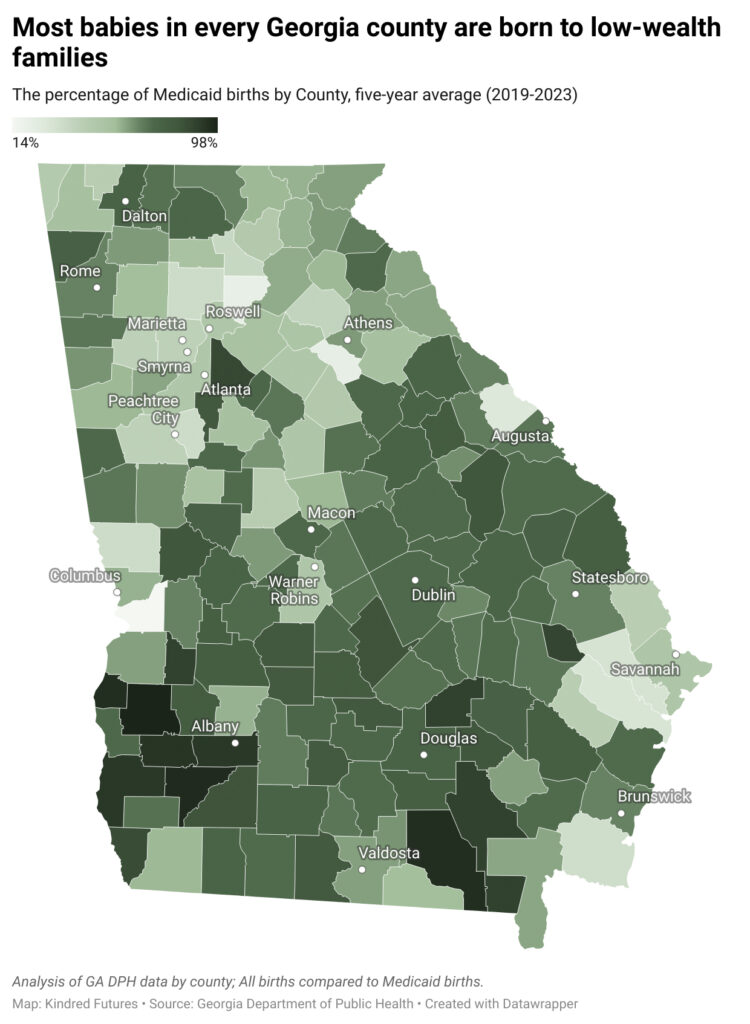
This design achieves multiple policy objectives: it ensures near-universal participation, simplifies enrollment through automatic birth registration, and allocates greater resources to children most likely to face long-term asset deprivation. Georgia’s demographic and economic context justifies this approach. A majority of rural births are Medicaid-covered, indicating disproportionate exposure to intergenerational wealth constraints. A flat universal model may be administratively efficient but lacks the targeting necessary to meaningfully reduce disparities. Conversely, a strictly targeted model could undermine public buy-in and limit political feasibility by excluding moderate-income families who also lack asset-building tools.

By contrast, a universal tiered model maximizes efficiency. It directs higher-value contributions to the bottom of the wealth distribution, where public dollars have the greatest marginal impact, while maintaining broad political appeal through universal access. This approach aligns with research indicating that targeted asset investments in early life yield high long-term returns in education, employment, and tax contributions, and reduces downstream public costs related to housing instability, underemployment, and debt.

Designing an effective baby bonds program for Georgia requires careful attention to core implementation principles that ensure access, growth, and long-term impact. Below are five key principles that should guide program development:

  1. Automatic Enrollment & Universal Access. Every child born in Georgia should be automatically enrolled in the baby bonds program at birth, ensuring that all eligible children—regardless of parental income, financial education, or bureaucratic barriers—receive a starting asset. By making the program universal and automatic, Georgia eliminates disparities in access and ensures that every child has a foundation for wealth-building.
  2. Publicly Managed Trust with Guaranteed Growth. The state should invest baby bond funds in a public trust, managed to achieve stable, long-term growth with a minimum guaranteed return (e.g., 3-5 percent annually). Using a diversified investment strategy—similar to pension funds or sovereign wealth funds—the program ensures that each account grows over time. This structure allows the state to maximize wealth-building opportunities while maintaining responsible oversight and financial sustainability.
  3. Guided Use with Flexible Guardrails at Withdrawal Age. Upon reaching eligibility at age 18 or higher, recipients should have broad flexibility in how they use their funds for wealth-building purposes such as education, homeownership, entrepreneurship, or relocation for employment. To balance agency with public accountability, the program could offer financial advising or planning resources to help participants make informed decisions and maximize long-term impact. These light-touch guardrails would build confidence in the program while preserving recipients’ ability to shape their economic futures.
  4. Tiered Contribution Model for Targeted Impact. To address Georgia’s racial and rural-urban wealth divide, the program should use a tiered funding structure, providing larger contributions to children from lower-income households. While all children would receive a base deposit, additional contributions would be scaled by family income, ensuring that those with fewer financial resources receive the most significant support.
  5. Statewide Wealth-Building & Economic Development Integration. Baby bonds should be integrated into Georgia’s broader strategy for inclusive economic growth. This includes aligning the program with existing wealth-building policies—such as first-time homebuyer incentives, small business capital access, and rural revitalization efforts and leveraging partnerships to provide financial education and outreach in disinvested communities.

A scalable baby bonds policy with automatic enrollment and tiered contributions would support a modest yet high-return investment in the next generation’s economic future. 

Notably, there are ways to mitigate the budgetary impact for the state: for example, establishing an endowment or trust fund today that grows and pays out benefits 18 years later, or using state bond financing (spread over decades) to fund the accounts upfront. The return on investment (ROI) for Georgia’s economy could be substantial. If tens of thousands of young Georgians each year enter adulthood with assets, we can expect higher college completion rates, greater entrepreneurship, and increased homeownership. Under House Bill 284, Georgia’s youth and young adults can acquire an estimated $1.4 billion in wealth per birth cohort to invest in Georgia’s economy when they reach the age of 18.48


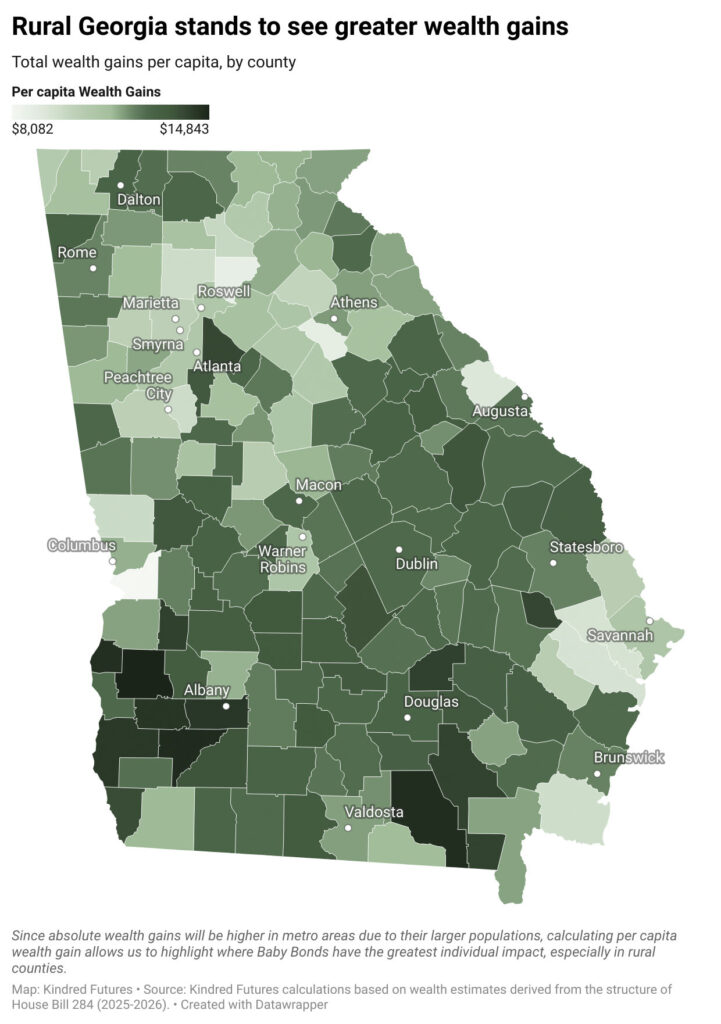
The map illustrates the projected per capita wealth gains for newborns in Georgia under House Bill 284, showing how Baby Bonds have the greatest relative impact in rural counties. While absolute wealth accumulation is higher in Metro Atlanta due to larger populations, this per capita analysis highlights where each child stands to benefit the most. The darker-shaded counties, concentrated in South and Central Georgia, reflect areas where a higher proportion of newborns qualify for the larger $15,000 baby bonds contribution, leading to greater wealth-building potential. In contrast, lighter-shaded counties, primarily in affluent suburban and metro areas, have lower per-child wealth gains due to a smaller share of low-income births. This visualization reinforces how baby bonds can help close wealth disparities between rural and urban communities, ensuring that children born in Georgia’s lowest-income counties have: stronger financial foundation by adulthood.

Under House Bill 284, Georgia’s youth and young adults can acquire an estimated $1.4 billion in wealth per birth cohort to invest in Georgia’s economy when they reach the age of 18.

View All References

Read More Of The Report

Why Baby Bonds?

Mounting evidence shows that assets can matter as much as income for a family’s long-term success.37 Income pays the bills, but assets change the future. A family with a savings cushion can move to pursue a better job, invest in a child’s education, or absorb a medical bill without plunging into poverty. Conversely, families without assets are one emergency away from hardship and have difficulty planning beyond immediate needs.

Assets like savings accounts, home equity, or thriving business ownership correlate with long-term financial stability and positive life outcomes. Families with even modest levels of wealth are better positioned to invest in education, weather financial shocks, and plan for the future. Yet millions of children grow up without any financial cushion to support their transition into adulthood. While income is essential, it often isn’t enough to break the cycle of generational poverty if families cannot accumulate some wealth. That’s why baby bonds focus on seeding assets—not just income supplements to the next generation, enabling young people to start adulthood with a meaningful foundation for economic security.

Baby bonds would inject new wealth into Georgia’s communities, allowing young adults to invest in education, homeownership, and entrepreneurship. Each year, a new cohort of 18-year-olds could collectively gain more than a billion dollars in total wealth38, stimulating local economies. This influx of capital could reduce student debt, increase homeownership rates, support small business formation, and enhance financial stability across the state. The debt-reducing power of baby bonds improves long-term economic security and increases disposable income, benefiting both individuals and local businesses, people and the economy.

Homeownership, Entrepreneurship, Asset Building

A baby bond account with just $10,000-$15,00039 by adulthood could serve as a down payment on a starter home in many parts of Georgia. Early homeownership helps young families build equity, which is a primary driver of intergenerational wealth. Baby bond recipients would own homes sooner and accumulate more equity by mid-life, strengthening communities through greater housing stability and increased property values. Additionally, increased homeownership leads to higher rates of civic engagement and neighborhood investment.

Supporting Entrepreneurship and Small Business Growth

Lack of startup capital is a major barrier for young entrepreneurs. With baby bonds, many Georgians could access the capital typically needed to start a business, fueling small business creation in historically across the state. Since 77 percent of small businesses rely on personal savings to launch, baby bonds could enable more increased diverse business ownership and job creation.40 Whether recipients use funds to open a storefront business or invest in digital entrepreneurship, baby bonds provide the necessary seed capital to turn business ideas into reality.

Local Economic Stimulus and Community Revitalization

Adults with baby bonds would spend and invest in their local economies, purchasing goods, securing housing, and starting businesses. This targeted wealth infusion could revitalize neighborhoods that suffered from disinvestment, particularly in historically Black and rural communities. Areas with historically limited financial resources would see increased consumer spending, better credit access, and overall economic improvement. Additionally, recipients using funds for wealth-building activities—like education, homeownership, or business investment—would experience higher incomes and net worth over time, further contributing to economic growth and stability in Georgia.

Fueling Long-Term Economic Growth

A wealth-building policy like baby bonds benefits the broader economy by expanding ownership, increasing consumer spending, and encouraging investment. When young people have capital, they are more likely to stay in their communities. Simulations suggest that Baby Bonds could reduce wealth concentration at the top while strengthening the middle class.41 Every Georgian would benefit from higher earnings, increased tax revenues, and a more dynamic economy.

Evidence from Other Initiatives

Baby bond policy is not an entirely new concept, but it builds on real-world experiments with Children’s Savings Accounts (CSAs), trust fund programs, and individual development accounts (IDAs).42 The idea of an endowment at birth has been tested. In the United States, many states and cities have launched CSAs, typically aimed at college savings. For instance, San Francisco’s Kindergarten to College program automatically opens a savings account with $50 for every public kindergarten student.43 Similarly, Maine’s Alfond Scholarship and programs in states like Oklahoma and Pennsylvania provide small deposits for children at birth or school entry.

These CSA programs, while modest in dollar amounts, have demonstrated important lessons: automatic enrollment leads to near-universal participation, and even minimal seed deposits spur families to contribute and engage in financial planning for their children.44 In Oklahoma’s SEED for Oklahoma Kids (a randomized control trial), every child in the treatment group received $1,000 in a 529 college account at birth. By toddlerhood, virtually 100 percent of those children had an account (compared to just 3 percent of the control group), and their average college savings (including the seed money) was about $1,040 versus only $13 for kids that were not enrolled. This shows the power of making saving automatic and funded – it creates a future asset that families would otherwise never have.

Baby bonds take these concepts further by providing larger dollar amounts and expanding the use of savings for wealth-building purposes in young adulthood. Several jurisdictions have moved to enact or explore baby bonds policies:

  1. Connecticut became the first state to pass baby bonds into law in 2021, with plans to invest $3,200 at birth for every baby born on Medicaid (approximately 15,000 babies a year). Connecticut’s program, once funded, is expected to yield around $10,000-$11,000 per beneficiary by maturity at age 18 for approved uses (education, homeownership, business, or retirement).45
  2. At least nine states have considered baby bonds legislation in recent years, often with bipartisan interest. This momentum is fueled by simulation research indicating strong potential impacts.
  3. A national baby bonds program (with sliding-scale contributions up to $50,000 for the lowest-wealth families) would virtually eliminate the racial wealth divide among young adults. Specifically, the median wealth divide between White and Black young households could shrink by over 90 percent, from a $43,100 divide to about $21,300. At the same time, baby bonds would raise the net worth of all young adults in the bottom 90 percent of the country’s wealth distribution. In other words, baby bonds can boost those who have least without harming the broader economy; in fact, they infuse new capital into communities that need it most, likely yielding positive economic spillovers.46

For Georgia, baby bonds offer a policy tailored to our state’s efforts to uplift rural and low-wealth communities. 

Consider some of Georgia’s unique wealth challenges: wide gaps between booming counties and struggling ones across the state. Traditional economic development hasn’t solved these problems – for instance, job growth in Atlanta doesn’t automatically translate to wealth for a family in Albany or a renter in Savannah. Every child born into a poor family in Georgia would, by design, accumulate a substantial financial asset by adulthood through baby bonds. This is essentially a publicly funded trust fund for the least advantaged, something that wealthy families routinely provide to their heirs, but low-wealth families cannot.

Importantly, Baby Bonds would help bridge Georgia’s racial wealth divide while also benefiting low-wealth people of all races. For example, many low-income White families in rural Georgia would receive the same asset boost for their children as low-income Black families in Atlanta’s Westside. Likewise, bringing rural areas into the economic mainstream would expand Georgia’s tax base and labor force. Baby bonds guarantee that every child has a fair start, thereby fostering a future where success is determined more by talent and effort and less by parental wealth.

View All References

Read More Of The Report

Current Wealth-Building Realities for Georgia’s Youth and Young Adults

Current Wealth-Building Realities
for Georgia's Youth and Young Adults

Upward Mobility for Children Born in the
Bottom of the Income Ladder in Georgia

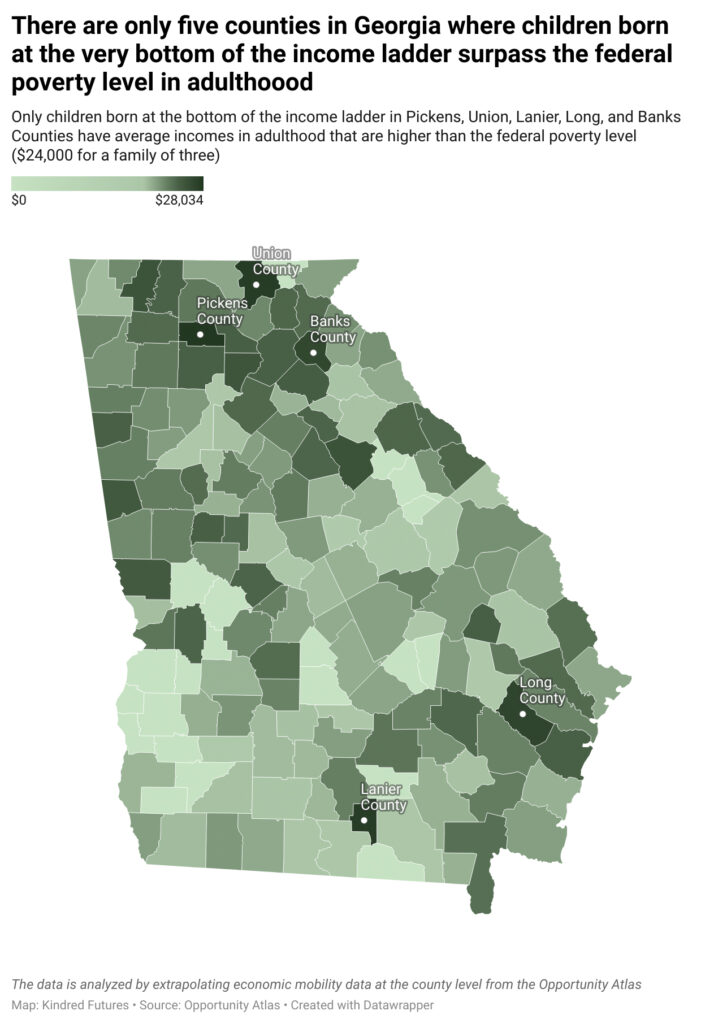
Economic mobility in Georgia remains significantly limited, particularly for children born into low-income households. A child born in Georgia to parents in the bottom 20 percent of the income ladder has less than a 5 percent chance of reaching the top 20 percent as an adult.32 To make matters worse, very few will surpass the poverty line later in life. Only children born in five counties will rise above the poverty line, and just barely. Structural barriers including disparities in wealth inheritance and economic investment, create significant challenges for children in Georgia to move up the economic ladder. Without intervention, these trends contribute to persistent wealth divides and hinder long-term economic growth across the state.

Geographically, mobility outcomes are particularly poor for children raised in certain regions of Georgia, including rural communities and historically disinvested neighborhoods across the state. Low-mobility zones tend to have higher poverty rates, lower-performing schools, and fewer job opportunities—factors that limit wealth accumulation as children transition into adulthood. The fact that economic mobility is so constrained in Georgia underscores the importance of policies that provide financial resources to children from an early age.33

Median Net Worth of Young Adults

For young adults in Georgia, the ability to build wealth early in life is crucial for long-term economic stability. However, median net worth data show that many young adults—especially those from low-wealth, rural and Black or Latinx families—enter adulthood with little to no financial assets. Nationally, young adults start out with a median net worth that often falls below $10,000. In Georgia, disparities in early-life financial resources mean that many young adults start their careers with zero or even negative net worth, particularly if they have accumulated student loan debt or face difficulties securing stable, well-paying jobs.34

The lack of early wealth presents a major hurdle to economic mobility, as young adults with few financial assets struggle to afford higher education, buy a home, or start a business—three of the most common pathways to long-term wealth accumulation. By providing a capital endowment at birth, baby bonds would ensure that every young adult in Georgia has a financial resource to help them transition successfully into independent adulthood.

Percentage of Babies Born to low-wealth households

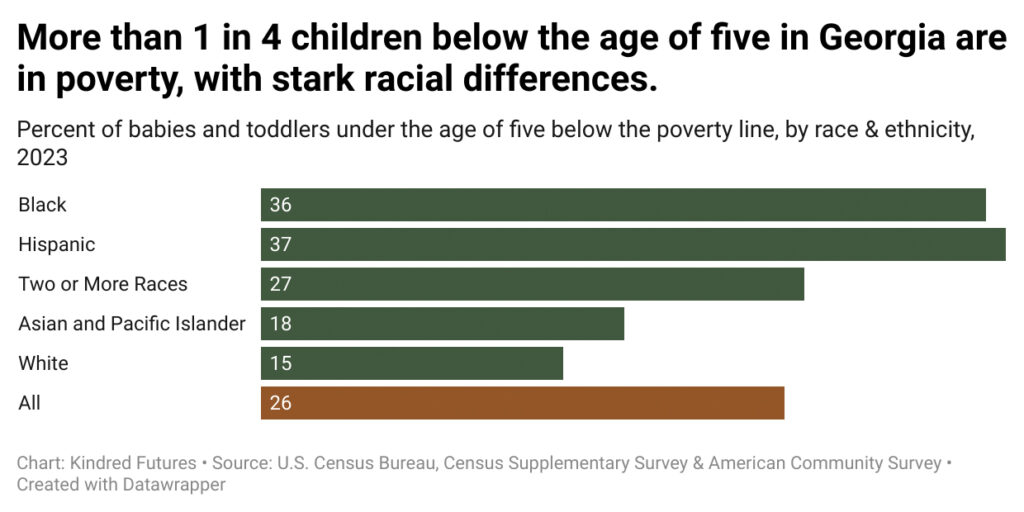
A significant portion of Georgia’s newborns enter a landscape shaped by structural economic inequality.35 Nearly half of all births in the state are covered by Medicaid, reflecting broader patterns of limited access to generational wealth, quality employment, and affordable healthcare. These inequities are not evenly distributed: Black and Latino infants are far more likely to be born into households classified as low-wealth due to historic and ongoing exclusion from economic opportunity. According to the Georgia Department of Public Health, nearly 65 percent of Black babies are born into Medicaid-eligible families, compared to about 35 percent of white newborns—underscoring how racial disparities in wealth and public health are present from birth.36

These disparities in birth conditions set the stage for long-term economic inequalities. Babies born into poverty often experience financial instability in their households, which can impact early childhood development, educational attainment, and future wealth-building opportunities. 

Without targeted interventions, children born into lower-wealth families are more likely to remain economically disadvantaged as adults, reinforcing generational cycles of wealth inequality. Strong policies are needed to offset the financial disadvantages present from birth, ensuring that all children—regardless of the household they are born into—have a fair opportunity to build wealth and achieve long-term economic security.

View All References

Read More Of The Report

Georgia’s Urban-rural Wealth Divide

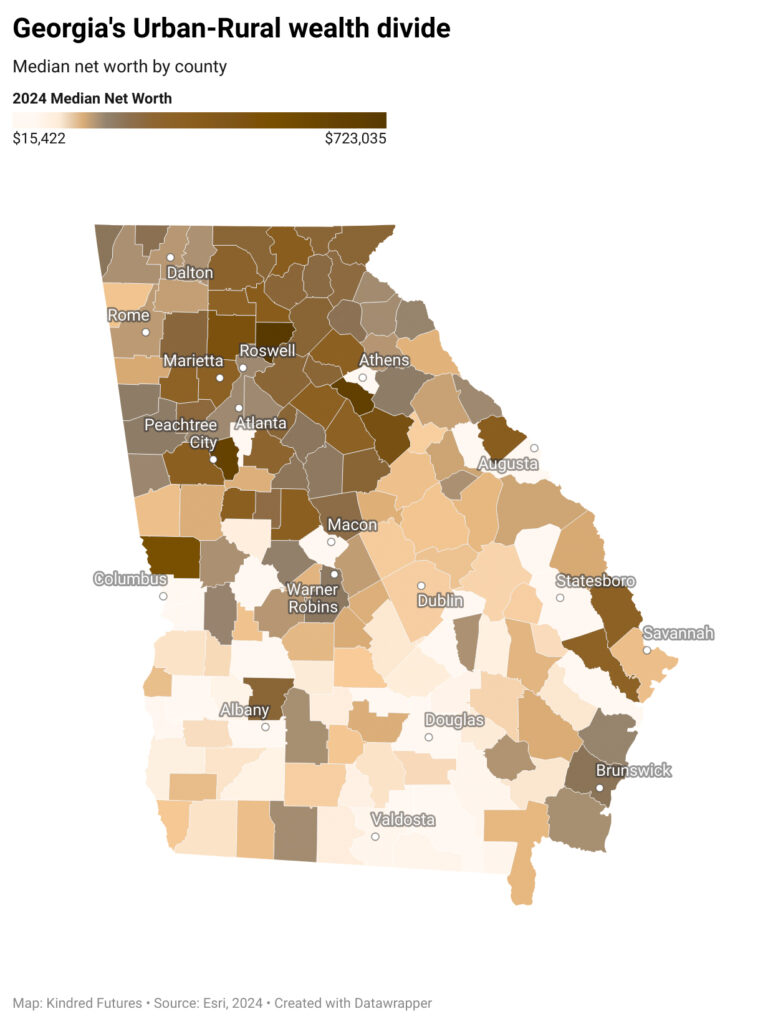
Georgia’s urban-rural wealth divide also deserves attention. Despite the vast majority of the state being rural, approximately 17 percent of the state’s household wealth is held in rural counties while 83 percent of the wealth is in non-rural counties.26 In North Georgia’s Forsyth, Cherokee, and Fayette counties (suburban areas near Atlanta), median household net worth exceeds $700,000. By contrast, many rural counties in east and South Georgia show median net worth figures below $100,000. For instance, in Chattahoochee County (south-western Georgia), the median household has around $15,000 in wealth.27

These differences reflect structural factors: rural economies often rely on a few industries (such as agriculture or manufacturing) and have seen the outmigration of talent and capital over the years.28 When a factory closes or crop prices fall, local wealth doesn’t have a cushion and can evaporate quickly, forcing families to deplete savings or go into debt. Additionally, assets common in rural areas (like small homes or used vehicles) do not appreciate in value as much as assets like urban real estate or stocks. All of this means that a child born in a low-wealth rural Georgia county faces an uphill climb to accumulate wealth in adulthood, even if their income improves.

It is precisely these disparities that baby bonds are designed to counteract. By seeding wealth for those who have very little or none at all, baby bonds could gradually even out the disparities and create a more balanced economic landscape in Georgia.

Asset Types Highlight Need for Broad Investment Tools for Georgians

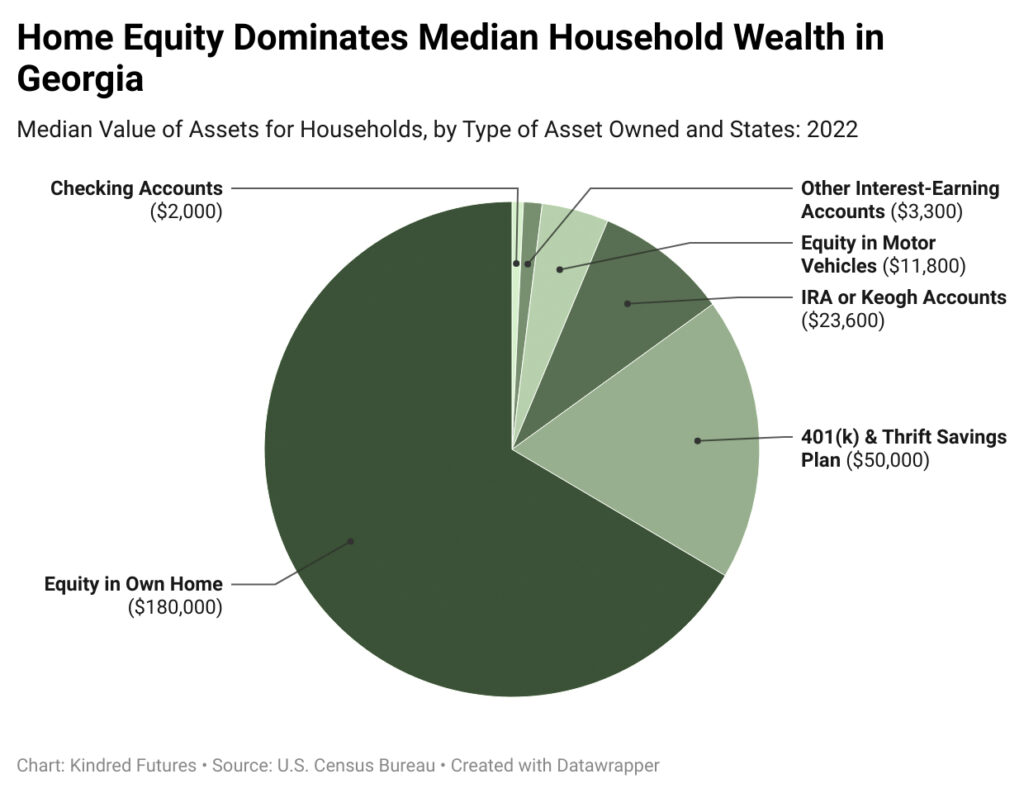
Home equity is the single largest component of household wealth in Georgia, exceeding even retirement savings and investment accounts. While it is expected to surpass lower-value assets like checking accounts or vehicles, the fact that it also outpaces higher-value, growth-oriented assets highlights how central homeownership is to wealth-building in the state. For families unable to afford a down payment or access credit, this creates a significant barrier to accumulating long-term wealth.29 The fact that the biggest share of median household wealth comes from owning a home underscore how critical an initial wealth starter can be.

Families from low-wealth backgrounds face multiple barriers to building home equity. First, many cannot afford the upfront costs of homeownership—especially the down payment—because they lack savings or family wealth transfers. This prevents them from accessing the primary pathway to long-term wealth accumulation in Georgia. Second, even those who do purchase homes often do so with smaller down payments, resulting in slower equity growth and greater vulnerability to market fluctuations. These structural disadvantages compound over time, making it harder to catch up with peers who entered the housing market with more capital, like retirement accounts or investment accounts.

There are also notable differences in how White and Black households in Georgia allocate their wealth across various asset categories. For White households, retirement accounts and primary residences each represent over a quarter of total holdings, with smaller yet meaningful shares in businesses, stocks, and mutual funds. In contrast, Black households direct nearly half of their asset portfolio toward business ownership, while retirement accounts and stocks make up relatively smaller proportions.30 This contrast points to distinct paths of wealth-building between the two groups, with White families more heavily invested in employer-sponsored or market-based vehicles (like 401(k)s and mutual funds), whereas Black families appear to rely more on entrepreneurial ventures and real estate for asset growth.

Households with a higher reliance on business ownership or real estate, for example, may face greater risks if they lack startup capital or resources to buffer against market swings.31 The variation in asset-holdings and values underscores why a universal policy that builds assets early on—rather than relying solely on traditional savings mechanisms—could be especially powerful in leveling the playing field for families who otherwise struggle to access stable, growth-oriented investments.

View All References

Read More Of The Report

Current State of Wealth for Georgians

Executive Summary

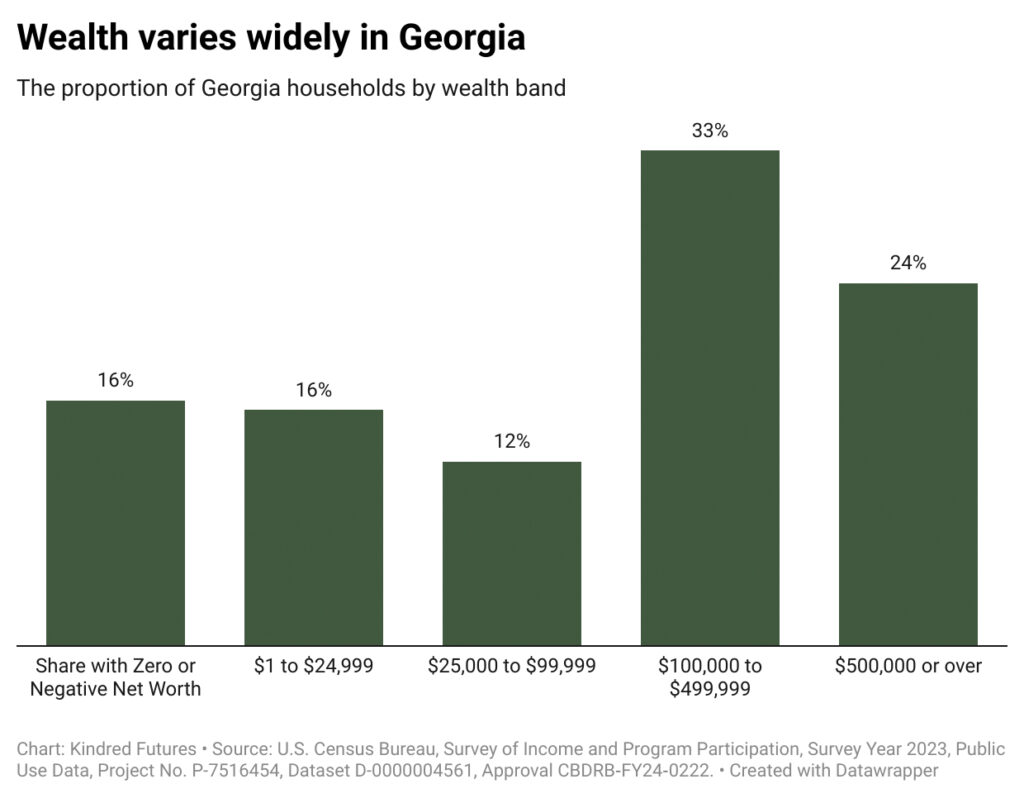
By many measures, Georgia’s economy is dynamic — yet the benefits are unevenly distributed. The median net worth of Georgia households is $166,300, ranking 26th out of the 45 states that have sufficient-enough data to report household wealth estimates.21 However, this single figure masks huge variations. For instance, 16 percent of Georgia households have zero or negative net worth, which means they have no resources to fall back on in the event of a financial emergency.

There is also geographic and racial inequality within Georgia – an inequality that is even more pronounced when looking at wealth. Statewide, White families are far more likely to own homes, businesses, and retirement accounts, whereas Black and Latinx families are overrepresented among the asset-poor, which contributes to a widening racial wealth divide.22 This means many families of color in Georgia have little beyond paycheck-to-paycheck income – few reserves to draw on for college tuition, a down payment, or an emergency expense.

Racial wealth inequality in Georgia has historical roots. Decades of discriminatory policies denied Black Georgians the chance to build wealth on equal terms.23 Similarly, rural Black communities suffered from Jim Crow-era exclusion and continue to experience depressed property values and limited access to credit.24 On the other side of the ledger, many White families – even of modest means – have benefited from intergenerational transfers of wealth. Large gifts and inheritances account for about 12 percent of the White-Black wealth divide nationally.25

View All References

Read More Of The Report

Securing Georgia’s Future: Executive Summary and Introduction

Executive Summary

Georgia’s economy is growing, but prosperity remains out of reach for many families. In Forsyth County, just north of Atlanta, the median household net worth exceeds $720,000. In nearby rural Chattahoochee County, it’s closer to $15,000.1

These vast disparities—by geography, race, and wealth—are not anomalies; they are the result of generations of unequal access to asset-building opportunities. For families without wealth, even a small financial emergency can derail progress toward homeownership, education, or small business formation. As a result, Georgia’s persistent wealth divide continues to constrain economic mobility and limit the state’s full potential.

These wealth disparities don’t just reflect the past – they shape the future, limiting the ability of children born into low-wealth households to move up the economic ladder. Georgia — like much of the Southeast — has among the lowest rates of intergenerational economic mobility in the United States2. In most parts of Georgia, a child born to parents in the bottom 20 percent of the income distribution has less than a five percent chance of rising to the middle class, reflecting persistent and intergenerational cycles of poverty.3

This report makes the economic case for children’s trust accounts, or baby bonds, as a state policy to address Georgia’s growing wealth inequality4. Baby bonds – publicly funded trust accounts for children would provide Georgia newborns vulnerable to poverty with a safety net for their future, giving young adults capital needed to go to college, help purchase a home, start a business, or reinvest into Georgia’s economy in other meaningful ways. By design, baby bonds would invest more in children from lower-wealth families, helping to close the wealth divide while benefiting all communities across Georgia.5

Key Findings

  • A universal baby bonds program in Georgia could build $1.4 billion in new wealth per birth cohort.6
  • Eligible children could access up to $16,000 by age 18 under the proposed model.
  • Rural counties—especially in South and Central Georgia—would benefit most due to higher rates of low-wealth births.
  • Baby bonds would advance economic mobility, reduce future public assistance needs, and help close Georgia’s racial wealth divide.

Recommendation

Georgia should implement a baby bonds program with universal eligibility and tiered contributions, as proposed in House Bill 2847 and House Resolution 998 (2025). Under this model, eligible newborns would receive a starter deposit and children in lower-wealth families (e.g. those on Medicaid) would receive substantially larger deposits or annual top-ups. By age 18, eligible youth could accumulate up to $16,000 in a trust account, depending on investment growth. 

This report assesses the state of wealth in Georgia currently, evaluates the cost and impact of several funding scenarios – from a basic universal plan to a more generous targeted plan – and finds that the progressive model would deliver the greatest reduction in Georgia’s wealth divide while remaining financially feasible and making an investment that would yield high returns in the form of a more prosperous generation of Georgians.

Introduction

Wealth—traditionally defined as the assets a family owns minus their debts—is a bedrock of financial security and opportunity.9 Yet wealth is distributed very unevenly in Georgia, leading to stark differences in life outcomes.10 While income allows families to get by month-to-month, wealth provides the resilience and springboard for families to get ahead. 

A nest egg can finance a down payment on a home, seed a business venture, or put a young adult through college – investments that build prosperity across generations. Unfortunately, many Georgia families have been historically excluded from wealth-building, whether due to low incomes, lack of inheritance, or discriminatory policies11. As a result, our state today grapples with deep wealth and income inequality along racial and geographic lines.12 Addressing this inequality isn’t just a moral imperative – it is essential for Georgia’s long-term economic health.

Georgia’s context highlights why a bold policy like baby bonds is worth considering. The state’s population of 10.7 million is diverse and growing. Atlanta’s booming metro area fosters substantial wealth creation, yet many rural communities have abundant strengths that remain underinvested, limiting their asset-building opportunities. Nearly 15 percent of Georgians live in poverty (and poverty rates in some rural counties exceed 30 percent).13 Moreover, Georgia ranks 37th in the nation for child well-being, partly due to high rates of child poverty and limited family assets. 14

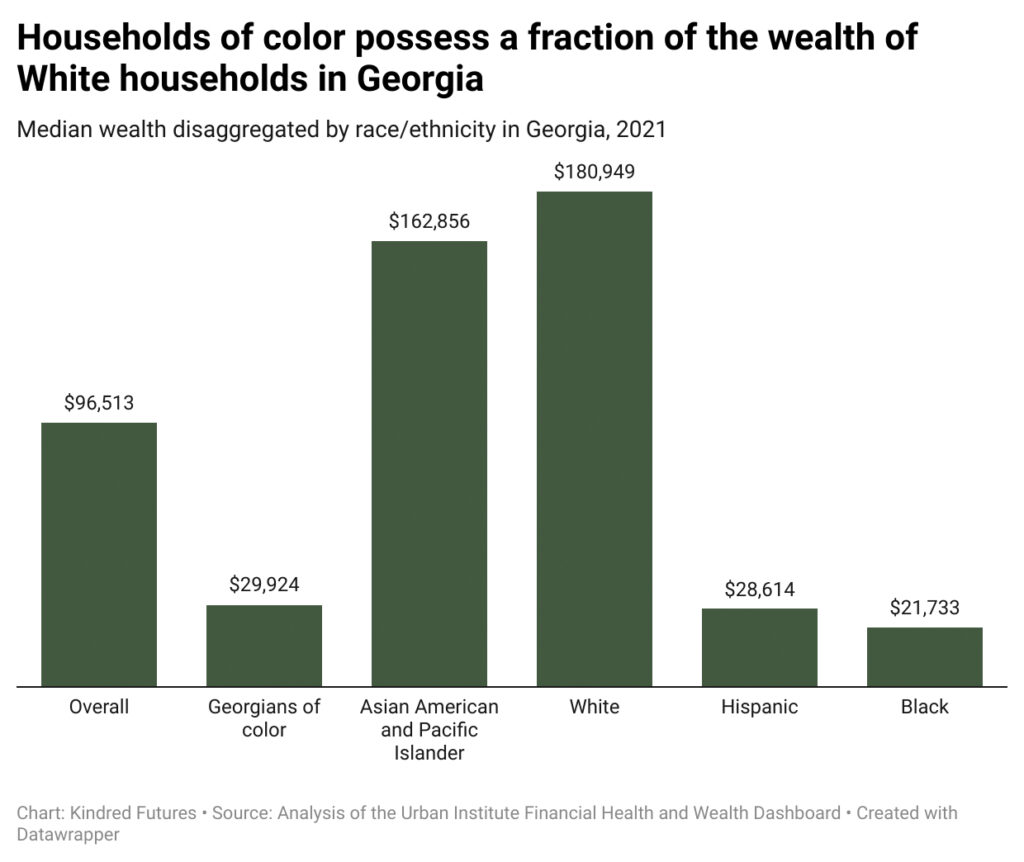
Crucially, wealth inequality in Georgia falls along historic racial lines.¹⁵ Generations of Black families were prevented from accumulating assets – first through slavery and sharecropping, penal colonies, later via Jim Crow segregation, redlining in housing, and exclusion from financial markets.15 These public policies created a yawning racial wealth divide that persists today: Georgia’s typical White family has about $180,949 in wealth versus just $21,733 for the typical Black family.16

At the same time, wealth inequality in Georgia is not solely an urban or racial issue – it has a clear geographic dimension. Three in four of Georgia’s 159 counties are rural, and many have not shared equally in the state’s economic growth. Approximately 17 percent of the state’s wealth is held in rural counties despite the vast majority of the state being rural, while 83 percent of the wealth is in non-rural counties. For example, in affluent Forsyth County north of Atlanta, the median net worth is over $720,000, while in rural Chattahoochee County it’s around $15,000.17

Such extreme differences reflect the concentration of high-paying jobs and real estate values in metro areas versus the chronic underinvestment in rural South Georgia. The result is a patchwork economy: some Georgia families enjoy stability and plenty, while many others whether in Atlanta’s Southside or Appalachia’s hill country — have little or no wealth to fall back on. Since policy choices created many of these disparities,18 smart and bold policy choices can help reduce them.

Faced with these challenges, state leaders have begun exploring solutions to boost household wealth and reduce inequalities. Traditional approaches have included spurring job creation, improving education, and offering tax credits for working families. While important, these measures alone haven’t closed the wealth divide, in part because they do not directly provide assets to those starting with very little or none. 

This is where baby bonds enter the discussion. Baby bonds propose to endow every child with a small trust fund at birth, which the child can claim upon reaching adulthood for wealth-building uses.19 By giving children — especially those from low-wealth families — a lump sum of capital as young adults, baby bonds aim to break the cycle of intergenerational poverty. In recent years, policymakers in Georgia have taken note: legislation was introduced in 2025 to create a Georgia Baby Bonds program.20 These developments signal growing recognition that wealth building – not just income support must be part of Georgia’s policy toolkit to foster shared prosperity.

“Baby bonds propose to endow every child with a small trust fund at birth, which the child can claim upon reaching adulthood for wealth-building uses.”

View All References

Read More Of The Report

Standing on Business Brief References

1 Staff, Eater. “TKO Closes Its Stall in East Atlanta’s Southern Feedstore.” Eater Atlanta, 3 Aug. 2021, https://atlanta.eater.com/2021/8/3/22607846/atlanta-restaurant-closings-closures.

2 Raymond, Elora Lee, Ben Miller, Michaela McKinney, and Jonathan Braun. “Gentrifying Atlanta: Investor purchases of rental housing, evictions, and the displacement of black residents.” Housing Policy Debate 31, no. 3-5 (2021): 818-834.

3 Richardson, Jason, Bruce Mitchell, and Juan Franco. “Shifting neighborhoods: Gentrification and cultural displacement in American cities.” (2019).

4 Hyra, Derek. “The back-to-the-city movement: Neighbourhood redevelopment and processes of political and cultural displacement.” Urban Studies 52, no. 10 (2015): 1753-1773.

5 Perry, A. M., Donoghoe, M., & Stephens, H. (2023). To increase Black well-being, look to an equitable share of Black-owned employer businesses, https://www.brookings.edu/articles/who-is-driving-black-business-growth-insights-from-the-latest-data-onblack-owned-businesses/

6 Perry, A. M., Donoghoe, M., & Stephens, H. (2023). To increase Black well-being, look to an equitable share of Black-owned employer businesses, https://www.brookings.edu/articles/who-is-driving-black-business-growth-insights-from-the-latest-data-onblack-owned-businesses/

7 Rupasingha, Anil. Locally owned: Do local business ownership and size matter for local economic wellbeing? No. 2013-01. Federal Reserve Bank of Atlanta, 2013.

8 Schnake-Mahl, Alina, Jessica AR Williams, Barry Keppard, and Mariana Arcaya. “A public health perspective on small business development: a review of the literature.” Journal of Urbanism: International Research on Placemaking and Urban Sustainability 11, no. 4 (2018): 387-411.

9 Anchored by a deep commitment to community based participatory research, AWBI completed this brief by conducting interviews with participants who play key roles in their communities as business owners, neighborhood residents, or both in the City of Atlanta. AWBI also analyzed data provided by Dun & Bradstreet Holdings, Inc. and Data Axle, Inc. to examine Black business trends at a neighborhood level. We use this approach because the U.S. Census surveys only report business demographics at the metro level, which limits the analysis of business dynamics on neighborhood well-being.

10 SBA’s Office of Advocacy. “Small Business Profiles for Major Metropolitan Areas,” July 11, 2023. https:// advocacy.sba.gov/2023/07/11/small-business-profiles-for-major-metropolitan-areas.

11 Camardelle, Alex, and Jarryd Bethea. “Building A Beloved Economy: A Baseline and Framework for Building Black Wealth in Atlanta.” Atlanta, Georgia: Atlanta Wealth Building Initiative, November 2023. https://buildblackwealth.into.

12 Headd, Brian. “The Small Business Facts: The Role of Microbusiness Employers in the Economy.” Small Business Administration, 2017; The standard definition of microbusiness is less than 9 employees; however, for the purpose of our analysis, we focus on those that employee as many as 20 employees given the frequency of those businesses in the dataset.

13 Atlanta Wealth Building Initiative analysis of data retrieved from Dun & Bradstreet Holdings, Inc.

14 Camardelle, Alex, and Jarryd Bethea. “Building A Beloved Economy: A Baseline and Framework for Building Black Wealth in Atlanta.” Atlanta, Georgia: Atlanta Wealth Building Initiative, November 2023. https://buildblackwealth.info.

15 Fairlie, Robert W., Alicia Robb, and David T. Robinson. “Black and White: Access to Capital among Minority-Owned Startups.” Working Paper. Working Paper Series. National Bureau of Economic Research, November 2020. https://doi.org/10.3386/w28154.

16 Ramanadhan, Shoba, Sabrina Werts, Collin Knight, Sara Kelly, Justin Morgan, Lauren Taylor, Sara Singer, Alan Geller, and Emma Louise Aveling. “The Role of Small, Locally Owned Businesses in Advancing Community Health and Health Equity: A Qualitative Exploration in a Historically Black Neighborhood in the USA.” Critical Public Health 33, no. 5 (October 20, 2023): 633-45.

17 Ruiz, Cristina, Estefanía Hernández-Fernaud, Gladys Rolo-González, and Bernardo Hernández. “Neighborhoods’ Evaluation: Influence on Well-Being Variables.” Frontiers in Psychology 10 (2019): Article 1736. Accessed July 4, 2024.

18 Shybalkina, luliia. “Place-Based Small Business Support and Its Implications for Neighborhood Revitalization.” Economic Development Quarterly 36, no. 4 (November 2022): 355-70.

19 Rupasingha, Anil. “Locally Owned: Do Local Business Ownership and Size Matter for Local Economic Well-Being?” FRB Atlanta Community and Economic Development Discussion Paper, FRB Atlanta Community and Economic Development Discussion Paper, 2013. https://ideas.repec.org//p/fip/fedacd/ 2013-01.html.

20 lbid.

21 Brookings. “To Increase Black Well-Being, Look to an Equitable Share of Black-Owned Employer Businesses.” Accessed May 29, 2024. https://www.brookings.edu/articles/to-increase-black-well-beinglook-to-an-equitable-share-of-black-owned-employer-businesses.

22 United Way of Greater Atlanta. Child Well-Being Index. Accessed 2024; Comprised of 16 metrics, the Index incorporates data from multiple sources including the Georgia Department of Education, Public Health Department, and U.S. Census. The Child Well-Being Index assesses various aspects of a child’s development, such as education, health, economic equity and stability, and family support.

23 Wiersch, Ann Marie, and Lucas Misera. “2022 Report on Firms Owned by People of Color Based on the Small Business Credit Survey.” Small Business Credit Survey Federal Reserve Banks, no. 20220629 (June 29, 2022). https://doi.org/10.55350/sbcs-20220629.

24 lbid.

25 Corcoran, Emily Wavering, Jordan Manes, Lucas Misera, and Ann Marie Wiersch. “2023 Report on Employer Firms: Findings from the 2022 Small Business Credit Survey.” Small Business Credit Survey Publications, no. 20220308 (March 8, 2022). https://doi.org/10.55350/sbcs-20230308.

26 Camardelle, Alex, and Jarryd Bethea. “Building A Beloved Economy: A Baseline and Framework for Building Black Wealth in Atlanta.” Atlanta, Georgia: Atlanta Wealth Building Initiative, November 2023. https://buildblackwealth.info.

27 Sherman, Fraser. “What Percentage of Rent Should You Pay According to Your Business’ Gross Income?” Chron, March 5, 2019. Accessed July 4, 2024. https://smallbusiness.chron.com/percentagerent-should-pay-according-business-gross-income-71111.html; This article states that while different industries have varying standards, retail operations typically aim for a rent-to-revenue ratio in the range of 5-10 percent.

28 “The State of Storefronts: Alarming Vacancy Rates and Rising Rents during the Pandemic.” Association for Neighborhood and Housing Development. Accessed July 4, 2024. https://anhd.org/report/statestorefronts-alarming-vacancy-rates-and-rising-rents-during-pandemic.

29 Rothwell, Jonathan, Tracy Hadden Loh, and Andre M. Perry. “The Devaluation of Assets in Black Neighborhoods: The Case of Commercial Property.” Brookings Institution, July 11, 2022. Accessed July 4, 2024. https://www.brookings.edu/research/the-devaluation-of-assets-in-black-neighborhoods-the-case-ofcommercial-property.

30 lbid.

Read More Of The Report