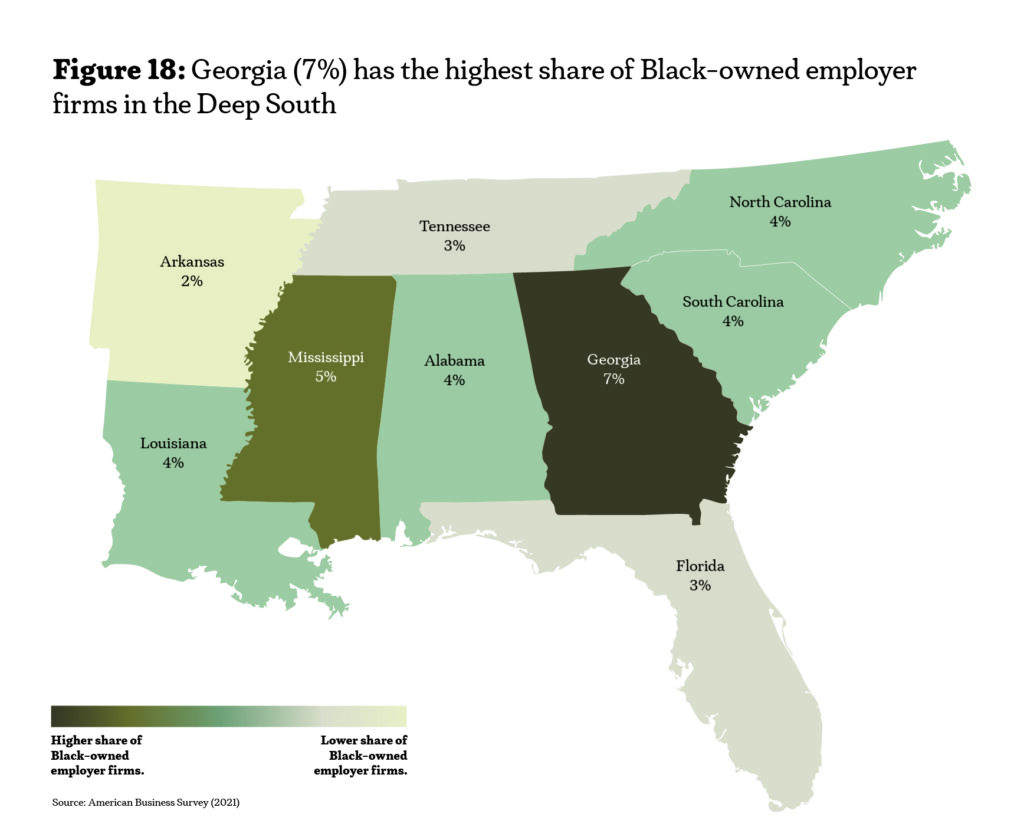
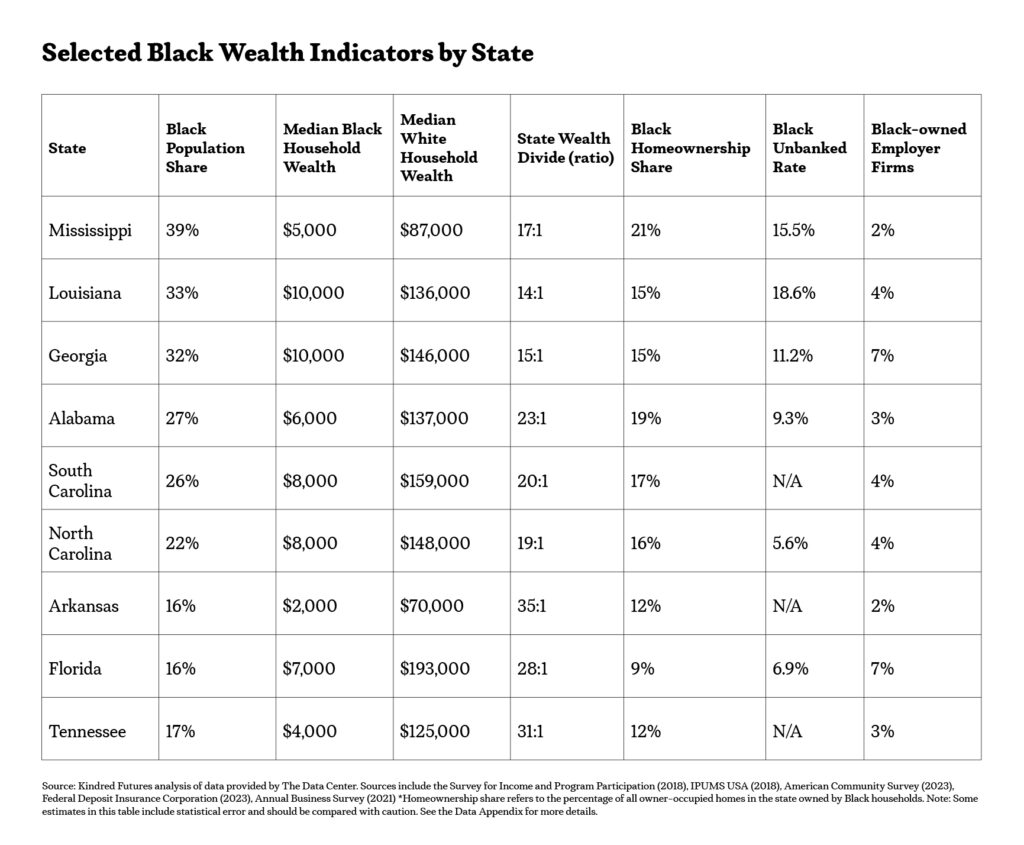
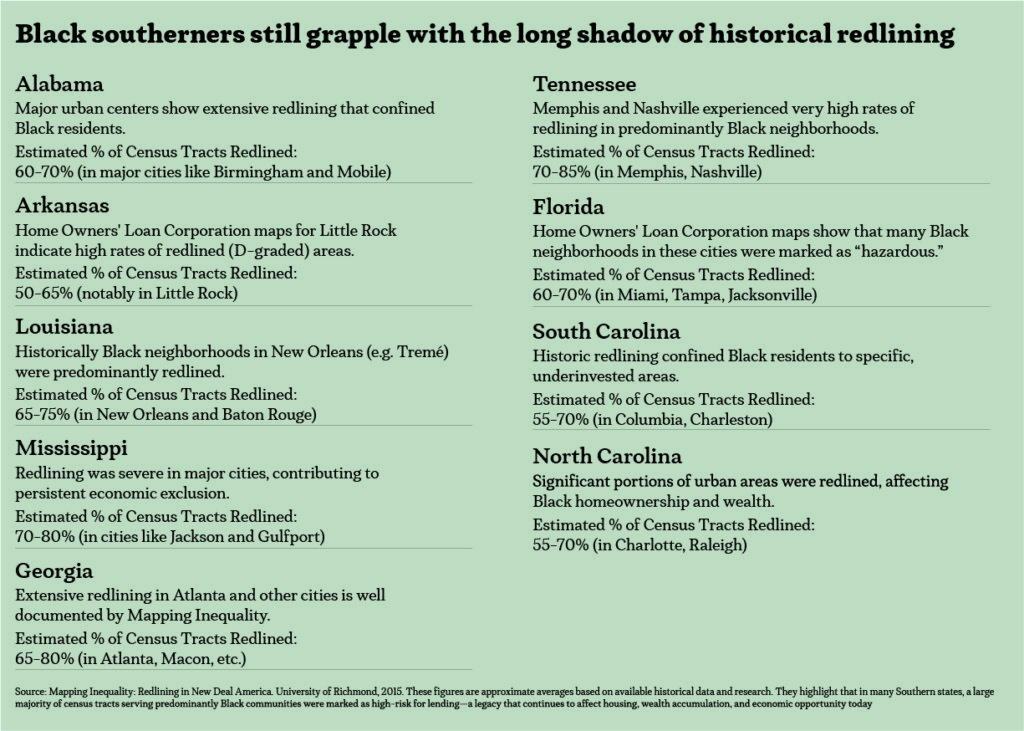
1. For the purposes of this report, the Deep South is defined as the states of Alabama, Arkansas, Louisiana, Mississippi, Georgia, Tennessee, Florida, South Carolina, and North Carolina. This delineation is based on both historical and contemporary socio-economic and political contexts. These states share common legacies of segregation, discriminatory lending practices, and underinvestment in Black communities—factors that have contributed to a profound racial wealth divide. By focusing on these states, our analysis captures the region where these challenges are most pronounced and where targeted policy interventions could yield significant improvements. More detail is available in the methodology section of the report.
2. The Data Center analysis of data from the Survey for Income and Program Participation (SIPP), 2018
3. Kindred Futures. 2025. Analysis of Black Household Wealth Using Panel Study of Income Dynamics (PSID) Data. Unpublished dataset analysis.
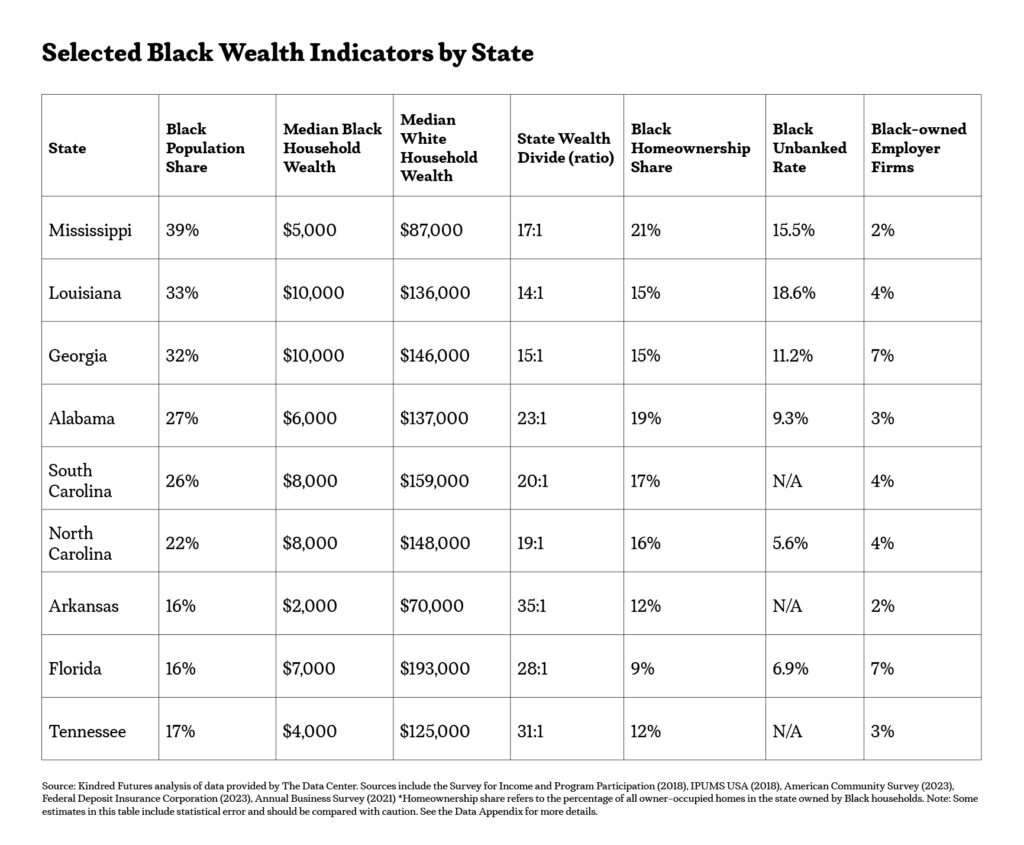
4. Kindred Futures analysis of data provided by The Data Center
5. Ibid; There are relatively large margins of error, so these differences should be interpreted with caution.
6. Derenoncourt, Hugo, et al. “Changes in the Distribution of Black and White Wealth since the US Civil War.” Journal of Economic Perspectives 37, no. 4 (2023): 71. https://doi.org/10.1257/jep.37.4.71.
7. Kindred Futures analysis of data provided by The Data Center
8. Sim, David C., Joanna E Cohen, Patrick J. Doyle, and Lydia Plath, 2016. “No backward step – Walter Johnson, river of dark dreams: slavery and empire in the cotton kingdom (Cambridge, MA: Harvard university press, 2013). isbn978 0 6740 4555 2.”, Journal of American Studies(1), 50:231-247. https://doi.org/10.1017/s0021875815001942
9. Derenoncourt, Hugo, et al. “Changes in the Distribution of Black and White Wealth since the US Civil War.” Journal of Economic Perspectives 37, no. 4 (2023): 71. https://doi.org/10.1257/jep.37.4.71.
10. Conley, Dalton, 2001. “Decomposing the black‐white wealth gap: the role of parental resources, inheritance, and investment dynamics”, Sociological Inquiry(1), 71:39-66. https://doi.org/10.1111/j.1475-682x.2001.tb00927.x
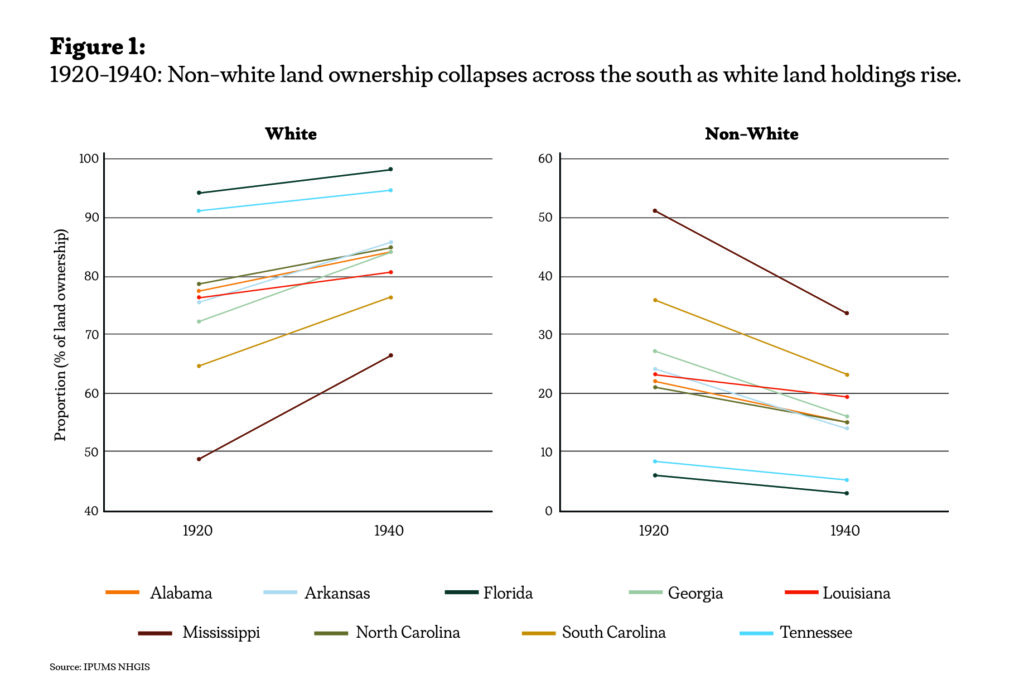
11. Kindred analysis of data provided by The Data Center (IPUMS; Table: Value & Race of Operator for Southern States, 1920 and 1940)
12. Fahy, Jennifer. “Heirs’ Property and the 90% Decline in Black-Owned Farmland.” Farm Aid, February 28, 2022. https://www.farmaid.org/blog/heirs-property-90-percent-decline-black-owned-farmland/.
13. Francis, Dania V., Darrick Hamilton, Thomas W. Mitchell, Nathan Rosenberg, and Bryce Wilson Stucki, 2022. “Black land loss: 1920–1997”, Aea Papers and Proceedings, 112:38-42. https://doi.org/10.1257/pandp.20221015
14. Shi, Ying, Daniel Hartley, Bhaskar Mazumder, and Aastha Rajan, 2021. “The effects of the great migration on urban renewal”,. https://doi.org/10.21033/wp-2021-04
15. Digital Scholarship Lab, “Renewing Inequality,” American Panorama, ed. Robert K. Nelson and Edward L. Ayers, accessed April 4, 2025, https://dsl.richmond.edu/panorama/renewal/#view=0/0/1&viz=cartogram.
16. Fullilove, Mindy Thompson. “Root shock: the consequences of African American dispossession.” Journal of Urban Health 78 (2001): 72-80.
17. Ibid.
18. Baker, Regina, 2022. “The historical racial regime and racial inequality in poverty in the American south”, American Journal of Sociology(6), 127:1721-1781. https://doi.org/10.1086/719653
19. Kindred analysis of data provided by The Data Center
20. Ibid.
21. Collins, William Job, Nicholas Holtkamp, and Marianne Wanamaker, 2024. “Black Americans’ landholdings and economic mobility after emancipation: evidence from the census of agriculture and linked records”, The Journal of Economic History(4), 84:963-996. https://doi.org/10.1017/s0022050724000299
22. Jones, Elizabeth H., 2017. “Racism, fines and fees and the us carceral state”, Race & Class(3), 59:38-50. https://doi.org/10.1177/0306396817734785
23. Williams, Jakobi, 2023. “Until I am free: Fannie Lou Hamer’s enduring message to America,” The Journal of African American History(4), 108:737-739. https://doi.org/10.1086/726547
24. At Kindred Futures, community wealth building means shifting the focus from individual success to collective prosperity by investing in the economic power of entire communities. We prioritize structural reforms—such as improved access to capital, affordable housing, quality jobs, and supportive business ecosystems—that empower Black households to accumulate and transfer wealth across generations. This approach recognizes that building sustainable, community-driven wealth is key to addressing historical inequities and creating an economy that benefits all.
25. Joint Center for Political and Economic Studies. “Affordability and Availability: Expanding Broadband in the Black Rural South.” Accessed October 17, 2023. https://jointcenter.org/affordability-availability-expanding-broadband-in-the-black-rural-south/.
26. Carpenter, Craig Wesley, F. Carson Mencken, Charles M. Tolbert, and Michael C. Lotspeich, 2019. “Locally owned bank concentration and business start-ups and closures in U.S. metropolitan, micropolitan, and rural counties from 1980-2010”, Review of Regional Studies(1), 50. https://doi.org/10.52324/001c.11479
27. Kindred Futures analysis of data provided by The Data Center; American Community Survey, U.S. Census Bureau; IPUMS
28. Shuaib, Faisal, H. Russell Foushee, John E. Ehiri, Suparna Bagchi, Angela Baumann, and Connie L. Kohler, 2010. “Smoking, sociodemographic determinants, and stress in the Alabama Black Belt”, The Journal of Rural Health(1), 27:50-59. https://doi.org/10.1111/j.1748-0361.2010.00317.x
29. Lichter, Daniel T. and Kenneth M. Johnson, 2023. “Urbanization and the paradox of rural population decline: racial and regional variation”, Socius Sociological Research for a Dynamic World, 9. https://doi.org/10.1177/23780231221149896
30. Hanlon, James, 2011. “Unsightly urban menaces and the rescaling of residential segregation in the united states”, Journal of Urban History(5), 37:732-756. https://doi.org/10.1177/0096144211407744
31. Richardson, Rachel, Damon T. Leach, Natalie M. Winans, David J. Degnan, Anastasiya V. Prymolenna, and Lisa Bramer, 2023. “Race-specific risk factors for homeownership disparity in the continental united states”, Journal of Data Science:591-604. https://doi.org/10.6339/23-jds1116
32. Kindred Futures analysis of data provided by The Data Center; American Community Survey, U.S. Census Bureau, IPUMS
33. Brown, Steven, and Shehryar Nabi. “From Rent to Riches? A Profile on the Wealth and Financial Well-Being of Renter Households.” (2024).
34. Richardson, Rachel, Damon T. Leach, Natalie M. Winans, David J. Degnan, Anastasiya V. Prymolenna, and Lisa Bramer, 2023. “Race-specific risk factors for homeownership disparity in the continental united states”, Journal of Data Science:591-604. https://doi.org/10.6339/23-jds1116
35. Brookings Institution. “How Racial Bias in Appraisals Affects the Devaluation of Homes in Majority‐Black Neighborhoods.” Brookings. Accessed April 3, 2025. https://www.brookings.edu/articles/how-racial-bias-in-appraisals-affects-the-devaluation-of-homes-in-majority-black-neighborhoods/.
36. Rugh, Jacob S., Len Albright, and Douglas S. Massey, 2015. “Race, space, and cumulative disadvantage: a case study of the subprime lending collapse”, Social Problems(2), 62:186-218. https://doi.org/10.1093/socpro/spv002
37. Phillips, Sandra, 2010. “The subprime crisis and African Americans”, The Review of Black Political Economy(3-4), 37:223-229. https://doi.org/10.1007/s12114-010-9078-7
38. Kindred Future analysis of data provided by The Data Center, using 2018 SIPP and 2018 IPUMS USA data. All dollar values are in 2018 dollars.
39. Taylor, Joanna, and Tatjana Meschede. “Inherited prospects: the importance of financial transfers for white and black college‐educated households’ wealth trajectories.” American Journal of Economics and Sociology 77, no. 3-4 (2018): 1049-1076.
40. Schermerhorn, Calvin. “Race for Profit: How Banks and the Real Estate Industry Undermined Black Homeownership.” (2022): 109-110.
41. Charron‐Chénier, Raphaël, 2020. “Predatory inclusion in consumer credit: explaining black and white disparities in payday loan use”, Sociological Forum(2), 35:370-392. https://doi.org/10.1111/socf.12586
42. Kluender, Raymond, Neale Mahoney, Francis Wong, and Wesley Yin. “Medical debt in the US, 2009-2020.” Jama 326, no. 3 (2021): 250-256.
43. Zuzak, Casey, Matthew Mowrer, Emily Goodenough, Jordan Burns, Nicholas Ranalli, and Jesse Rozelle. “The national risk index: establishing a nationwide baseline for natural hazard risk in the US.” Natural Hazards 114, no. 2 (2022): 2331-2355.
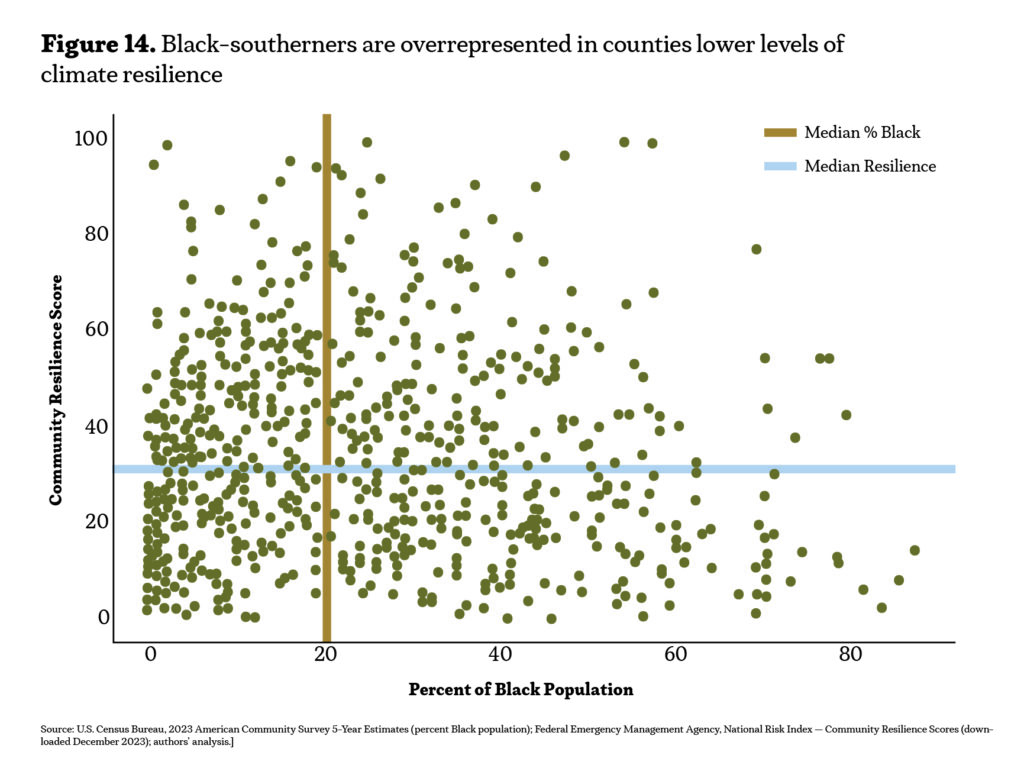
44. Kindred Futures analysis of National Risk Index county-level data, Federal Emergency Management Association (FEMA)
45. Emrich, Christopher T., and Susan L. Cutter. “Social vulnerability to climate-sensitive hazards in the southern United States.” Weather, Climate, and Society 3, no. 3 (2011): 193-208.
46. Ferreira, Regardt J., Clare Cannon, Fred Buttell, and T M Davidson, 2023. “Explaining disaster and pandemic preparedness at the nexus of personal resilience and social vulnerability: an exploratory study”, Disaster Medicine and Public Health Preparedness, 17. https://doi.org/10.1017/dmp.2023.78
47. Howell, Junia, and James R. Elliott. “Damages done: The longitudinal impacts of natural hazards on wealth inequality in the United States.” Social problems 66, no. 3 (2019): 448-467.
48. Sabree, Rahkim. “How ‘The Black Tax’ Affects Intergenerational Wealth Transfer.” Forbes. Accessed April 6, 2025. https://www.forbes.com/sites/rahkimsabree/2023/04/08/how-the-black-tax-affects-intergenerational-wealth-transfer/.
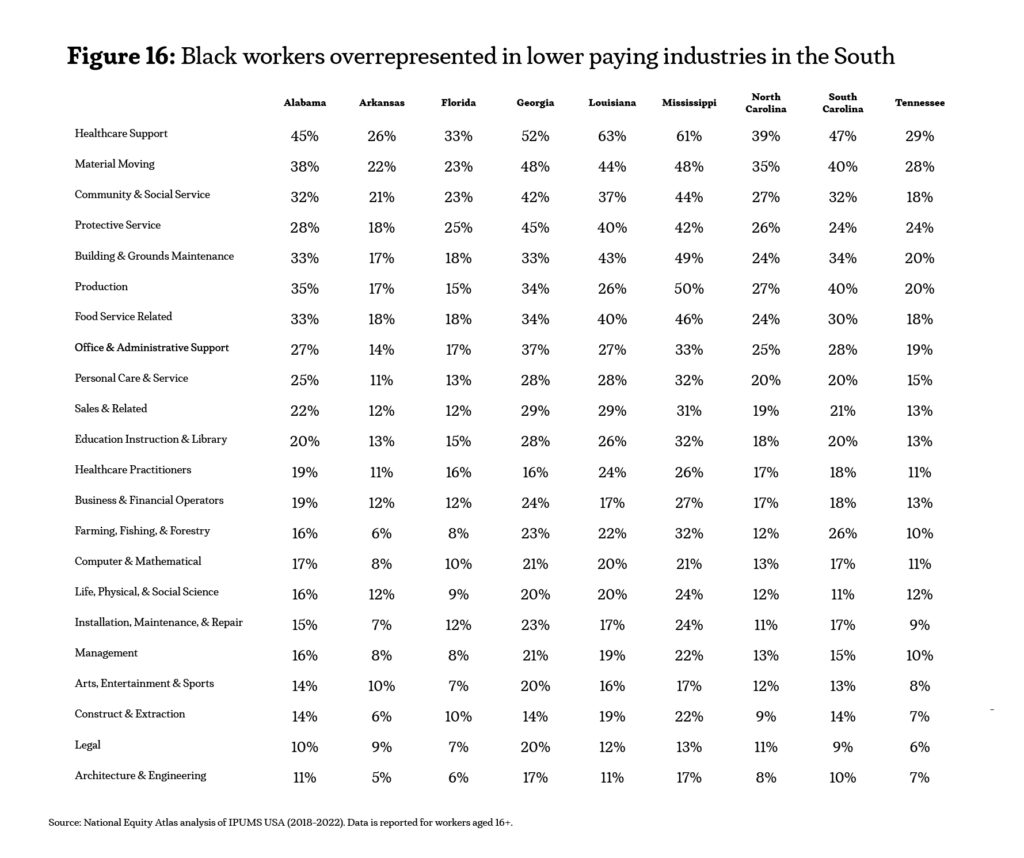
49. Kindred Futures analysis of data provided by The Data Center
50. Dill, Janette, and Mignon Duffy. “Structural Racism And Black Women’s Employment In The US Health Care Sector: Study examines structural racism and black women’s employment in the US health care sector.” Health Affairs 41, no. 2 (2022): 265-272.
51. Stelzner, Mark, and Kate Bahn. “Discrimination and monopsony power.” The Review of Black Political Economy 49, no. 2 (2022): 152-174.
52. Couch, Kenneth A., and Robert Fairlie. “Last hired, first fired? Black-white unemployment and the business cycle.” Demography 47, no. 1 (2010): 227-247.
53. Nowotny, Kathryn M., and Anastasiia Kuptsevych‐Timmer. “Health and justice: framing incarceration as a social determinant of health for Black men in the United States.” Sociology Compass 12, no. 3 (2018): e12566.
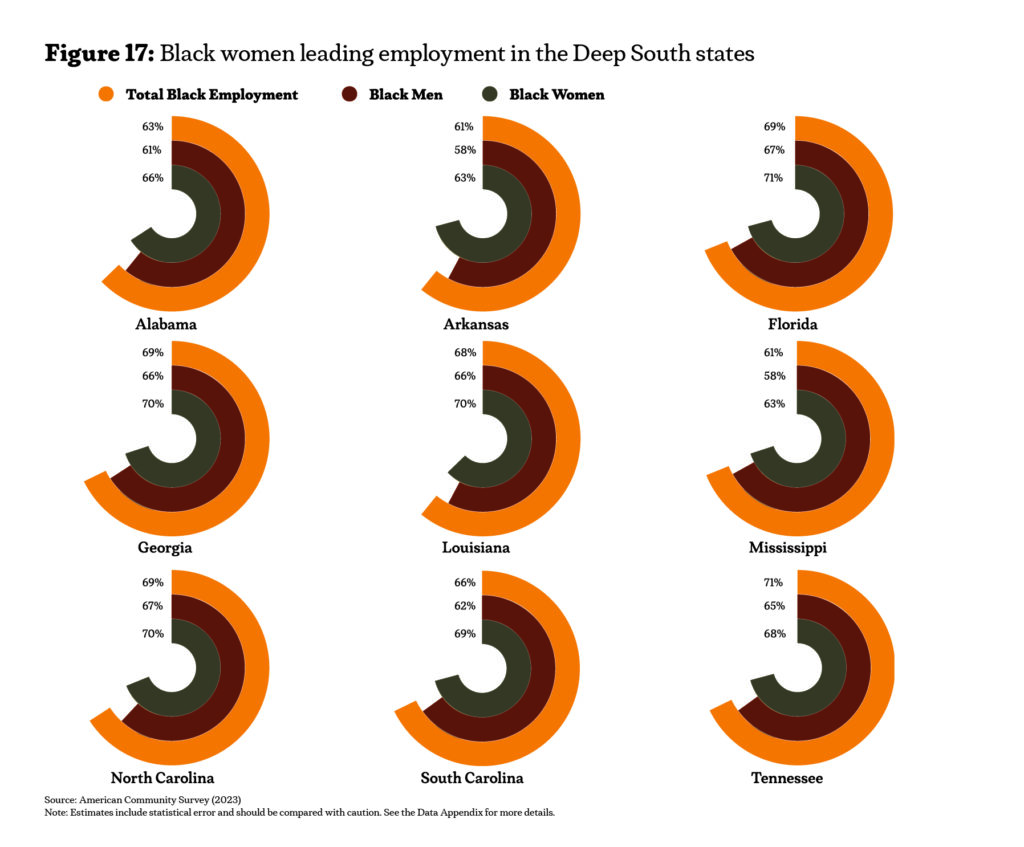
54. Kindred Futures analysis of data provided by The Data Center
55. Ibid.
56. Brookings. “Black-Owned Businesses in U.S. Cities: The Challenges, Solutions, and Opportunities for Prosperity.” Accessed April 6, 2025. https://www.brookings.edu/articles/black-owned-businesses-in-u-s-cities-the-challenges-solutions-and-opportunities-for-prosperity/.
57. Aram. “Venture Capital Diversity: The Non-Obvious Solution,” April 3, 2023. https://thevcfactory.com/venture-capital-diversity-the-non-obvious-solution/.
58. Yang, Tiantian and Olenka Kacperczyk, 2023. “The racial gap in entrepreneurship and opportunities inside established firms”, Strategic Management Journal(4), 45:745-774. https://doi.org/10.1002/smj.3565
59. Theogene, Edwith, and Christian E. Weller. “Baby Bonds: A Worthwhile Step to Reduce the Racial Wealth Gap.” Center for American Progress, February 20, 2025. https://www.americanprogress.org/article/baby-bonds-a-worthwhile-step-to-reduce-the-racial-wealth-gap/.
60. Quint, Colleen J., and Margaret M. Clancy. “My Alfond Grant CDA: Experience From 10 Years of Automatic Deposits for All Maine Newborns.” (2023)
61. Economic Policy Institute. “Raising the Federal Minimum Wage to $15 by 2025 Would Lift the Pay of 32 Million Workers: A Demographic Breakdown of Affected Workers and the Impact on Poverty, Wages, and Inequality.” Accessed April 6, 2025. https://www.epi.org/publication/raising-the-federal-minimum-wage-to-15-by-2025-would-lift-the-pay-of-32-million-workers/.
62. Madland, David, Christian E. Weller, and Alex Rowell. “Unions Continue To Build Wealth for All Americans.” Center for American Progress, March 20, 2024. Accessed April 6, 2025.
63. David Madland, Christian E. Weller, and Sachin Shiva, Unions Continue To Build Wealth for All Americans (Washington, DC: Center for American Progress, March 20, 2024), https://www.americanprogress.org/article/unions-continue-to-build-wealth-for-all-americans/.
64. Welburn, Jonathan W., Pedro Nascimento de Lima, Krishna B. Kumar, Osonde A. Osoba, and Jonathan Lamb. “Overcoming Compound Racial Inequity: Policies and Costs for Closing the Black-White Wealth Gap.” RAND Corporation, December 7, 2022. https://www.rand.org/pubs/research_reports/RRA1259-2.html.