Building A Beloved Economy: References

1 Allums, C. A., Markley, S. N., & Hafley, T. J. (2022). “A better place to be”? Black Mecca, White democracy, and the contradictions of neoliberal cityhood in Atlanta’s Black suburbs. Journal of Urban Affairs, 44(6), 793-807.

2 Jackson, Dylan. “Atlanta Has the Highest Income Inequality in the Nation, Census Data Shows.” The Atlanta Journal-Constitution, Nov 28, 2022, sec. Investigations.

3 Price, Anne. “Don’t Fixate on the Racial Wealth Gap: Focus on Undoing Its Root Causes.” Insight Center (blog), February 5, 2020. https://insightcced.org/dont-fixate-on-the-racial-wealth-gap-focus-on-undoing-its-root-causes/.

4 AWBI analysis of American Community Survey data, 2017-2021 5-year estimates

5 AWBI analysis of “Financial Health and Wealth Dashboard.” Urban Institute, October 6, 2022. https://urbn.is/ 3DKam1u.

6 Ibid.

7 Asante-Muhammad, Dedrick, Chuck Collins, Josh Hoxie, and Emanuel Nieves. “The Road to Zero Wealth: How the Racial Wealth Divide Is Hollowing out America’s Middle Class.” Report. Prosperity Now, Institute for Policy Studies, September 1, 2017. United States of America. https://apo.org.au/node/220721.

8 A. Darity, William, and Kirsten A. Mullen. From Here to Equality, Second Edition: Reparations for Black Americans in the Twenty-First Century. UNC Press Books, 2022.

9 “War in Our Backyards.” Accessed October 6, 2023. https://battleofatlanta.ajc.com/part1.html.

10 Atlanta History Center. “A City Enslaved | The Color-Line: The Problem of the Centuries | Exhibitions.” Accessed October 6, 2023. https://www.atlantahistorycenter.com/exhibitions/the-color-line-the-problem-of-the-centuries/a- city-enslaved/.

11 Camardelle, Alex. “Telling the Unvarnished Truth About Georgia.” Georgia Budget and Policy Institute (blog), February 26, 2020. https://gbpi.org/telling-the-unvarnished-truth-about-georgia/.

12 Godshalk, David Fort. Veiled visions: The 1906 Atlanta race riot and the reshaping of American race relations. Univ of North Carolina Press, 2006.

13 Hobson, Maurice J. The legend of the Black mecca: Politics and class in the making of modern Atlanta. UNC Press Books, 2017.

14 Ibid.

15 Williams, Janelle, and Sarah Torian. “Changing the Odds.” The Annie E. Casey Foundation, June 24, 2015. https://www.aecf.org/resources/changing-the-odds.

16 Toone, Stephanie. “Forbes: These Are the Top Cities Where African-Americans Are Doing the Best Economically.” The Atlanta Journal-Constitution, January 2020. https://www.ajc.com/news/the-cities-where-african- americans-are-doing-the-best

17 Frey, William. “A 2020 Census Portrait of America’s Largest Metro Areas: Population growth, diversity, segregation, and youth.” (2022): 1.

18 “Advancing Collective Prosperity through Entrepreneurship in Atlanta | Prosperity Now,” January 23, 2018. https://prosperitynow.org/resources/advancing-collective-prosperity-through-entrepreneurship-atlanta.

19 AWBI analysis of American Community Survey data, U.S. Census Bureau

20 AWBI analysis of “Prosperity Now Scorecard.” Prosperity Now, October 6, 2023.

21 Ibid.

22 AWBI analysis of “Metro Atlanta Speaks survey.” Atlanta Regional Commission, October 6, 2023. https:// 33n.atlantaregional.com/mas

23 AWBI analysis of American Community Survey data, U.S. Census Bureau

24 Ibid.

25 Thompson, Jeffrey P., and Gustavo Suarez. “Accounting for racial wealth disparities in the United States.” (2019).

26 Aladangady, Aditya, and Akila Forde. “Wealth Inequality and the Racial Wealth Gap,” October 22, 2021. https:// www.federalreserve.gov/econres/notes/feds-notes/wealth-inequality-and-the-racial-wealth-gap-20211022.html.

27 Leonhardt, David. “In Climbing Income Ladder, Location Matters.” The New York Times, July 22, 2013, sec. U.S.  https://www.nytimes.com/2013/07/22/business/in-climbing-income-ladder-location-matters.html.

28 AWBI analysis of American Community Survey data, US Census Bureau

29 Brookings. “Long Shadows: The Black-White Gap in Multigenerational Poverty.” Accessed October 6, 2023. https://www.brookings.edu/articles/long-shadows-the-black-white-gap-in-multigenerational-poverty/.

30 Sullivan, Laura, Tatjana Meschede, Lars Dietrich, and Thomas Shapiro. “The racial wealth gap.” Institue for Assests and Social Policy, Brandeis University. Demos (2015).

31 Hicks, Natasha, Fenaba Addo, Anne Price, and William Darity Jr. “Still Running Up the Down Escalator: How Narratives Shape our Understanding of Racial Wealth Inequality.” Samuel DuBois Cook Center on Social Equity (2021).

32 AWBI analysis of American Community Survey data, U.S. Census Bureau

33 AWBI analysis of American Community Survey data, U.S. Census Bureau

34 Aliprantis, Dionissi, and Daniel R. Carroll. “What is behind the persistence of the racial wealth gap?.” Economic Commentary 2019-03 (2019).

35  Demos. “The Racial Wealth Gap: Why Policy Matters.” Accessed October 27, 2023. https://www.demos.org/research/racial-wealth-gap-why-policy-matters.

36 Hicks, Natasha, Fenaba Addo, Anne Price, and William Darity Jr. “Still Running Up the Down Escalator: How Narratives Shape our Understanding of Racial Wealth Inequality.” Samuel DuBois Cook Center on Social Equity (2021).

37 Ibid.

38 Wright, Will. “Atlanta Migration Patterns: A Closer Look (Pt. 2).” 33n (blog), February 2, 2023. https:// 33n.atlantaregional.com/regional-snapshot/atlanta-migration-patterns-a-closer-look-pt-2.

39 AWBI analysis of American Community Survey data, U.S. Census Bureau

40 Hamil-Luker, Jenifer, and Angela M. O’Rand. “Black/White Differences in the Relationship between Debt and Risk of Heart Attack across Cohorts.” SSM – Population Health 22 (February 25, 2023): 101373. https://doi.org/ 10.1016/j.ssmph.2023.101373.

41 Stewart III, Shelley et al. “The Economic State of Black America: What Is and What Could Be | McKinsey.” Accessed October 6, 2023. https://www.mckinsey.com/featured-insights/diversity-and-inclusion/the-economic-state- of-Black-america-what-is-and-what-could-be#/.

42 AWBI analysis of “Financial Health and Wealth Dashboard.” Urban Institute, October 6, 2022. https://urbn.is/ 3DKam1u.

43 “The Complex Story of American Debt,” July 29, 2015. http://bit.ly/1DJ4xbL.

44 AWBI analysis of “Financial Health and Wealth Dashboard.” Urban Institute. October 6, 2023.

45 Berliner, Benjamin. “The Burden of Debt on Mental and Physical Health.” The Aspen Institute, August 2, 2018. https://www.aspeninstitute.org/blog-posts/hidden-costs-of-consumer-debt/.

46 Hamil-Luker, Jenifer, and M. O. Angela. “Black/white differences in the relationship between debt and risk of heart attack across cohorts.” SSM-population health 22 (2023): 101373.

47 Jackson, Victoria, and Jalil B. Mustaffa. “Student Debt Is Harming the Mental Health of Black Borrowers.” Education Trust (2022).

48 Center, Student Borrower Protection. “The South Has Something to Say: Atlanta.” Student Borrower Protection Center Research Paper (2023).

49 Ibid.

50 McNamara –, John. “Debt Collectors Re-Evaluate Medical Debt Furnishing in Light of Data Integrity Issues.”Consumer Financial Protection Bureau, February 14, 2023. https://www.consumerfinance.gov/about-us/blog/debt- collectors-re-evaluate-medical-debt-furnishing-in-light-of-data-integrity-issues/.

51 AWBI analysis of “Financial Health and Wealth Dashboard.” Urban Institute. October 6, 2023.

52 A Survey of Georgia Residents: State of the State”. The Southern Economic Advancement Project. June, 2022

53 Wiltshire, Jacqueline C., Keith Elder, Catarina Kiefe, and Jeroan J. Allison. “Medical Debt and Related Financial Consequences Among Older African American and White Adults.” American Journal of Public Health 106, no. 6 (June 2016): 1086–91. https://doi.org/10.2105/AJPH.2016.303137.

54 AWBI analysis of American Community Survey data

55 AWBI analysis of “Financial Health and Wealth Dashboard.” Urban Institute. October 6, 2023.

56 Ruetschlin, Catherine, and Dedrick Asante-Muhammad. “The challenge of credit card debt for the African American middle class.” (2013).

57 U.S. Census Bureau. “COVID-19 Pandemic Hit Black Households Harder Than White Households, Even When Pre-Pandemic Socio-Economic Disparities Are Taken Into Account.” Census.gov. Accessed October 6, 2023. https:// www.census.gov/library/stories/2021/07/how-pandemic-affected-black-and-white-households.html.

58 Rice, Lisa, and Deidre Swesnik. “Discriminatory effects of credit scoring on communities of color.” Suffolk UL Rev. 46 (2013): 935.

59 Ratcliffe, Caroline, and Steven Brown. “Credit scores perpetuate racial disparities, even in America’s most prosperous cities.” Urban Wire-the Blog of the Urban Institute (2017).

60 Ibid.

61 Brevoort, Kenneth P., Jasper Clarkberg, Michelle Kambara, and Benjamin Litwin. “The geography of credit invisibility.” Consumer Financial Protection Bureau Office of Research Reports Series 18-6 (2018).

62 Ibid.

63 Todd, Tim, and Esther L. George. Let Us Put Our Money Together: The Founding of America’s First Black Banks. Public Affairs Department of the Federal Reserve Bank of Kansas City, 2019.

64 Ibid.

65 Ibid. pp. 106

66 Lewis, Willard. “Citizens Trust Bank.” New Georgia Encyclopedia, lab modified Od 30, 2021. heps:// www.georgiaencyclopedia.org/arVcles/business-economy/ciVzens-trub-bank/

67 Toussaint-Comeau, Maude, and Robin Newberger. “Minority-owned banks and their primary local market areas.” Economic Perspectives 4, no. 4 (2017): 1-31.

68 AWBI analysis of “FDIC lists of Minority Depository Institutions (MDIs) Second Quarter 2023.” FDIC. October 20, 2023

69 Mattos, Trevor, and Matthew Brewster. “The Color of the Capital Gap.” Boston Indicators, 2021. https:// www.bostonindicators.org/reports/report-detail-pages/color-of-the-capital-gap.

70 Ibid.

71 Board of Governors of the Federal Reserve System. “The Community Reinvestment Act.” Accessed October 7, 2023. https://www.federalreserve.gov/newsevents/testimony/braunstein20080213a.htm.

72 Blower, Brad, Josh Silver, Jason Richardson, Glenn Schlactus, and Sacha Markano-Stark. “Adding Robust Consideration of Race to Community Reinvestment Act Regulations: An Essential and Constitutional Proposal – NCRC.” National Community Reinvestment Coalition, 2021. https://ncrc.org/adding-robust-consideration-of-race- to-community-reinvestment-act-regulations-an-essential-and-constitutional-proposal/.

73 Haspel, Moshe. “The Decline of Bank Branches and the Rise of Atlanta Banking Deserts.” 33n (blog), September 8, 2023. https://33n.atlantaregional.com/data-diversions/the-decline-of-bank-branches-and-the-rise-of-atlanta- banking-deserts.

74 “CDFI Certification | Community Development Financial Institutions Fund.” Accessed Odober 13, 2023. heps:// www.cdfifund.gov/programs-training/cerVficaVon/cdfi.

75 Fund, Reinvebment. “A Conversaton with Georgia’s Community Development Financial Institutions (CDFI): CDFIs Are Quietly Multiplying in Georgia, Creating a Wealth of Opportunity.” SaportaReport, Odober 13, 2022. hep:// saportareport.com/a-conversation-with-georgias-community-development-financial-institutions-cdfi-cdfis-are- quietly-multiplying-in-georgia-creating-a-wealth-of-opportunity/thought-leadership/reinvestment-fund/.

76 AWBI analysis of “Prosperity Now Scorecard.” Prosperity Now. October 7, 2023

77 Bot Populi. “How Fintech Became the Gateway to Predatory Lending in Sub-Saharan Africa.” Accessed October 7, 2023. https://botpopuli.net/?post_type=post&p=7278.

78 AWBI analysis of data from the FDIC National Survey of Unbanked and Underbanked Households

79 Darity Jr, William, Darrick Hamilton, Mark Paul, Alan Aja, Anne Price, Antonio Moore, and Caterina Chiopris.“What we get wrong about closing the racial wealth gap.” Samuel DuBois Cook Center on Social Equity and Insight Center for Community Economic Development 1, no. 1 (2018): 1-67.

80 Holloway, Steven R., and Elvin K. Wyly. “” The Color of Money” Expanded: Geographically Contingent Mortgage Lending in Atlanta.” Journal of Housing Research (2001): 55-90.

81 Dreier, Peter. “Redlining cities: How banks color community development.” Challenge 34, no. 6 (1991): 15-23.

82 Holloway, Steven R., and Elvin K. Wyly. “” The Color of Money” Expanded: Geographically Contingent Mortgage Lending in Atlanta.” Journal of Housing Research (2001): 55-90.

83 U.S. Department of Housing and Urban Development (HUD). “History of Fair Housing – HUD.” Accessed October 7, 2023. https://www.hud.gov/program_offices/fair_housing_equal_opp/aboutfheo/history.

84 Ibid.

85 “Civil Rights Division | Housing And Civil Enforcement Cases Documents,” August 6, 2015. https:// www.justice.gov/crt/housing-and-civil-enforcement-cases-documents-485.

86 “More Americans Own Their Homes, but Black-White Homeownership Rate Gap Is Biggest in a Decade, NAR Report Finds,” March 2, 2023. https://www.nar.realtor/newsroom/more-americans-own-their-homes-but-black- white-homeownership-rate-gap-is-biggest-in-a-decade-nar.

87 Rothwell, Johnathan, and Andre Perry. “How Racial Bias in Appraisals Affects the Devaluation of Homes in Majority-Black Neighborhoods.” Brookings. Accessed October 12, 2023. https://www.brookings.edu/articles/how-racial-bias-in-appraisals-affects-the-devaluation-of-homes-in-majority-black-neighborhoods/.

88 Home Mortgage Disclosure Act (HMDA) data, accessed via DataNexus

89 Tracking Homeownership Wealth Gaps.” Accessed October 13, 2023. https://urbn.is/2YQ33Dz.

90 Perry, Andre. “The devaluation of assets in black neighborhoods: How racism robs homeowner of the American Dream.” (2019).

91 Ibid.

92 Du Bois, William Edward Burghardt, ed. The Negro in business: report of a social study made under the direction of Atlanta University, together with the proceedings of the fourth Conference for the Study of the Negro Problems, held at Atlanta University, May 30-31, 1899. No. 4. Atlanta University, 1899.

93 Atlanta History Center. “Sweet Auburn | Atlanta in 50 Objects | Exhibitions.” Accessed October 7, 2023. https:// www.atlantahistorycenter.com/exhibitions/atlanta-in-50-objects/sweet-auburn/.

94 Ibid.

95 Youngblood, Mtamanika. “The Historic District Development Corporation and the Challenge of Urban Revitalization.” In Planning Atlanta, pp. 40-48. Routledge, 2017.

96 Bates, Timothy. “CONTESTED TERRAIN: The Role of Preferential Policies in Opening Government and Corporate Procurement Markets to Blaq-Owned Businesses.” Du Bois Review: Social Science Research on Race 12, no. 1 (2015): 137–59. doi:10.1017/S1742058X14000289.

97 Levy, Jessica Ann. “Selling Atlanta: Black Mayoral Politics from Protest to Entrepreneurism, 1973 to 1990.” Journal of Urban History 41, no. 3 (May 2015): 420–43. https://doi.org/10.1177/0096144214566953.

98 City of Atlanta, City Auditor’s Office. “Office of Contract Compliance – June 2021.” Accessed October 12, 2023. http://www.atlaudit.org/office-of-contract-compliance—june-2021.html.

99 AWBI analysis of Annual Business Survey data, U.S. Census Bureau

100 Meyer, Bruce D. “Why are there so few black entrepreneurs?.” (1990).

101 Wiersch., Ann Marie, and Lucas Misera. “2022 Report on Firms Owned by People of Color Based on the Small Business Credit Survey.” Small Business Credit Survey Federal Reserve Banks, no. 20220629 (June 29, 2022). heps://doi.org/10.55350/sbcs-20220629.

102 Corcoran, Emily Wavering, Jordan Manes, Lucas Misera, and Ann Marie Wiersch. “2023 Report on Employer Firms: Findings from the 2022 Small Business Credit Survey.” Small Business Credit Survey Publications, no. 20220308 (March 8, 2022). https://doi.org/10.55350/sbcs-20230308.

103 Lincoln Quillian, Devah Pager, Ole Hexel, and Arnfinn H. Midtbøen, “Meta-analysis of Field Experiments Shows No Change in Racial Discrimination in Hiring Over Time,” Proceedings of the National Academy of Sciences 114 (41) (2017): 10870-875.

104 Devah Pager, Bruce Western, and Naomi Sugie, “Sequencing Disadvantage: Barriers to Employment Facing Young Black and White Men with Criminal Records,” The Annals of the American Academy of Political and Social Science 623 (1) (2009): 195-213.

105 Maryam Jameel and Joe Yerardi, “Workplace Discrimination is Illegal. But Our Data Shows it’s Still a Huge Problem,” Vox, February, 2019.

106 Hicks, Natasha, Fenaba Addo, Anne Price, and William Darity Jr. “Still Running Up the Down Escalator: How Narratives Shape our Understanding of Racial Wealth Inequality.” Samuel DuBois Cook Center on Social Equity (2021).

107 Torian, S., West, A., & Williams, J. (2019). Changing the Odds: Progress and Promise in Atlanta. Annie E. Casey Foundation.

108 AWBI Analysis of American Community Survey data, U.S. Census Bureau

109 Schneider, Daniel, and Kristin Turney. “Incarceration and black–white inequality in homeownership: A state- level analysis.” Social Science Research 53 (2015): 403-414.

110 “Mass Incarceration.” Atlanta, Georgia: Southern Center for Human Rights, 2023. https://www.schr.org/mass-incarceration/#:~:text=With%20one%20out%20of%20every,second%2Dhighest%20correctional%20control%20rate.

111 National Equity Atlas.  At What Cost? Examining Police, Sheriff, and Jail Budgets Across the US (dashboard). Accessed at: https://nationalequityatlas.org/us-carceral-spending/dashboard

112 Booker, Meredith. “The wealth of incarcerated versus non-incarcerated men over a lifetime, visualized”. Prison Policy Initiative (2016). Accessed at: https://www.prisonpolicy.org/blog/2016/04/26/wealth/#:~:text=Previous%20research%20in%20Black%20Wealth,men%20who%20never%20experienced%20incarceration.

113 Zaw, Khaing, Darrick Hamilton, and William Darity. “Race, wealth and incarceration: Results from the National Longitudinal Survey of Youth.” Race and Social Problems 8 (2016): 103-115.

114 Maroto, Michelle, and Bryan L. Sykes. “The varying effects of incarceration, conviction, and arrest on wealth outcomes among young adults.” Social Problems 67, no. 4 (2020): 698-718.

115 Policing Alternatives & Diversion Initiative. “Jail Population Review Committee.” Accessed October 26, 2023. https://www.atlantapad.org/jail-population-review.

116 Atlanta History Center. “Students and Strategy | The Color-Line: The Problem of the Centuries | Exhibitions.”Accessed October 7, 2023. https://www.atlantahistorycenter.com/exhibitions/the-color-line-the-problem-of-the- centuries/students-and-strategy/.

117 Collins, Keith, Ford Fessenden, Lazaro Gamio, Rich Harris, John Keefe, Denise Lu, Eleanor Lutz, AmySchoenfeld Walker, Derek Watkins, and Karen Yourish. “Tight Georgia Race Comes Down to Metro Atlanta.” The New York Times, November 4, 2020, sec. U.S. https://www.nytimes.com/interactive/2020/11/04/us/elections/ georgia-election-results-atlanta.html.

118 Fowler, Stephen, Sam Gringlas, and Huo Jingnan. “A New Georgia Voting Law Reduced Ballot Drop Box Access in Places That Used Them Most.” WABE, July 27, 2022. https://www.wabe.org/a-new-georgia-voting-law-reduced-ballot-drop-box-access-in-places-that-used-them-most/.

119 Derenoncourt, Ellora, Chi Hyun Kim, Moritz Kuhn, and Moritz Schularick. Wealth of two nations: The US racial wealth gap, 1860-2020. No. w30101. National Bureau of Economic Research, 2022.

120 ITEP. “Investment Income and Racial Inequality.” Accessed October 20, 2023. https://itep.org/investment-income-and-racial-inequality/.

121 Derenoncourt, Ellora, Chi Hyun Kim, Moritz Kuhn, and Moritz Schularick. Wealth of two nations: The US racial wealth gap, 1860-2020. No. w30101. National Bureau of Economic Research, 2022.

122 Love, Hanna, and Manann Donoghoe. “The Black-White Wealth Gap Left Black Households More Vulnerable.” Brookings. Accessed October 20, 2023. https://www.brookings.edu/articles/the-black-white-wealth-gap-left-black-households-more-vulnerable/.

123  Oliver, Melvin, L. and Thomas M. Shapiro (2006) Black Wealth/White Wealth, New York: Routledge, pp. 18-252; Brown, Dorothy (2021) The Whiteness of Wealth. New York: Penguin Random House.

124 ITEP. “Georgia: Who Pays? 6th Edition.” Accessed October 20, 2023. https://itep.org/georgia/.

125 Stokes, Stephanie. “Black Neighborhoods Bear the Brunt of Fulton’s Tax Auctions. What Could Change That?” WABE, May 8, 2023. https://www.wabe.org/black-neighborhoods-bear-the-brunt-of-fultons-tax-auctions-what-could-change-that/.

126 Ibid.

127 Howell, Junia, and James R. Elliott. “Damages done: The longitudinal impacts of natural hazards on wealth inequality in the United States.” Social problems 66, no. 3 (2019): 448-467.

128 “CDC/ATSDR Social Vulnerability Index (SVI) | Place and Health | ATSDR,” August 2, 2023. https://www.atsdr.cdc.gov/placeandhealth/svi/interactive_map.html.

129 Kann, Drew, and Meris Lutz. “Heat Risk Is Growing. These Are Atlanta’s Most Vulnerable Neighborhoods.” The Atlanta Journal-Constitution, July 20, 2023, sec. Local News.

130 Data from GreenLink Analytics, GreenLink Equity Map (GEM) 2017

131 “Bank On Atlanta.” Accessed October 8, 2023. https://bankon.atlantaga.gov/.

132 Hudáková, V., Antonides, G., & Haagsma, R. (2015). The impact of a basic income on labor and work performance. Wageningen University of Life Sciences and Research Centre. Work Performance.

133 “Bank On Atlanta.” Accessed October 8, 2023. https://bankon.atlantaga.gov/.

134 WABE. “Georgia Bill to Require Bail for More Crimes Fails to Pass,” March 30, 2023. https://www.wabe.org/georgia-bill-to-require-bail-for-more-crimes-fails-to-pass/.

135 Blasi, Joseph, Douglas Kruse, and Dan Weltmann. “Guest editorial: New research on the impact of COVID-19 on employee-owned firms and the racial wealth gap in the context of the research literature.” Journal of Participation and Employee Ownership 4, no. 2 (2021): 89-91.

136 Boguslaw, J., & Schur, L. (2019). Building the Assets of Low and Moderate Income Workers and their Families.

137 Camardelle, Alex. “Women-Powered Prosperity.” Georgia Budget and Policy Institute (blog), September 10, 2019. https://gbpi.org/women-powered-prosperity-report/.

138 Economic Policy Institute, (2018). Worker rights preemption in the U.S.: A map of the campaign to suppress worker rights in the states. Accessed August 2019. https://www.epi.org/ preemption-map/

139 AWBI analysis of American Community Survey data, 2017-2021 five-year estimates

140 Brookings. “How Equity Isn’t Built into the Infrastructure Bill—and Ways to Fix It.” Accessed October 8, 2023. https://www.brookings.edu/articles/how-equity-isnt-built-into-the-infrastructure-bill-and-ways-to-fix-it/.

141 Darity Jr, William A., and A. Kirsten Mullen. From here to equality: Reparations for Black Americans in the twenty-first century. UNC Press Books, 2022.

142 Guarino, Mark. “Evanston, Ill., leads the country with first reparations program for Black residents.” Washington Post. https://www. washingtonpost. com/national/evanston-illinois-reparations/2021/03/22/6b5a308c-8b2d-11eb-9423-04079921c915_story. html (2021).

143 The King Center. “The King Philosophy – Nonviolence365®.” Accessed October 8, 2023. https://thekingcenter.org/about-tkc/the-king-philosophy/.

Building a Beloved Economy: Recommendations & Conclusion

Recommendations & Conclusion

“We need help on building wealth, we really do. And that’s something that we should have had a long time ago.”

Atlanta’s current economic policies have not supported opportunities for all people to thrive. Amid public health crises and economic and racial injustice, state and local policy tools and budgetary decisions have consistently failed Black Atlantans who bear the brunt of the racial wealth divide. An enduring legacy of racial terror, enslavement, Jim Crow and more continues to permeate Atlanta’s policy agenda. Moreover, the calls to eliminate the considerations of the government and private sector’s role in terrorizing Black and Brown communities and accelerating the racial wealth divide continue to swell. Policymakers must take up a renewed and bold commitment to counteract these efforts by working alongside Black residents to craft data-informed solutions that seek to redress past harms and build Black wealth.

Now is the time to build a beloved economy free from structural racism that promotes opportunities to build Black wealth – an economy that creates the beloved community from which all Atlantans benefit. Policy solutions must consider the role of the structural determinants of Black wealth in influencing outcomes. To that end, we urge local policymakers to focus on the following policy recommendations to create systemic changes that allow for everyone to benefit from closing Atlanta’s racial wealth divide.

  1. Support local efforts to launch a baby bonds program bonds program. A baby bonds program may have the single largest effect on the racial wealth divide.131 Baby bonds are universal, publicly funded child trust accounts that provide significant sums (up to $50,000) for children born into households with the lowest wealth. When recipients reach adulthood, they can use the funds for wealth-building activities such as purchasing a home or starting a small business. A baby bond – paired with a guaranteed income – can stabilize incomes and accelerate wealth building. Baby bonds are designed to be publicly funded, ideally by the federal government. However, the City of Atlanta can support the Georgia Resilience and Opportunity (GRO) Fund’s local effort to launch a pilot program which can inform the development of a full City of Atlanta-funded baby bonds program.
  2. Establish a publicly-funded guaranteed income program. Unrestricted cash helps families transition from poverty to asset creation. Guaranteed income participants spend the money on basic needs and remain attached to the labor force when they are able to do so. Atlanta is home to one of the largest privately-funded guaranteed income programs in the South managed by GRO Fund, offering $850 to Black women for 24 months to enable debt paydown, investing in caregiving, and build a financial cushion for their families. The City should codify guaranteed income, scale the programs, and invest public dollars to make the programs permanent.
  3. Establish community accountability for strict enforcement of the Community Reinvestment Act (CRA). The CRA encourages banks to help meet the credit needs of their local communities, but there is little insight into the enforcement of the CRA at the local level. The City of Atlanta should lead the creation of an oversight board comprised of residents from chronically disinvested neighborhoods. The board can work in close collaboration with the federal Office of the Comptroller of the Currency and it’s regional community outreach officials to ensure the benefits of CRA are materializing in Black communities equitably.
  4. Provide free access to checking accounts at trusted banks. Atlanta operates the Bank On Atlanta program which is designed to connect Atlantans to low-cost banking options.132 However, there is no guarantee that the banking options are free of charge for participants. The City can bolster the program and improve banking outcomes by working with bank partners to establish a pathway to checking and high yield savings accounts for those living in neighborhoods with the highest rates of unbanked and underbanked residents.
  5. Establish a city-led initiative to address predatory lending. Predatory lending is a significant issue for Atlantans. The City should establish a strike force to investigate, respond to, and hold accountable predatory financial services in the city’s Black neighborhoods. City resources should be used to evaluate and address the concentration of predatory actors like expensive check-cashing and title loan shops in majority Black neighborhoods.
  6. Eliminate the use of wealth-based punishment through fines, fees, and cash bail. Eliminate court fines and fees, as they are inequitable and overly punitive to Black households. Atlanta officials should evaluate the use of fines and fees to develop permanent reform proposals that can replace them with adequate revenue generating measures (i.e. scaling back tax incentives to corporations). The same should hold true for the use of cash bail. Although Atlanta sought to end the use of cash bail in 2018 for those incarcerated at the Atlanta City Jail, the Georgia General Assembly passed a law in 2023 that rolled back that progress across the state.133
  7. Increase transparency in procurement outcomes for Black-owned businesses in the City. Atlanta contracts hundreds of millions of dollars a year and a portion of those funds are earmarked for minority business enterprises (MBEs). However, very little public information is available to assess the outcomes of Black-owned businesses in the City’s procurement process.  Atlanta officials should implement innovative race-conscious performance reports to create transparency into the City’s procurement practices and policies. Atlanta officials should also leverage data and investments to strengthen the capacity of Black-owned businesses and business-serving organizations to remove barriers to procurement opportunities within the City.
  8. Strengthen affordable commercial space opportunities in the City. Significant market pressures have impacted affordability for legacy businesses that serve as anchors for the City’s historically Black commercial and cultural corridors. Creating and protecting commercial affordability is a group project. The City of Atlanta should target city-owned properties and abandoned or underutilized infrastructure to create affordable commercial space. The city should also use city-owned properties to develop shared ownership models, which can be leveraged toward the future ownership of the buildings and build collective wealth among Black businesses that occupy the space.
  9. Invest in employee ownership. Workers at employee-owned companies gain access to employee stock ownership plans (ESOPs) that enable families to significantly increase their assets, shrinking—though not eliminating—racial wealth disparities,134 suggesting employee ownership can build Black wealth.135 The city should invest in technical assistance to educate existing businesses on the benefits of employee ownership as well as assist with capital and other tools to help them make the transition. Businesses where Black employees account for more than half of the payroll should be prioritized.
  10. Launch an Atlanta delegation and campaign committed to repealing state preemption. Georgia began preempting the City of Atlanta from key worker protections in 2004 and has since held the record for some of the strictest preemption laws in the country.136 Lawmakers began with banning municipalities from requiring minimum wages in the private sector, along with bans on paid family leave, fair scheduling, rent control, and more.137 Atlanta officials should establish a delegation and campaign focused on repealing state preemption laws.
  11. Use public dollars to hold companies accountable for the creation of asset-building jobs. For the most part, the millions of dollars granted by Atlanta in business tax breaks go unaudited, and very little data is publicly available to assess the community benefits of those breaks. Due to Atlanta’s lack of transparency when it comes to evaluating major subsidy programs, it is unclear how many of the jobs created are paying a meaningful living wage and are permanently created and maintained in Atlanta’s majority Black neighborhoods. Atlanta officials should evaluate local job creation proposals using job quality and racial equity impact assessments. These assessments ensure that careful consideration is given to the quality of jobs being added to a community. It also allows policymakers to address chronic creation of bad jobs in Black neighborhoods.
  12. Prioritize inclusionary zoning regulations with a racial equity lens. Current zoning laws and land use policies are the legacy of prejudiced actors who sought to maintain racial segregation within the city. The creation of single-family homes in affluent white neighborhoods and multifamily homes in predominately Black neighborhoods has eroded housing opportunities for Black Atlantans. Atlanta officials should employ a racial equity lens when addressing zoning laws for the city, particularly for new developments in rapidly gentrifying neighborhoods.
  13. Invest in community land trusts. The innovation of community land trusts (CLTs) offers a viable model for affordable housing in Atlanta, as mortgage rates reach record highs and the barriers to purchasing and maintaining a home become increasingly difficult to overcome. CLTs are nonprofit organizations that lease land to residents in low-income neighborhoods. The CLT owns the land on which the housing is located and residents, who become members of the CLT, can purchase units or homes from the land trust. The separation of the housing structure from the land allows the CLT to keep rates permanently affordable.
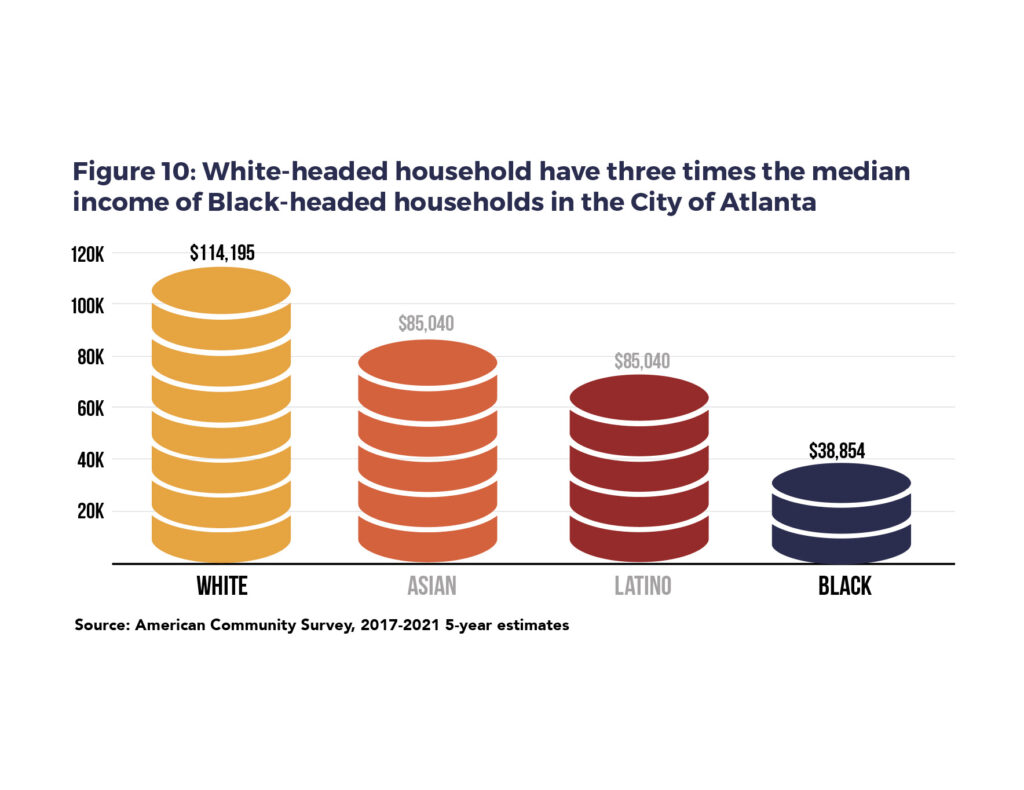
  14. Commit to more deeply affordable housing goals. The City of Atlanta currently defines affordable housing using the national area median income (AMI). The AMI is an insufficient metric for which to compare affordability in the city. In ten years, Atlanta’s AMI increased from $66,300 in 2013 to $103,500 in 2023– a 56 percent increase.138 In contrast, the Black median household income in the City of Atlanta only sits at $38,854 – about $65,000 less than the AMI.139  The stark contrast demonstrates how the use of AMI is an inaccurate reflection of the household income for a significant proportion of the city. Atlanta officials should support more deeply affordable housing units and establish a minimum goal of deeply affordable units attached to all new housing developments that take into account the need using timely data disaggregated by race and ethnicity.
  15. Expand housing affordability strategies to include a complementary approach to promote economic mobility. As housing prices have ballooned over the past few years, wages have been left relatively stagnant. A coordinated economic mobility strategy is critical to help Atlanta’s Black residents that have been locked into low-paying jobs that ultimately make them vulnerable to displacement.
  16. Commit to opportunities for Black-owned businesses in infrastructure spending. As the Infrastructure Investment and Jobs Act’s federal dollars continue to be distributed in Atlanta, much of the work will be contracted out to small, medium-sized, and large businesses. This will be an important opportunity for leaders to follow through on their promises by formalizing and building relationships with the Black businesses that create wealth for these communities.140 However, equity isn’t systematically built into the infrastructure bill; The City of Atlanta will need to develop explicit strategies to drive capital from the legislation to Black-owned firms.    
  17. Codify a commitment to reparations. The City of Atlanta should establish, through local ordinance, a reparations committee to report on the financial cost of enslavement, property theft, discrimination, and segregation among Atlanta’s Black families. While local reparations efforts are encouraged, no municipality can advance a robust reparations agenda without full investment from the federal government.141 However, the City can make a down payment. The goal of the committee should be to determine how the City of Atlanta should pay for the generational wealth losses created by intentional public policies and private actions since the City’s founding. For example, officials can look to Evanston, Illinois, which provides a restorative housing program as a form of reparations to Black families in $25,000 increments funded by a three percent tax on legal recreational marijuana sales.142
  18. Establish the Office of Community Wealth Building. The City of Atlanta should establish a comprehensive data-centered, solutions-based office that provides city resources and services to ensure wealth-building opportunities for Atlanta residents. This go-to resource will serve as the one-stop shop for information and technical assistance for individuals and organizations working to tackle the racial wealth divide with a priority focus on scaling small businesses, employee ownership, worker cooperatives, and shared ownership of land. The office will also promote building household wealth by connecting individuals to community partners that assist residents with navigating complicated tax circumstances, avoiding predatory debt products, and more. Additionally, the office could convene residents and development stakeholders to coordinate city-level community benefit agreements (CBA). Lastly, the office can convene stakeholders to research and pilot innovative wealth building policies.

Conclusion

This report was written to establish a baseline of data, historical insights, and policy recommendations that can help local leaders develop actionable strategies to build Black wealth in Atlanta. If nothing else is taken from this report, let the key learning be that Atlanta’s policies and programs must approach the racial wealth divide using the structural determinants of Black wealth framework. Building the beloved economy requires bold, data-informed and community-led approaches to counteract centuries of harm that have produced the Black wealth outcomes Atlanta grapples with today amid a growing resistance to race-explicit policies.

No single solution will be a catch-all for fixing Atlanta’s widening racial wealth divide. But a bold commitment to addressing Black wealth can set the City on the right path to prosperity for all. Understanding the data and reforming Atlanta policies and budget investments to expand access to wealth-building vehicles can put the City on the right path to help all Black Atlantans achieve greater wealth and freedom.

When Atlanta’s own Dr. Martin Luther King Jr. spoke about the beloved community – “a world in which all people can share in the wealth of the earth”143 – he always acknowledged that making it a reality would require an all-in approach to reform our economic, social, and political systems. This acknowledgement is the inspiration for developing a framework focused on building Black wealth. Taken together, this report, its data, stories, and recommendations serve as a tool that can address the role these converging systems play in limiting opportunities for all Atlantans to thrive. And given its legacy of the racial and economic justice movement, a beautiful tapestry of creative Black brilliance, and an enduring spirit of hope that lives within Black Atlantans, no other city is better positioned to serve as the nation’s model for building the beloved community like Atlanta.

Toward a More Holistic View of Determinants of Wealth 

Toward a More Holistic View
of Determinants of Wealth

It is difficult to fully capture all the ways that Black wealth in Atlanta has been impacted by the structural determinants. But stakeholders committed to building Black wealth should not limit their analysis to typical measures of financial health to understand and rectify past harms that intersect with Black wealth outcomes. For this reason, we extend our focus to other less-discussed determinants of Black wealth: mass incarceration, access to climate resilient communities, a fair tax code, and a free democracy.

Freedom from Mass Incarceration and Overpolicing

The history of policing and incarceration is inextricably linked to today’s wealth outcomes. The combined effects of mass incarceration permeate the lives of people directly subjected to interactions with law enforcement and imprisonment, and ripples throughout the lives of their friends, family members, and entire communities. Contact with the mass incarceration system severely limits wealth building opportunities. For example, states with high incarceration rates are associated with fewer Black homeownership rates,109 which increases the racial wealth divide. This is important to consider for Atlantans who just so happen to live in a state that has the highest rate of carceral control in the country.110

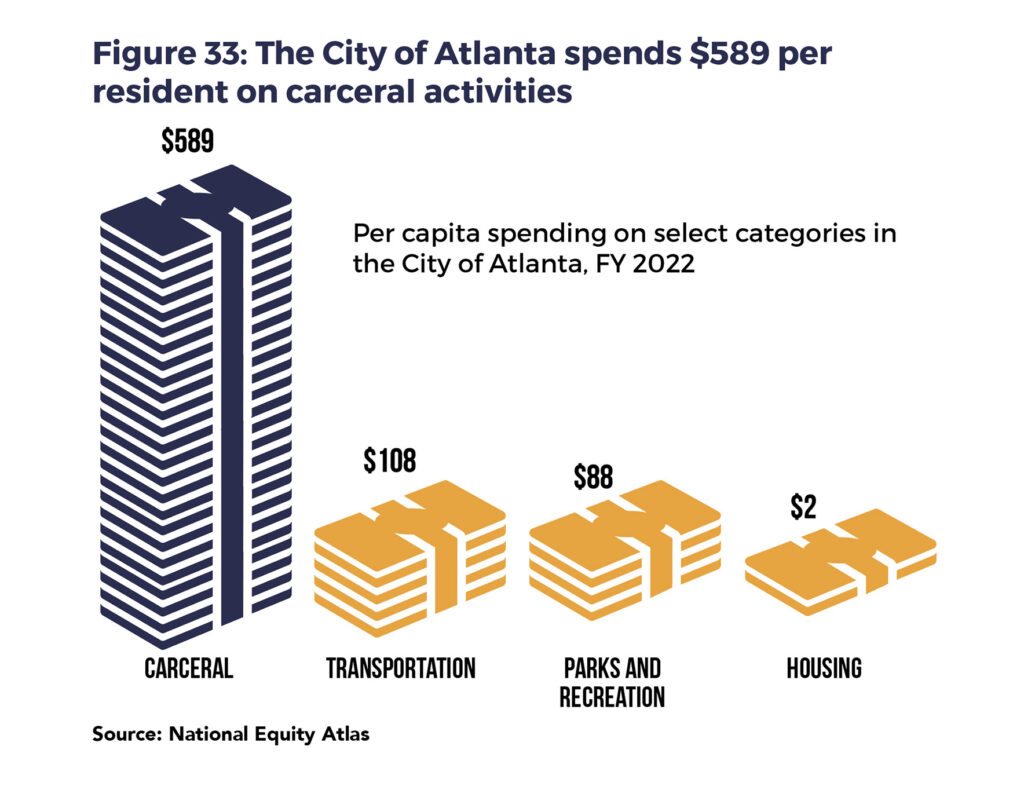
The physical, mental, and social costs of contact with the criminal legal system is significant in Atlanta’s Black communities, but so is the financial cost. In 2022, the City of Atlanta spent $292.3 million on carceral activities – about $589 per resident – which includes spending on corrections and community services, police, and the citizens review board. The total spent on carceral systems represents roughly 14 percent of the city’s budget.111

Racial discrimination in the criminal legal system compounds poor wealth outcomes that Black Atlantans already face while reinforcing racial wealth inequality. For instance, the median wealth of formerly incarcerated white adults is higher than the median wealth of Black adults who had never been incarcerated before.112 The disproportionate lack of wealth means Black residents have fewer resources available to navigate the system with high-quality lawyers and investigators and post bond for timely release from jail.

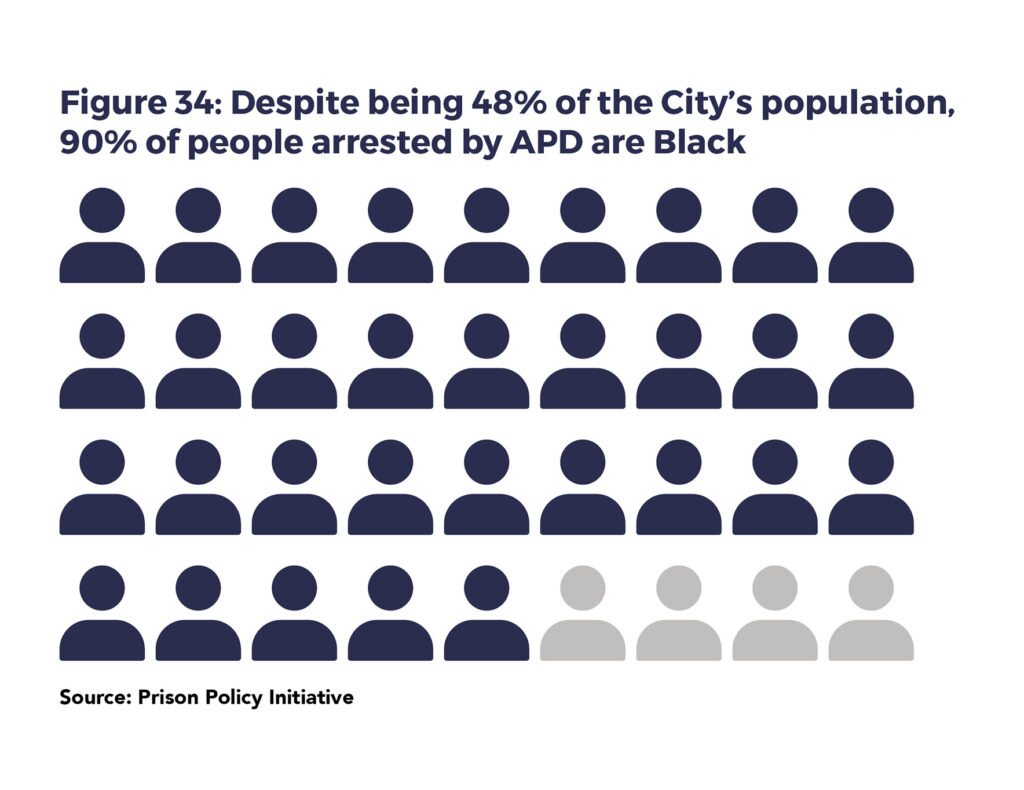
Arrests and convictions have a sharp impact on wealth building prospects for Black households. In recent research, arrests were found to matter most for wealth outcomes. Even arrests without conviction is associated with wealth declines – wealth is reduced to little or nothing while in jail or prison.113 Attention to the relationship between arrests and Black Atlantans is critical given the reality that Black people account for an egregious 90 percent of all arrests made by the Atlanta Police Department, despite making up just 48 percent of the city’s population.

Due to oppressive public policies, overpolicing, and an excessive use of incarceration, the relationship between wealth and arrests in Atlanta is clear. In 2022, a study found that a third of people incarcerated in Fulton County Jail were there because they couldn’t pay a bond of $15,000 or less. The study reported that one individual spent nearly 500 days in jail because he couldn’t afford his freedom.114 

The high number of arrests is associated with increased fines and fees imposed on Black communities, which can drive Black households deeper into debt and reverse or completely eliminate opportunities to build wealth altogether. Despite fines, fees, and cash bail systems being rooted in systems of control that emerged from enslavement, the City of Atlanta continues to enforce these policies disproportionately among Black residents, actively contributing to the city’s massive racial wealth divide. To that end, addressing the mass incarceration and overpolicing of Black Atlantans is a key community wealth building strategy.

Freedom to Participate in Democracy

Wealth inequality and financial insecurity has as much an effect on suppressing democracy as draconian poll taxes, poll closings, and voter ID laws. Atlanta’s stubborn racial wealth divide presents a loss of a lever of power for Black communities to remove barriers to building wealth by electing leaders or holding incumbents accountable to address their specific needs and improve their access to opportunity.

As the cradle of the Civil Rights Movement, Atlanta has long been in the voting rights spotlight as a result of a notable history of organizing, Black political power, and advances in voting rights. Atlanta’s contributions to the national movements that led to the passage of the Civil Rights Act of 1964 and Voting Rights Act of 1965 cannot be understated. For example, both reforms were driven in large part by the organizing of the Atlanta Student Movement.115 Atlanta played a critical role in securing the rights of Black Americans and improving the state of democracy in the United States.

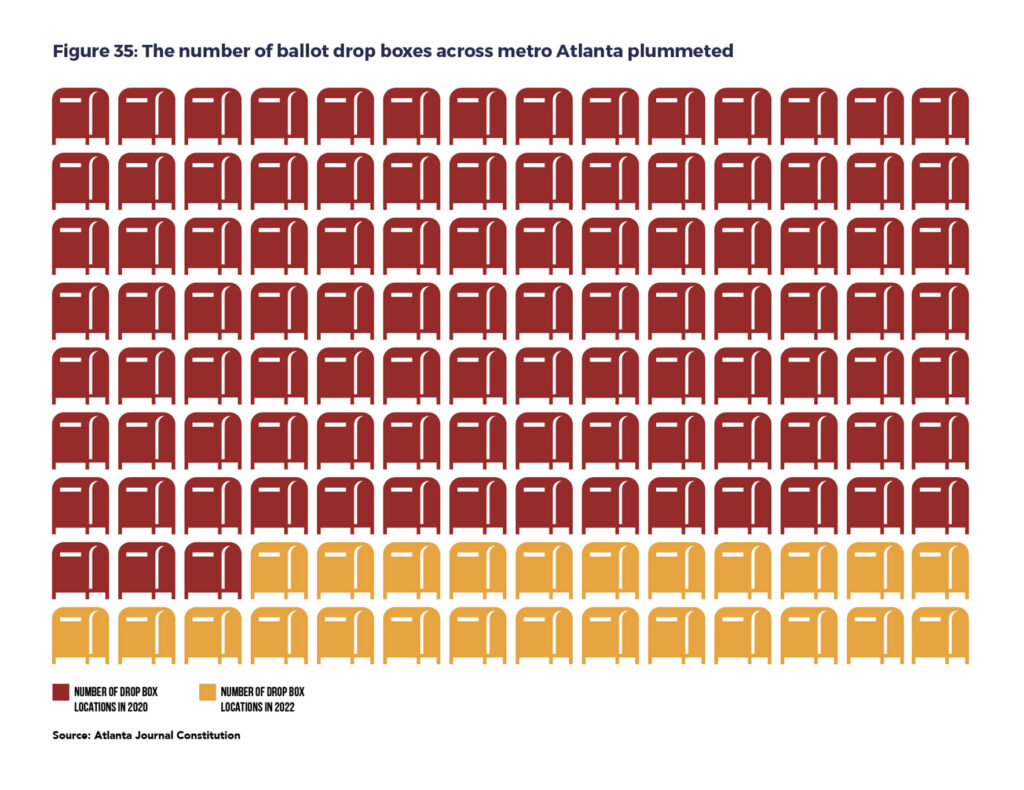
Today Atlanta is at a crossroads when it comes to voting rights in the 21st century. Recent historic elections have shone a bright light on the City of Atlanta and Fulton County, which played an outsized role in ensuring a changing political regime in the 2020 presidential and senate elections.116 In response to this, efforts to limit the voting power of Black Atlantans and other Black residents across the South were launched in the form of racially biased voter suppression tactics, such as improper voter purges and the closing of polling locations in Black neighborhoods. For example, state lawmakers passed a law in 2021 that reduced the availability of voting drop boxes in Black communities across Greater Atlanta from 107 to just 25.117

It is not a coincidence that Atlanta’s wealth and income inequality has grown as democracy has become increasingly exclusionary. In order to build Black wealth, Atlanta must prioritize full democratic participation in processes that determine economic outcomes in across the city.

Capital Gains, Inheritances, and Tax Advantages

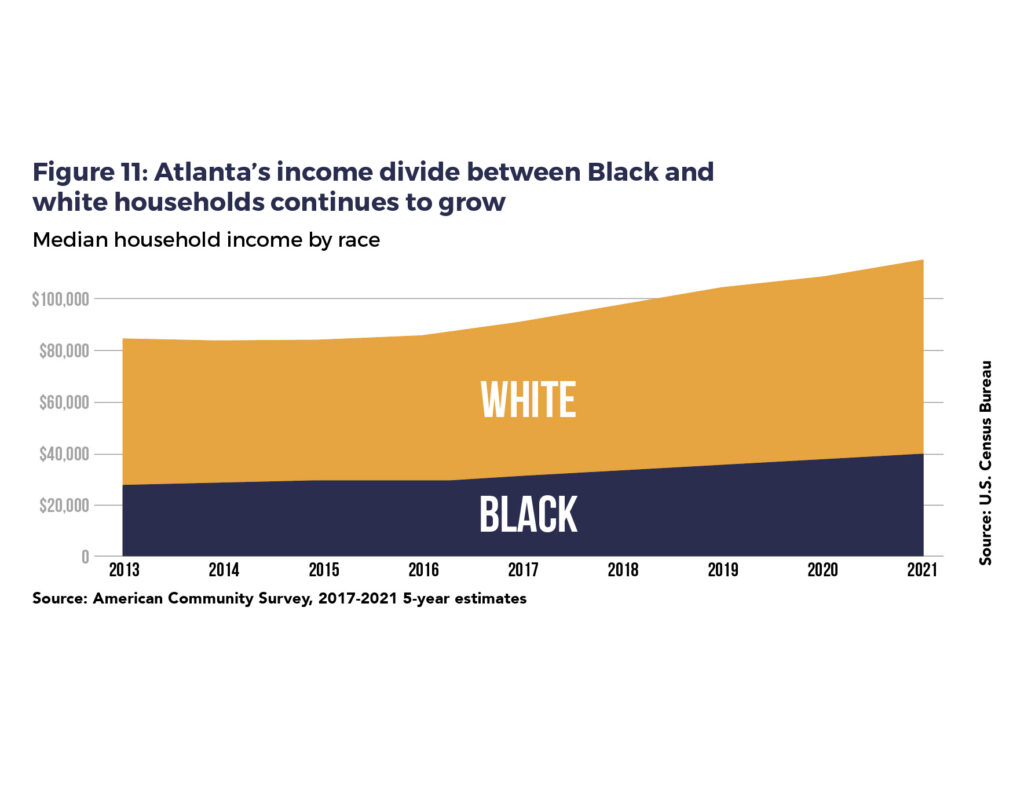
Since the 1980s, the racial wealth divide has widened as capital gains have predominantly benefited white households.118 While the national Black-white income gap has narrowed over time, differences in Black and white Americans’ capital gains rates throughout history have accelerated the chasm between Black and white wealth, resulting in an enduring wealth divide that shows no sign of resolving. Meanwhile, the City of Atlanta’s income divide continues to grow, offsetting any possibility of Black households to reap the benefits of capital gains at a rate similar to that of white households.

Wealth Transfers

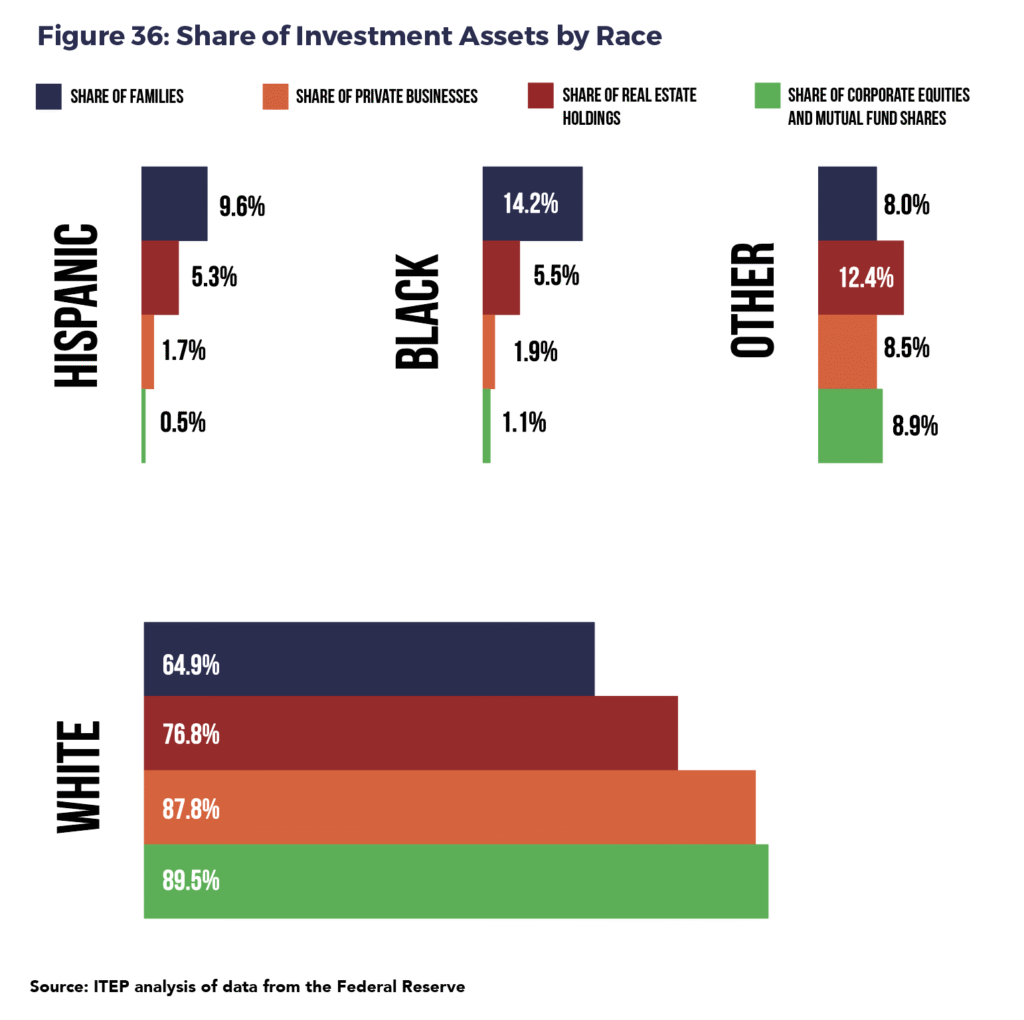
While local Atlanta data on investment assets does not exist, we can see how the disparities play out at the national level. White families make up 65 percent of families but own nearly 90 percent of corporate stock, nearly 90 percent of private business assets, and more than 76 percent of real estate holdings. Black families, in contrast, own just 1.1 percent of corporate equities, less than 2 percent of private business assets, and under 6 percent of real estate holdings.119 We can, therefore, assume that white families receive a disproportionate share of the income and wealth generated by capital gains, which helps to explain the widening racial income divide in Atlanta.120

Holdings in various investment assets allows families to pass down ownership of the assets from generation to generation, thus accruing financial returns that will sustain the long-term financial well-being of families. Recent studies show that half of total wealth in the United States results from intra-generational transfers from inheritances. Moreover, these inheritances now account for more of the racial wealth divide than any other demographic and socioeconomic indicators including education, income and household structure.121

Local data is also unavailable on the rate of generational transfers and inheritances, but nationally, 30 percent of white households receive an average inheritance of about $195,500 compared to 10 percent of Black households that receive an average inheritance of $100,000.122 Because investment assets and inheritances are lightly taxed, these inequities can play a large role in perpetuating a widening Black-white wealth divide in Atlanta that will span generations.

A Fair Tax Code

While some may argue the tax code is race neutral, the data tells a different story. The tax code benefits wealth over work by taxing income from ownership at much lower rates than income from salaries and wages, which is the primary source of income for Black households. As a result, Black households are less likely to reap the wealth building benefits from the tax code given the inequities in income and investment assets.

City-level data on taxes is not available, but state-level data exists, showing the regressive and inequitable nature of the tax code in Georgia. Georgia’s income tax contains a design flaw that causes it to fall more sharply on workers with low-income. Georgia’s income tax brackets are mostly unchanged from the 1930s, when $10,000 a year was considered a high-wage salary. As a result, the state’s income tax starts applying to families at unusually low levels of income.

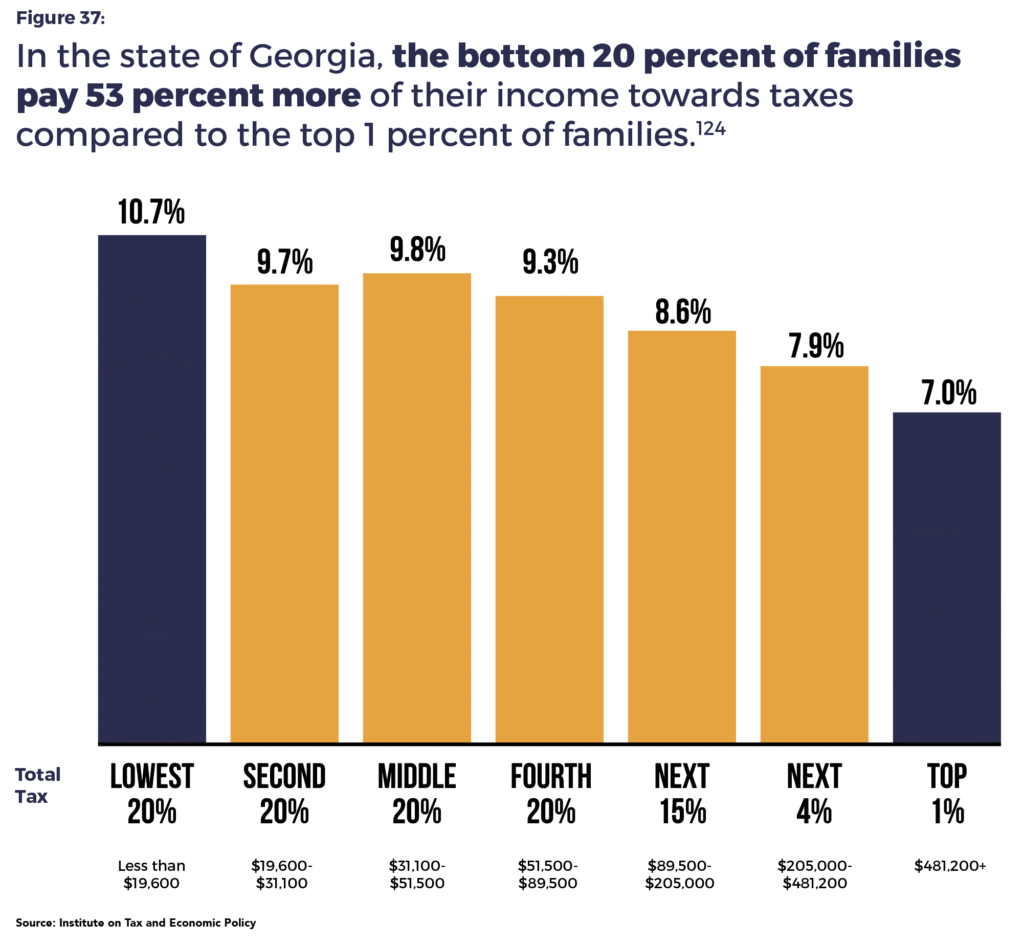
In 1990, Atlanta families with an income of $50,000 and less — disproportionately Black families — spent about 10 percent of their income on state and local taxes. Meanwhile, families with an income of $100,000 and more spent less than one percent of their income on state and local taxes.123 Today in Georgia, the 20 percent of families with the lowest income pay 11 percent of their income towards taxes, while the top one percent of families with the highest income pay seven percent.

Getting Local: Atlanta Property Taxes and Wealth

For the 33 percent of Black homeowners in Atlanta, the tax advantages for property ownership still amounts to a racial subsidy for white families, while local property tax assessments are systematically biased against Black homeowners. For instance, Atlanta and Fulton County have a history of overtaxing Black property. The county has continued a racially biased practice of valuing Black-owned properties with a significant share of Black residents at lower amounts than their white counterparts.

Nationally, Black homeowners pay higher property taxes than white homeowners, even while appraisers are more likely to assign them with lower home values. This practice created a pattern of increasing property tax delinquency among Black homeowners. As a result, property taxes lead to losses of wealth in Atlanta disproportionately for Black homeowners. A recent investigative study analyzed more than 3,200 properties auctioned for delinquent tax debt between 2015 and 2022 in Fulton County and found that 80 percent were in historically Black neighborhoods.125

Without property tax relief, primarily in the form of homestead exemptions in these cases, Fulton County will not offer payment plans to help homeowners settle their debt. In fact, it has been reported that Fulton County denies people who should otherwise be eligible for exemptions and other forms of property tax relief. Unfortunately, if families can’t pay their tax bills, Fulton County can sell their debt to for-profit investors who can in-turn auction off their homes.126

While we need better data to understand the role of capital gains and tax advantages in reinforcing the racial wealth divide in Atlanta, the insights provided above do shine a light on critical policies and practices that warrant attention. If Atlanta policymakers want to help build Black community wealth, eliminating disparities in access to investment assets and addressing racial disparities cemented by the tax code will be essential.

Access to Climate Resilient Communities and Wealth

A largely ignored contributor to the racial wealth divide is climate change and related natural disasters. For instance, damages from natural hazards, which are expected to increase substantially in coming years, are found to increase wealth inequality.127 As we look to solutions to build Black wealth, we must consider the impending harms that will be created by climate change that are compounded by generations of environmental racism in Atlanta.

The Centers for Disease Control (CDC) developed the Environmental Justice Index (EJI) to assess the ability of neighborhoods and cities to respond to environmental hazards or to be resilient in the face of climate shocks and stressors. The EJI for majority Black neighborhoods is 90 percent compared to the overall city average of 62 percent. In other words, majority Black neighborhoods in Atlanta are 28 percentage points more vulnerable to environmental shocks compared to the rest of the city.128 The widening racial wealth divide in Atlanta means that Black families are more likely to live in communities that are more vulnerable to environmental threats.

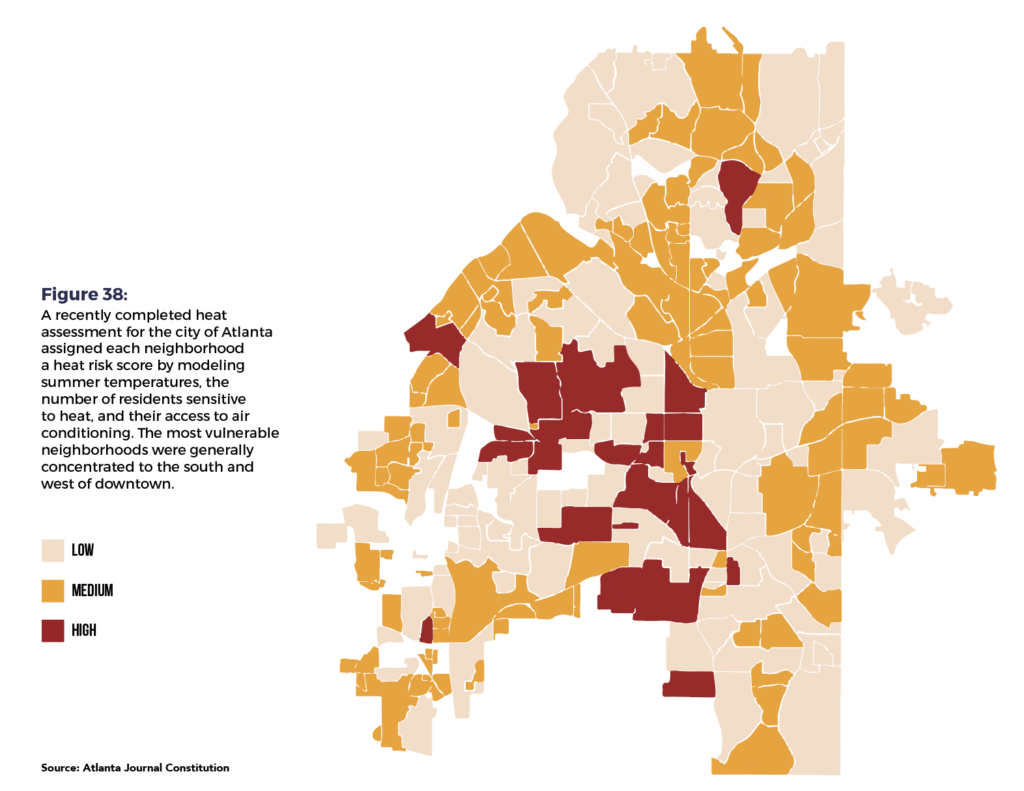
Another factor that bridges wealth and climate is rising heat. Across Atlanta, substandard housing can lead to poor health outcomes for households and the costs to maintain and keep housing safe and cooled can be significant. A recent study of rising heat in Atlanta’s neighborhoods found that 30 percent of houses in Atlanta’s historically Black Pittsburgh neighborhood lack central heating and air cooling systems. In fact, most neighborhoods that were found to have the highest heat vulnerability are majority Black neighborhoods.129

Extreme heat is also linked to higher utility costs. It costs households money to keep the air conditioning running, but Black households bear the brunt of these costs more than others. At 9.5 percent, Black households in Atlanta experience double the energy burden of the average household (4.7 percent).130

The growing threat of climate change heat requires all policy leaders to take action to reduce greenhouse gas emissions and to pursue policies that mitigate the effects of extreme heat, natural disasters, and the financial stress these events cause. These efforts are necessary across all of Atlanta, but especially in low-income neighborhoods, communities of color, and other settings where the structural and financial impacts of climate change are felt the greatest.

Jobs & Wealth

Discrimination in the labor market continues to impede economic mobility for Black workers in Atlanta. On average, white job applicants receive 36 percent more callbacks than equally qualified Black applicants who apply for the same jobs.103 Legal, racist hiring practices also hurt Black job seekers impacted by mass incarceration.

Public access to criminal records and requiring job applicants to reveal whether they have a criminal record lead to higher rates of discrimination among Black jobseekers.104 Black workers are 13 percent of the U.S. workforce, but they file 26 percent of the racial discrimination claims with the Equal Employment Opportunity Commission (EEOC) and its partner agencies.105

When doors to job opportunities with better pay and benefits are closed for Black people, their wealth-building opportunities are stymied. For instance, studies show that Black wealth would increase 25 percent if access to employer-based health coverage was equal to that of white people and 53 percent more wealth if pension rates were equalized.106

Job Creation

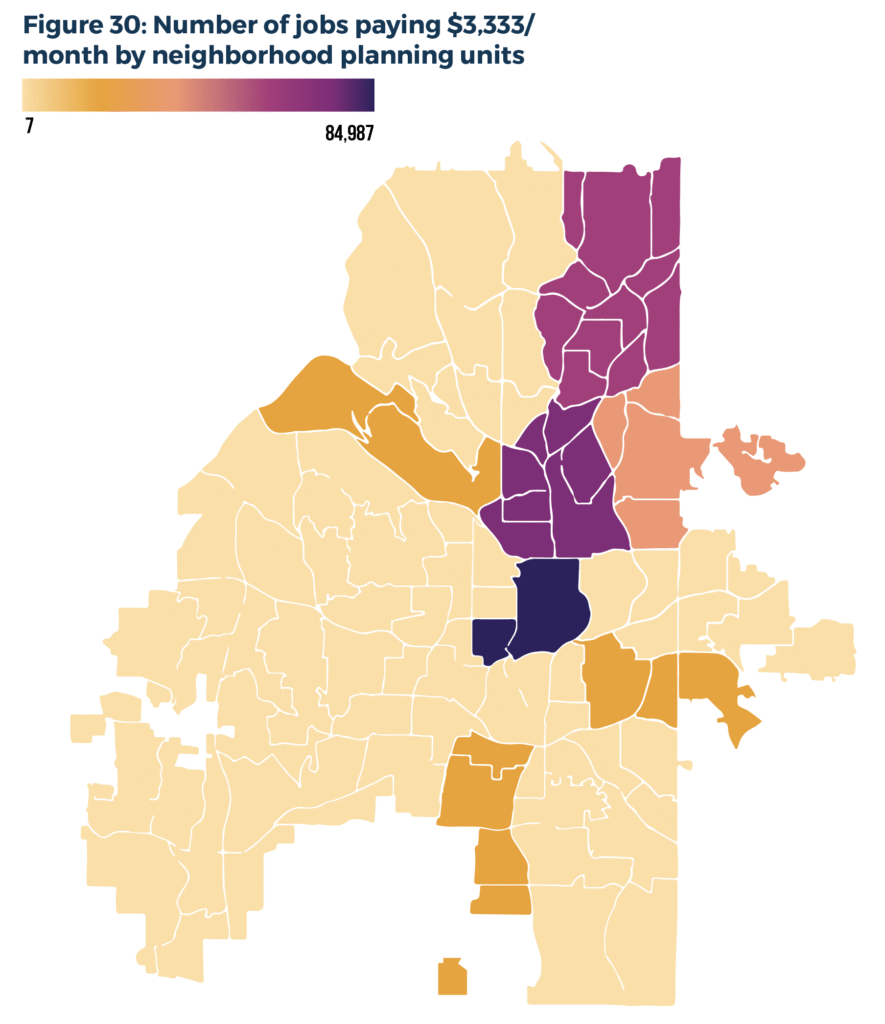
Creating jobs in Atlanta is not an end in itself, though many mistakenly think this to be true. There is no value in creating jobs if those jobs do not create wealth for whole communities or the jobs do not help workers acquire assets. And yet, job creation in an important economic development tool that can help Black Atlantans acquire the assets necessary to build wealth. Unfortunately, Atlanta’s job creation practices and policies lure development away from their neighborhoods. The map below shows eighty-five percent of all jobs in Atlanta are located in majority-white neighborhood planning units (NPUs) on the city’s northside, severely limiting employment options for residents in South Atlanta where most Black workers live.107

It is not enough to focus solely on job creation as an indicator. Instead, focus must shift to the creation of quality jobs in majority Black communities. Historically, disinvested neighborhoods in Atlanta have faced a disproportionately bad labor market. Moreover, incentives have failed to drive asset building jobs into Black neighborhoods. For instance, analysis shows that jobs created in majority Black neighborhoods in Atlanta are concentrated in low paying industries, which are notorious for offering fewer asset building tools like retirement funds, health care, and paid leave.

The Racial Wage Divide

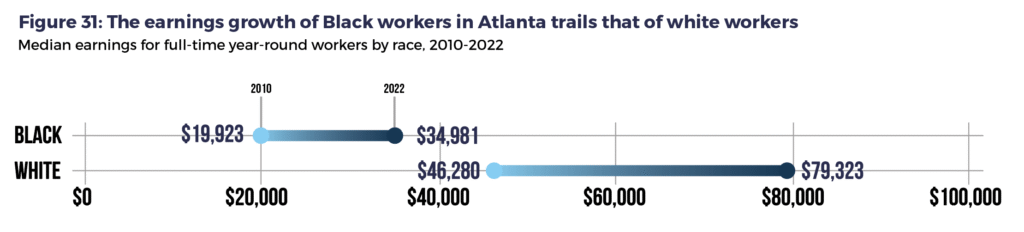
Figure 30 shows that access to higher-paying jobs is closely associated with race and place. Atlanta neighborhoods with more Black residents have fewer jobs that offer earnings of $3,333 per month or more. In other words, the more Black residents there are, the fewer high-paying jobs are available in Atlanta. These economic development policy choices cement earnings disparities that limit opportunities to build Black wealth in the city. Despite modest growth in earnings between 2010 and 2022, the median earnings of Black workers trail far behind those of white workers.

Occupational Segregation

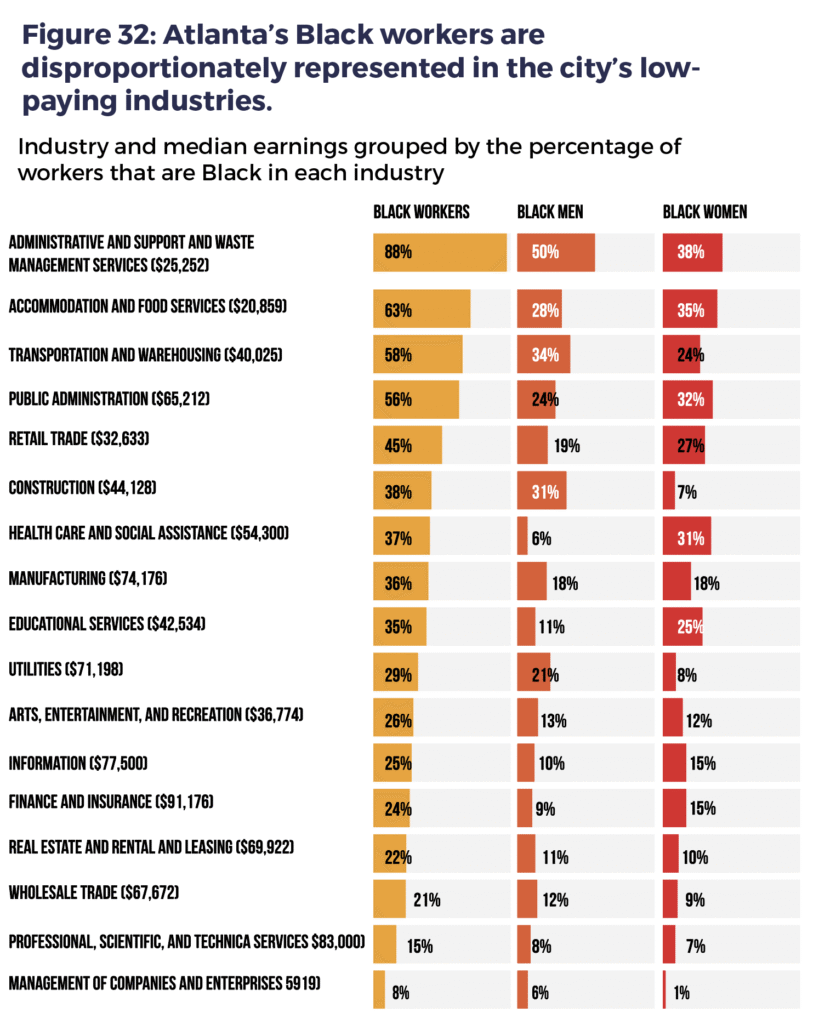
Despite Atlanta’s reputation for having a strong professional class of Black workers, there is still a great deal of occupational segregation. Owing to a history of systematic discrimination and public policies that have acted to reenforce and widen the wage divide between Black and white workers, clear patterns in the labor force demonstrate that a disproportionally large share of Black workers are concentrated in low-wage industries. In Atlanta, Black workers account for the vast majority of industries that pay poverty wages. For instance, Black workers are 88 percent of the administrative, support, and waste management industry in the city – an industry that typically pays just $25,252 annually.108

Investments in workforce training and upskilling have kept the focus on individual solutions rather than on the broader exclusionary policies and practices that shape labor market opportunities and outcomes in Atlanta. Job training emphasizes personal responsibility, which compounds the effects of structural racism that spans the lives of Black job seekers. This focus on personal responsibility in skills training policies and programs carries the extraordinary expectation that nothing will interfere with Black workers’ individual effort to access good, asset building jobs—not even racism.

Business Ownership

Business Ownership

A Brief Backstory: A History of Black Business in Atlanta

The spirit of entrepreneurship is inextricably woven into Atlanta’s culture.

In W.E.B. Dubois’s 1899 study the Negro In Business, 61 Black businesses were operating in Atlanta. The businesses represented a combined investment of $64,260, or $2,350,373, when adjusted for inflation and represented in 2023 figures. Among the most common lines of business were grocery stores, general merchandise stores, and barbershops.92

Atlanta’s Black business community enjoyed unparalleled success in the late 19th and early 20th century. The district known today as Sweet Auburn, situated east of downtown along Auburn Avenue, is considered a success story that demonstrates the vibrancy and resiliency of Black entrepreneurs in the segregated South. At the turn of the 20th century, the district contained ten Black businesses and two Black medical practitioners.93 As Sweet Auburn grew, it became the center of the city’s Black community, replete with commercial offices, bustling retail, places of worship, Black-owned financial institutions, and more. Fortune Magazine coined the district “the richest Negro street in the world” in a 1956 issue.94

Unfortunately, the vitality of the community began to diminish shortly after the donning of this title. City leaders and developers erected what is known today as the I-75/I-85 downtown connector, which eliminated a sizable portion of the commercial corridor and divided the remaining businesses on either side of the interstate. Coupled with the desegregation of the country and subsequent migration of Black businesses to other parts of the city, the once vibrant Sweet Auburn district suffered from disinvestment and became another community subject to racist urban renewal policies and investments.95

Former Atlanta Mayor Maynard Jackson, the city’s first Black mayor, catalyzed reinvestment in the city’s Black business ecosystem by adopting a policy agenda during his tenure from 1974-1982 that put affirmative action and Black businesses at the forefront.96 One of his most successful and well-known accomplishments as mayor was his diversification of the procurement process at the Atlanta airport. A champion for equity and a son of the Civil Rights Movement, Jackson recognized the importance of Black businesses in the city. He earmarked 25 percent (approximately $450 million) of all procurement contracts for the construction of Hartsfield-Jackson Atlanta International Airport to be awarded to minority firms. The airport was the largest construction project in the South during that time, and Jackson had successfully positioned Black businesses to benefit from the influx of capital. His efforts increased minority contracts from 0.13 percent in 1973 to 23 percent in 1982.97 A 2021 audit revealed that the city of Atlanta did not meet its airport procurement target goals for minority-owned or female-owned business enterprises, a goal that is still set at approximately 25 percent.98

Black Business Ownership Today in Atlanta

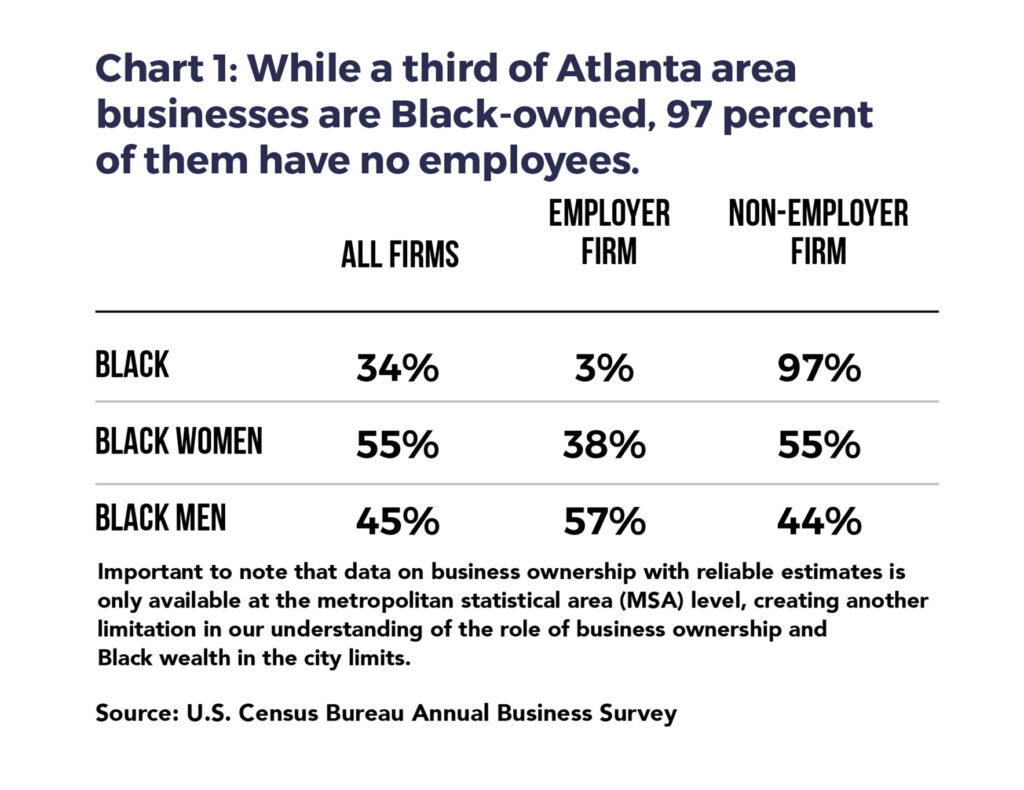
In a city like Atlanta, where the population is over 48 percent Black, one might expect that the business landscape would tell a triumphant story of a thriving Black business landscape. Unfortunately, the data contradicts this notion, showing that Black businesses only constitute 34 percent of all firms in the Atlanta area. But when broken down by employer-firm or non-employer firm (i.e. sole proprietorships), there is a large difference in business ownership. Just 3 percent of the Atlanta area’s Black-owned businesses are employer-firms, while the vast majority of Black-owned businesses – 97 percent – operate as non-employer firms with no employees.99

Businesses are an even greater asset and community wealth building tool when they have at least one paid employee. Although Black women make up the majority of Black-owned businesses in the Atlanta area, they are least likely to have employees.

Business Revenues in Atlanta

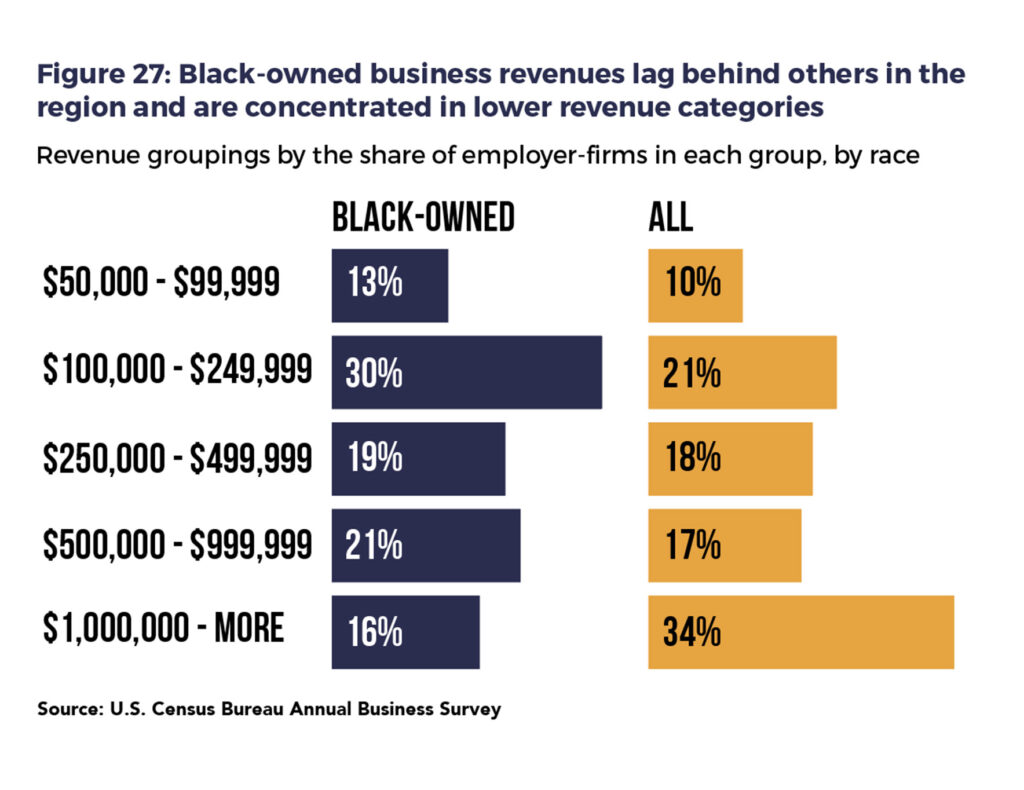
The key method of ensuring a business can build Black wealth is to ensure structural barriers are removed that prevent Black-owned businesses from increasing their revenues. Currently, annual revenues for Black-owned employer firms are lower than the revenues of others in the Atlanta area. It is important to keep in mind that when we are discussing the revenues of Black-owned businesses, we are not discussing income, but rather the profits generated by a business.

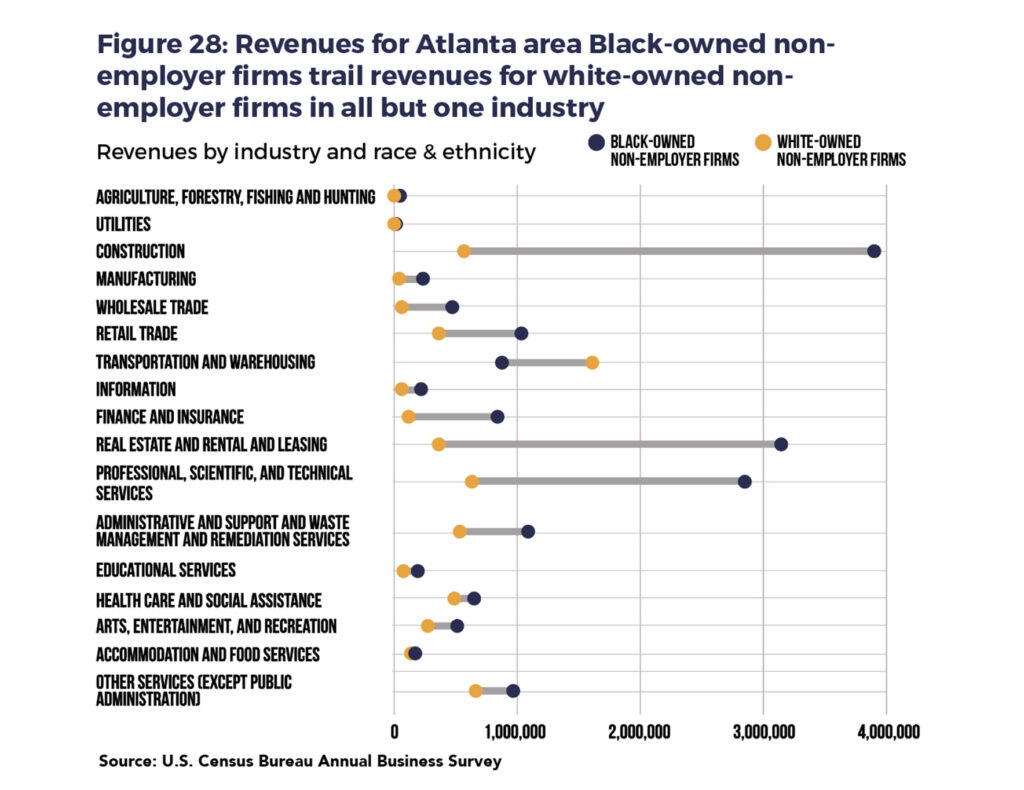
Among non-employer firms, the disparities in revenues that Black businesses face are more apparent, driven largely by the industry that the businesses are operating in. For instance, Black-owned businesses in Atlanta are more concentrated in lower-revenue industries.

Black entrepreneurs are underrepresented in employer firms of all types, but in Atlanta, they are overrepresented in the transportation and warehousing sector. In order for business ownership, especially among sole proprietors, to serve as a vehicle to build Black wealth, structural barriers blocking growth in high-revenue industries must be removed. High-revenue industries command larger amounts of capital,100 suggesting that the structural barriers in accessing capital are an impediment to greater representation in high-growth, high-revenue industries for Black-owned businesses.

Access to Capital

Although most entrepreneurs use personal or family wealth to start their businesses, Black entrepreneurs in Atlanta have fewer resources to do so. Instead, Black entrepreneurs are more likely to rely on personal credit cards to fund their businesses.101 Barriers to bank loans and other sources of capital stemming from centuries of systemic racism and ongoing discrimination in financial markets continue to erect barriers to business financing. Even after controlling for creditworthiness, Black entrepreneurs experience higher rates of loan denial and pay higher interest rates than white-owned businesses.

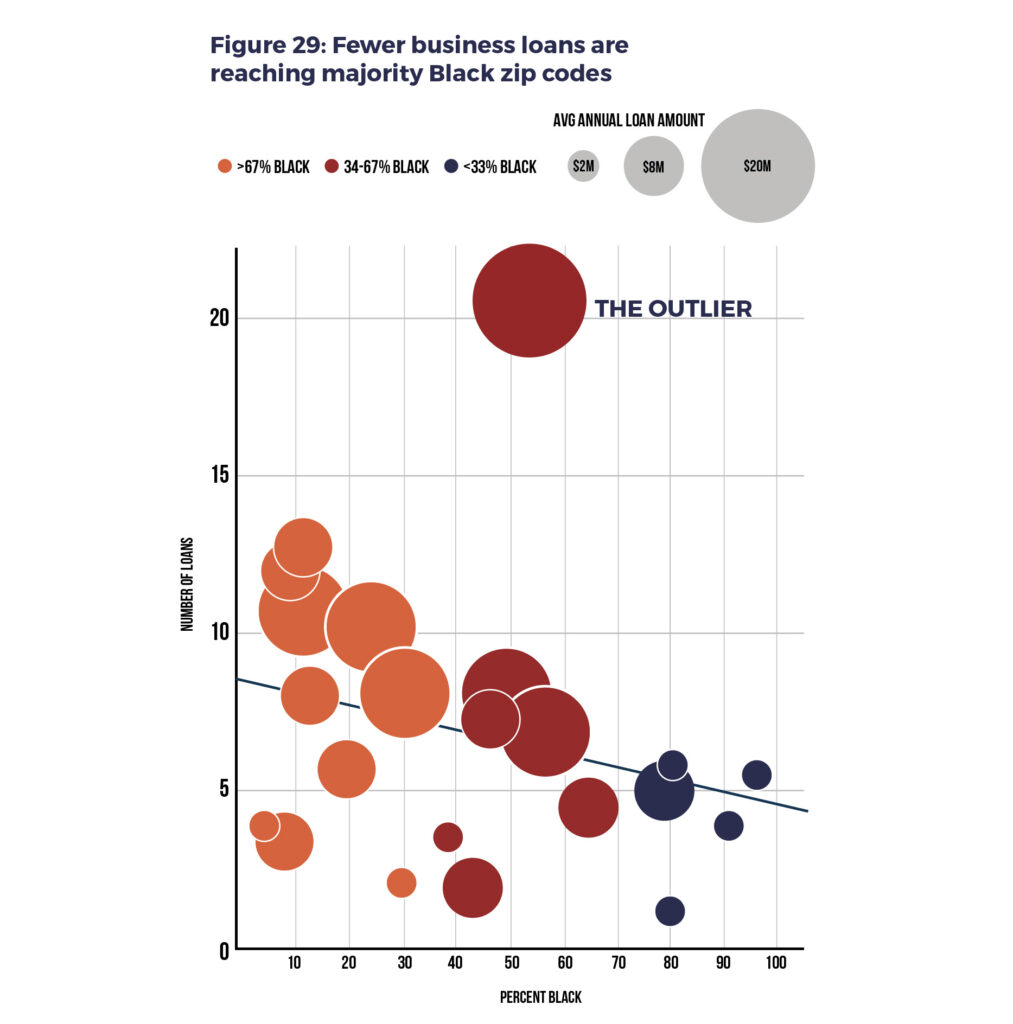
Nationally, only 20 percent of Black business owners are approved for loans, lines of credit, and cash advances, compared to 33 percent or more for all other racial-ethnic groups.102 In Atlanta, majority Black neighborhoods receive lower business amounts compared to other neighborhoods. Looking at government business funding provided by the Small Business Administration, the median loan amount shrinks as the proportion of Black residents increase in Atlanta’s neighborhoods, thus replicating an inequity that has lasted for generations.

The outlier represents the 30318 zip code. The number of small business establishments with more than 5 employees (range is 6-499 employees) is highest in 30318. We speculate the quantity of loans in 30318 greater because larger small businesses may be better equipped to apply for loans. This explains the higher number of loans but doesn’t necessarily explain the large bubble size/larger avg. loan amount.

As Atlanta continues its current trajectory of large-scale growth, it will be critical that financial institutions prioritize outreach to Black businesses in Black neighborhoods. The rate at which business loans are approved for Black Atlantans will be a critical metric for measuring equitable and inclusive progress in the city’s larger economic development agenda.

Our conversations with Atlanta residents illuminated how business ownership served as a vital part of their wealth building journey. We found that the theme of business longevity arose across all our conversations. Children of business owners recalled how their parents kept their businesses afloat and provided for their families. Previous business owners shared their passions and reasons for investing in themselves.

Within the stories of joy and entrepreneurial success were pervasive obstacles that caused the lifespan of the business to be cut short. Increasing rent, the deterioration of the surrounding community by developers, low-value business investments from outside investors, and lack of capital were the top contributors to the closure of Black businesses. The implications of such lie in the inability to create intergenerational wealth.

Housing

Homeownership is often recognized as the long-term goalpost for Americans to strive toward on their journey to build wealth. Homeownership offers families the needs and comforts of shelter, but it can also function as an asset that can be used to transfer generational wealth, build equity, and access alternate forms of capital for economic mobility. The goalpost, however, is not equidistant for all racial-ethnic groups within Atlanta, as the pathway to homeownership is fraught with harmful policies, prejudice in the housing market, and predatory financing for Black people. Moreover, homeownership is not the driver of the racial wealth divide that conventional wisdom leads us to believe.79

A Brief Backstory: United States v. Decatur Federal

The Black residential population of Atlanta, akin to many southern cities, endured systemic and coordinated efforts by financial institutions, mortgage lenders, insurance companies, and land developers to prevent wealth building in the form of homeownership.80 The most well-known of these coordinated efforts is redlining – a discriminatory practice whereby credit lending institutions and developers withhold investment in specific neighborhoods, often comprised of majority residents of color.81 The coordinated efforts by these groups have restricted Black Atlantans from obtaining fair mortgage rates, accessing affordable and adequate insurance coverage for their homes, migrating into various parts of the city, and participating in the wealth-building activities afforded to homeowners.82 The pervasive presence and impacts of redlining in Atlanta are clearly outlined in the 1992 landmark mortgage lending case, United States v. Decatur Federal Savings and Loan.

The United States v. Decatur Federal was the first case where the Department of Justice sued a mortgage lending company, notably in defense of the Black population, since Congress passed the Fair Housing Act of 1968. The Fair Housing Act of 1968  “prohibited discrimination concerning the sale, rental, and financing of housing based on race, religion, national origin, sex, (and as amended) handicap and family status.”83 Decatur Federal violated this Act and several civil rights protections by advertising mortgage products almost exclusively to Atlanta’s white population, employing and contracting white appraisers and rarely or never contracting with Black appraisers, and enabling its predominately white account executive team to engage in discriminatory relationships with primarily white real estate agencies.84

In 1979, Decatur Federal defined its lending area to exclude 76 percent of Fulton County’s Black population by using the Southern Railway line and Georgia Railroad, historic markers used to segregate Black and white neighborhoods in the Jim Crow South. Only six percent of Decatur Federal’s 24,300 processed applications were from Black residents between 1985 and 1990. In the years 1988, 1989, and 1990, the lending company only originated three percent of home mortgage loans in Black census tracts, with the remaining 97 percent in white census tracts. Stricter underwriting standards, an outright denial of financial capital, and branch closures in majority Black neighborhoods are some of the lending company’s known tactics to carry out their discriminatory practices against Atlanta’s Black residents.85

Decatur Federal was not the sole actor hindering Black homeownership in Atlanta. Their actions were seeded by the direct enablement of state and government programs that rewarded white homeowners and penalized Black homeowners. The aftermath of these destructive policies is evidenced by the 20 percent mortgage denial rates that Black Georgians face when applying for a home loan.86 It is evidenced by the -22.2 percent average devaluation of homes in Black Atlanta neighborhoods, which is equivalent to $42,964 of unrealized home value.87 The extent of the damage done is immeasurable, but by examining lending behavior, trends in affordability, the tax code and other housing and community development policies, we may know where to position our wealth building efforts in housing.

The Legacy Continues: Housing Wealth in Atlanta

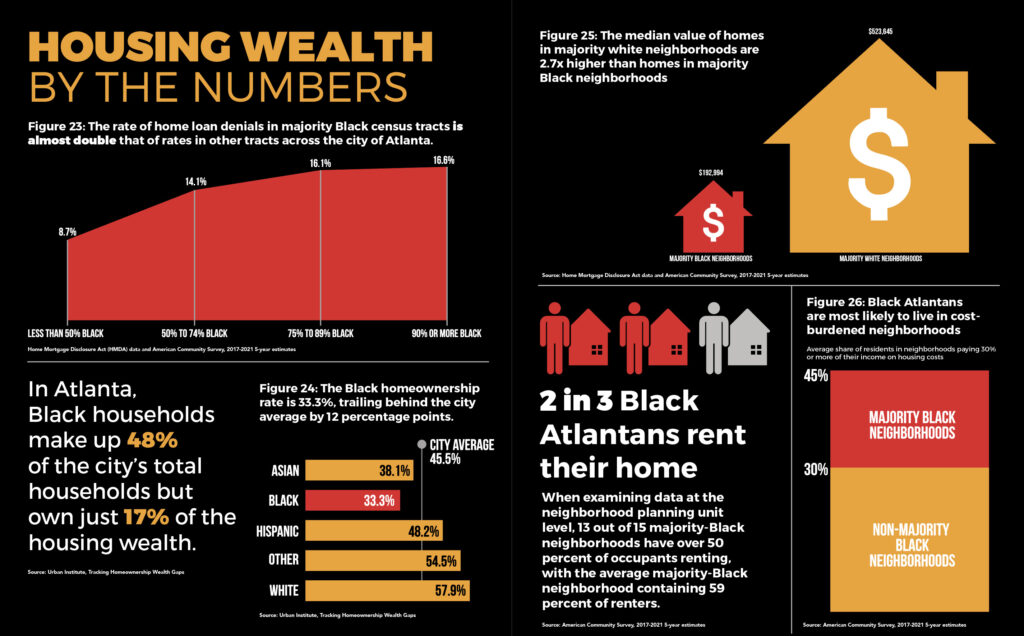
The number of mortgages originating in majority Black neighborhoods is important for examining whether access to homeownership is increasing for Black residents. Today, the rate of home loan denials in majority Black census tracts (15.9 percent) is almost double that of rates in other tracts across the city of Atlanta (8.7 percent).88 As the size of the Black population in a neighborhood increases, so does the denial rate.

The case of analysis of Decatur Federal exposed the systemic ways that Black residents of Atlanta were denied fair mortgage rates and home loan assistance. The legacy of those discriminatory actions continue to play out in the routine denial of Black borrowers seeking to purchase a home. There should be a very targeted approach to remedy these injustices. Observing the number of loans originated and loan denial rates, will offer a good proxy for measuring prejudice in majority Black Atlanta neighborhoods.

In Atlanta, Black households make up 48 percent of the city’s total households but own just 17 percent of the housing wealth, or the total value of primary residences.89 The Black homeownership rate is 33.3 percent, trailing behind the city average by 12 percentage points. The existence of this divide not only represents housing instability within the Black community, but it has direct consequences on the financial well-being and wealth building prospects of the Black Atlantans.

For those that do own their home, the benefits are not shared equitably. Homeowners face chronic devaluing of their homes as a result of implicit and explicit bias in the home appraisal process.90 The median home value in majority Black neighborhoods is $192,994, which is 2.7 times lower than the median value in majority white neighborhoods.

Homeownership can be a meaningful wealth-building tool because it allows the homeowner to access the equity in an asset that appreciates in value. This equity affords the homeowner the ability to borrow money from their home to pursue entrepreneurial endeavors and pivot during unexpected life circumstances. But home value appreciation looks different for Black homeowners due to systemic racism. As long as this trend continues, the notion of homeownership as a wealth building tool will remain questionable, at best. As The Color of Law’s Richard Rothstein argues, “a home is one of the only assets in which the race of the owner affects the rate of return.”91

The majority of Black Atlantans are renters, so it is important to include renters in discussions about building Black wealth. When examining data at the neighborhood planning unit level, 13 out of 15 majority-Black neighborhoods have over 50 percent of occupants renting, with the average majority-Black neighborhood containing 59 percent of renters.

It is also particularly important to pay attention to the percentage of Black Atlanta residents who are cost-burdened, typically defined by spending 30 percent or more of one’s income on housing. In Atlanta, majority Black neighborhoods average 45 percent of residents classified as cost-burdened.

Cost-burdened individuals are in a reduced position to build wealth due to their overbearing housing costs. Those who are rent-burdened are in an especially precarious position with limited resources to save and consider homeownership.

The housing instability that Black Atlantans face is due to a confluence of factors. If there is any real belief that homeownership can build Black wealth, then a coordinated effort from policymakers will be needed to develop a race-conscious approach toward equity-building in the realm of housing and homeownership.

Access to Capital

Access to Capital

The relationship between Black people and capital is rife with pain and unforgivably intertwined with human cruelty and subjugation. The United States financial system is a balance of credits and debts attributed to an individual. In the 18th and 19th centuries, enslaved Black people represented a form of acceptable capital, securities, and collateral in the country’s financial system. To this end, Black people were used as capital to secure land and property mortgages, purchase other enslaved persons, and were used as settlements for accrued debts.63 Making the transition from being considered capital to overcoming policies that restrict access to capital for Black persons in this in this country is anything but straightforward.

As the country solidified its banking infrastructure, Black people remained excluded from accessing the same financial institutions as white persons until 1868, when the 14th Amendment was passed. As a result, Black-owned and operated banks became an emergent solution. From 1888 to 1928, research shows that 40-57 Black-owned banks were chartered in the United States. The variation in number is due to a lack of coordinated efforts by monitoring agencies, consensus around the definition of a Black bank, and the knowledge that some banks may have had a short lifespan.64 During this time, more and more Black people gained the opportunity to move from a financial system rooted in borrowing and debt to one that emphasized saving, land ownership, and capital investment.

The mere presence of Black-owned banks in communities increased the number of Black persons who held a bank account. Accounts from Black bankers in 1906 recall that “in Richmond, one out of every nine Black residents had a bank account… Conversely, in Atlanta, where there were no Black-owned banks, only about one out of every 30 Black residents had a bank account.”­65 This was a catalyst for the founding of the first Black bank in Atlanta in 1921, Citizens Trust Bank.66

Black Owned Banks and MDIs

Black-owned banks are categorized as Minority Depository Institutions (MDIs). An MDI is an institution where “(1) 51 percent or more of the voting stock is owned by minority individuals, or (2) a majority of the board of directors is minority and the community that the institution serves is predominantly minority.”67 The presence of MDIs is in decline; between 2008 and 2018, approximately one-third of minority-owned banks closed or merged. Black-owned banks have declined to represent only 20 out of 142 MDIs in 2020, down from 48 in 2001. Today, Citizens Trust Bank remains the sole Black bank in Atlanta.68

MDIs and Black-owned banks are important community fixtures because of their often-proximate location to minority communities. Black owned banks’ vested interest in who they serve empowers the financial institutions to approve Black applicant loans at a higher rate than other banks. Amidst the decline of bank branches in majority Black areas, it is increasingly important that MDIs are protected and seen as a resource.

CDFIs

Community development financial institutions (CDFIs) were established in 1994 by the Riegle Community Development and Improvement Act. The purpose of CDFIs is to invest in the economic revitalization and community development of low-income neighborhoods that are often overlooked. CDFIs can take the form of various financial institutions like banks, minority deposit institutions, credit unions, and loan funds. The social missions of CDFIs make them valuable resources for Black entrepreneurs and homeowners, as they often have more flexible underwriting criteria, lower credit score requirements, and are more likely to issue microloans.69 

“I remember having conversations with my mom, my uncles, and my aunts when they talked about how back in the day all of the Black and Brown people, people who look like us, dealt with credit unions because they weren’t allowed to have bank accounts.”

Black Atlantans revealed that credit unions, which are also considered CDFIs, were often a source of financial fortitude for Black people. A consensus across our listening conversations was that credit unions are perceived to have more favorable interest rates and deeply engage with community residents. The ways in which credit unions have served Black communities should be further examined and compared to the reputational and structural regulations governing traditional FDIC insured banking institutions.

While CDFIs are useful vehicles to funnel capital into Black communities, their lending power is often constrained. As a result, CDFIs obtain borrowed capital from banks; about 45 percent of CDFI capital is borrowed from the banks.70 As the lender, the bank can pursue its own interest and set the terms and rates of the lending agreement. This can restrict the CDFI’s flexibility of rate offerings and underwriting requirements. Despite imposing strict regulations on CDFIs borrowing money, banks still receive credit towards Community Reinvestment Act (CRA) requirements.

Community Reinvestment Act

The Community Reinvestment Act of 1977 (CRA) was Congress’s response to the very blatant and damaging impacts of redlining carried out by financial institutions in the late 19th and early 20th century. Financial institutions would willingly accept deposits from low to moderate-income neighborhoods but withhold lending credit for lines of businesses and mortgages, labeling the community members as high risk on the basis of low credit scores – an intentional disinvestment and wealth-stripping practice. The CRA creates an imperative for institutions insured by the FDIC to serve the interests and needs of the communities where they are chartered,71 but more oversight and enforcement is needed.72

Access to Banking in Atlanta

Our analysis finds that there are approximately 37,102 Black Atlantans living in banking deserts, which means they live in census tracts that contain no bank branches within a two mile radius. Banks are important vehicles for securing home mortgages and small business loans; the absence of these capital lending and saving institutions lead Black people to seek alternative offerings of capital, mostly predatory in nature.

A large ten-census tract cluster located within Southwest Atlanta constitutes the largest banking desert in the metro Atlanta area. Each of these ten tracts is majority Black. Furthermore, there are 14 total banking deserts identified within Atlanta, and all 14 of these tracts are majority Black – illustrating just how underserved Black Atlantans are when it comes to banking access.73 The figure illustrates how the presence of bank branches in the city is clustered near the northeast corner of the city and within census tracts where 50 percent or less of the population is Black.

In the state of Georgia there are 28 certified CDFIs. We have been able to identify at least eight CDFIs in the city of Atlanta, with six being located in neighborhood planning unit M.74 The mission of CDFIs has led some of the larger and more national firms to support development efforts beyond the communities where they are headquartered. Thus, making it difficult to capture the true impact of CDFIs in Atlanta communities.75

Access to varying financial institutions can reduce interest rates and raise savings rates, as the banks begin to compete for business in the area. Brick and mortar banks are vital to the health of low-income neighborhoods. The reduction of banking deserts within the city should be a principal concern of city officials.

Nearly half (48 percent) of Black households in Atlanta are either unbanked or underbanked, compared to the 24 percent of households within the city.76 Households that are unbanked are those that do not have a single member with a checking or savings account at a bank or credit union.

Households who are underbanked use financial services and products that exist outside of the traditional banking system. Predatory small-dollar lenders prey on consumers with financial problems by providing quick cash loans with unreasonably high interest rates and fees, making them difficult to pay on time. When Black folks are excluded from mainstream debt channels (i.e. banks), their risk for exploitation increases. Exploitation has been partly institutionalized with the rise of digital lending products and weak regulatory protections.77

Analysis shows that 12 percent of Black households in the Atlanta metro-area used a nonbank credit product such as a payday loan, pawn shop loan, rent-to-own service, refund anticipation loan, and auto title loan in the past 12 months, compared to six percent of all households and three percent of white households. This means Black households are four times more likely to use predatory lending than than white households in Atlanta.78

Safe, affordable, and reliable banking options are the key for accessing the capital necessary to build Black wealth in Atlanta. And yet, access to reliable banks is denied for nearly half of the city’s Black households. Policymakers and practitioners in the financial services sector must look to improving banking access in Black communities.

Debt and Black Atlantans

Debt and Black Atlantans

Debt is both the cause and consequence of Atlanta’s enormous racial wealth divide. Conventional wisdom tells us that debt has the potential to help families build wealth. Unless families have the ability to make cash purchases outright, debt is required, in most cases, to buy a home, purchase a car, pay for college, and more. But faith in debt ignores the reality that debt creates disproportionate financial risks for Black Atlantans. As a result of discriminatory public policy and financial systems, Black families have a disproportionate reliance on debt to make ends meet.40

Financial advisers argue that wise uses of debt products can promote prosperity, thus feeding a widespread promotion of programs and policies centered on financial education, credit repair, and more as tools to close the racial wealth divide. However, these services prioritize personal responsibility in a manner that ignores the systemic policy choices upheld by the structural determinants that created and maintains the racial wealth divide. They also carry the notion that good debt exists and works in service of building Black wealth. Structurally, we argue that there is no such thing as good debt. Instead, debt is extraction and looms over Black Atlantans in a manner that limits community wealth building opportunities.

Navigating Household Debt in Atlanta

It is understood that households create assets and wealth by incrementally saving some portion of their income. But continuous cycles of delinquent debt make it harder for Black consumers to put money aside, contributing to a $75 billion annual disparity in savings.41 In Atlanta, only 37 percent of Black households have at least $2,000 in savings compared to 89 percent of white households and 66 percent overall.42

Consumers use various forms of debt to cover costs, and some debts are directly connected to the ability to buy assets. For example, in the wealth-building space, analysts pay close attention to mortgage debt, which is a form of a loan. Mortgage debt enables individuals to purchase a home which is an asset that appreciates in value, can be transferred generationally, and enables wealth creation.

Not all debt is created equal though. For instance, debt held by white households is more likely to be mortgage debt than the typical debt of Black households – and the debt amount is twice as large.43 While some debt is used to purchase large assets like a home or a business, families under financial distress go into debt to cover daily expenses, often leading to a debt cycle. This disparity reinforces white households’ cumulative advantages over everyone else in the race to build wealth, and it reflects a trend that has persisted for more than a century.

Delinquent Debt in Atlanta

The difference between what makes debt ‘good’ or ‘bad’ ultimately is the ability to pay. Delinquent debt is a significant problem that contributes to the ability to access credit and capital needed to purchase wealth and asset creation tools like a home, a car, or access to higher education. In Atlanta, 36 percent of residents are in delinquency, meaning they owe a debt that is 60 days or more past due. When disaggregated by race, the disparities in delinquency are illuminated. Forty-five percent of Black residents are in debt delinquency, compared to 21 percent of white residents.44

Debt delinquency can have devastating effects on the financial, social, physical, and mental health of everyone. Among individuals with consumer debt, those in financial distress or those struggling to repay debts are more likely to report lower life satisfaction and higher anxiety. Debt delinquency is also associated with depression.45 Moreover, higher unsecured debt is associated with increased risks of heart attack for Black adults.46

The sections below look at the role of three different types of consumer debt that affect Black wealth in Atlanta based on data available at the local level. These unsecured forms of debt do not require assets, typically have higher interest rates, and do not build value over time: student loan debt, medical debt, and credit card debt.

Student Loan Debt

Despite higher education being presented as a solution to improve wealth outcomes in Atlanta, the pursuit of higher education comes at an extreme cost that falls disproportionately on the backs of Black people in the form of student loans. Because of systemic racism, the inequitable distribution of wealth, a stratified labor market, and rising college costs, Black borrowers are among those most negatively affected by student loans.

Black people borrow the most and struggle the most with repayment. One year after completing their bachelor’s degree, Black borrowers owe $39,043, on average, in principal and interest, compared to $28,661 for White borrowers. Twenty years after beginning repayment, the median Black borrower still owes approximately 95 percent of their original balance, whereas the median white borrower has paid down nearly 95 percent of their balance.47

In 2023, the Student Borrower Protection Center (SBPC) analyzed zip-code level data on student loan debt for Atlanta. The data shows that the student loan problem has ballooned into a critical state for Black borrowers in recent years. Roughly 1-in-7 borrowers in majority-Black Atlanta neighborhoods owe more than $100,000 in student debt — a rate 50 percent greater than borrowers in majority-white neighborhoods.48

Black neighborhoods in Atlanta had higher student loan balances than predominantly white neighborhoods. These disparities have grown over the decade. By 2018, average student debt in majority-black zip codes was nearly $7,000 more than in majority-white zip codes, compared to slightly over $1,500 more in 2010.49

Recent research shows that 52 percent of Black households with student loans have zero or negative wealth compared to just 25 percent of Black households without student debt. Sixty-four percent of Black student debt borrowers report that student debt negatively impacted their mental health. Student debt drastically affects Black borrowers’ ability to build wealth in Atlanta.

Medical Debt

Medical debt is one of the most common forms of debt held by consumers. The Consumer Financial Protection Bureau (CFPB) estimates that $88 billion of medical debt is in collections nationwide, making medical debt the leading cause of bankruptcy in the nation.50 While data is insufficient to capture the magnitude of medical debt specifically for Black Atlantans, some data does provide insight into the local disparity. In Atlanta, only seven percent of white households have medical debt in collections, compared to 21 percent of households of color.51

Medical debt is explained primarily by health incidents, income, and access to health insurance.52 Black Atlanta residents are at particular risk of increasing medical debt, given that Atlanta exists in one of seven states that have yet to expand Medicaid. A June 2022 survey of Georgia adults, where Medicaid has not been expanded, found that 37 percent of Black Georgians have medical debt. Research shows that insurance accounts for about 20 percent of medical debt.53 While Black residents comprise 48 percent of the city population, they account for 69 percent of the uninsured. Race and place are linked –neighborhoods with higher percentages of Black residents have higher uninsured rates.54

Credit Card Debt in Atlanta

Credit card debt is more common in Black households than in white households. Credit card debt is another common form of consumer debt that can limit the wealth and asset creation prospects of Atlanta’s Black households. Like other forms of consumer debt, Black households have a rougher start catching up on repayment. While the local data is insufficient to disaggregate for Black residents, data does show that Atlanta residents of color are 4.5 times more likely than white residents to have delinquent credit card debt.55

Relying on credit card debt to stay afloat comes at a cost. Black households report disproportionately higher interest rates, which adds to their balances and prolongs their debt repayment period.56 COVID-19 has exacerbated the disproportionate take-up of credit card debt. Even after controlling for economic differences, Black adults are more likely to use credit cards or borrow money to cover costs like food, gas, or rent. This was especially true during the pandemic when someone in the household lost their job.57

Access to Credit

Higher levels of debt and delinquency lowers credit scores and limits access to other forms of credit. Access to credit is understood as the ability to borrow against one’s own assets to finance a purchase. When times get tough financially, families can turn to credit to help address financial shocks or to make large purchases. However, the ability to access credit is heavily dependent on credit scores in the United States.

Credit reports help determine access to and costs of debt, with low credit scores limiting the options available to borrowers. In the United States, racial discrimination in credit reporting has led to racial disparities in debt. Credit score systems are well known to contain racial bias and have been shown to increase racial disparities as studies show that Black populations have substantially lower scores than white households on average.58

Black households tend to have low credit scores due to several factors, including lower rates of homeownership, higher rates of delinquent debt, predatory lending and more. In Atlanta, Black residents have the lowest median credit scores when compared to other groups.

Within cities, predominantly white neighborhoods have significantly higher average credit scores than neighborhoods primarily home to people of color.59 Evidence suggests that discrimination is a root cause—credit score disparities cannot be fully explained by income level and length of credit history.60

It is worth noting that there are roughly 26 million Americans who are “credit invisible,” meaning they have no credit history with any of the nationwide credit reporting agencies.61 In other words, consumers in this category are completely locked out of the current credit scoring system altogether. Black and Hispanic people and those living in low-income neighborhoods have higher credit invisibility rates.62

Poverty, Income, and Black Wealth in Atlanta 

Poverty, Income, and Black Wealth in Atlanta

Focusing exclusively on poverty is insufficient for addressing Black wealth outcomes in Atlanta, especially considering the official measure of poverty is actually a measure of income. But while the magnitude of the racial wealth divide is extreme, poverty and income are still essential measures to grasp the complete picture of Black wealth outcomes. While Black Atlantans make up just under half of the city’s overall population, they comprise almost three-quarters of the city’s population living below the federal poverty line (72.8 percent).24

The City of Atlanta’s long-term position as the number one city for income inequality also requires an examination of the relationship between income, poverty, and wealth. Black households earn considerably less income than white households, limiting their ability to save and build wealth.25 Income differences do explain a part of the racial wealth divide, though a significant divide exists even after accounting for income.26  The income divide is still a driver of the racial wealth divide. Moreover, income remains a primary source of money for most Black people, given the structural barriers that prevent access to other assets. Consider that for the more than one-third of Black Atlanta households with zero or negative net worth, income is an important entry point to building Black wealth.

Poverty in Atlanta

In Atlanta, children born to families in the bottom fifth of the income ladder have just a four percent chance of moving into the high income category.27 According to the latest estimates, 28 percent of Black Atlantans – over 60,000 people –live below the federal poverty line.28

There are many mechanisms that contribute to higher rates of poverty in Atlanta’s Black neighborhoods, most of which stem from a long history of explicitly discriminatory policies and extractive economic development practices in the city. Just as the cumulative effects of wealth accumulation can span generations, so can multi-generational poverty. One in five Black people are experiencing poverty for the third generation in a row, compared to just one in a hundred white Americans.29

Income

Black households see less of a return than white households on the income they earn. Research shows that for every $1 in wealth that accrues to median Black households associated with a higher income, median white households accrue $4.06.30 Studies also show that wealth differentials hold across income groups. For instance, Black households in the bottom 20 percent of the income quintile hold just $1,900 compared to white households in the same income group, who hold $29,800 in wealth. The typical Black household in the highest income group has similar wealth holdings as a typical white household in the middle-income group.31

An ongoing limitation of publicly available data is the lack of granularity necessary to observe city or neighborhood-level estimates of wealth and income inequality in a similar way that is presented above. However, we proceed with providing a snapshot of income disparities in Atlanta. Black Atlantans have the lowest median income – $38,854 –compared to all other groups.32

A snapshot of income disparities does not capture the troubling trend we observe in the data over time. The median income for Black Atlantans has grown slightly over the years. However the difference in median income between white and Black households has grown from $56,291 to $73,563 over the past decade, indicating a widening gulf in economic opportunity that reinforces the City of Atlanta’s status as the number one place for income inequality.33

While income is not the primary driver of wealth for white wealth households, it is for Black households.34 In fact, research shows that eliminating disparities in income would reduce the racial wealth divide.35

Educational Attainment, Income, and Wealth

Racialized personal responsibility narratives form dominant views on education and training and its role in addressing the wealth divide. The notion that people can build wealth by taking the personal responsibility to improve their educational outcomes is overstated. Moreover, the personal responsibility narrative dismisses the role of structural forces that limit the potential of high educational attainment to narrow the racial wealth divide.

Research shows that higher education does not yield the same advantages for Black people as it does for white people, nor does it address the racial wealth divide in any substantial way.36 Although educational attainment is associated with higher levels of wealth, the relationship between degree status and median wealth varies sharply between Black and white adults.37

Figure 12 shows that Black wealth is only a fraction of white wealth regardless of educational attainment. Households headed by a college-educated Black person hold $22,000 less wealth than white households, even without a high school diploma. These disparities signal diminishing returns on the investment that Black families make in higher education – an investment that routinely results in deeper debt and worsening wealth disparities.

While the systemic data issues limit our ability to present these wealth and educational attainment figures at the local level, it is worth examining the relationship between income and educational attainment in Atlanta. Atlanta is attracting a more educated population to the city and the region, which brings higher incomes to the city.38 However the prosperity generated from the combination of higher incomes and higher education is not distributed evenly. Similar to the wealth picture, income disparities persist across education levels in Atlanta.

Atlanta’s white households headed by someone with only a high school diploma make almost as much as Black households headed by someone with a college degree. Moreover, the typical white household starts breaking into the six-figure income range with just a bachelor’s degree, an income level that Atlanta’s Black households don’t see unless someone with a doctoral degree heads them.39 The income divide between Black and white households in Atlanta widens at higher levels of degree attainment.

If the income of Black Atlantans equaled that of white Atlantans, the total earnings for everyone could improve, and the whole economy would experience growth through greater purchasing power. Moreover, wealth for Black families would begin to grow with increased savings for emergencies, more cash on hand to buy homes and vehicles, and more money to put aside and invest in other assets.

Black Wealth in Atlanta

Black Wealth In Atlanta

Wealth, typically defined as the total sum of one’s assets minus one’s debts, is essential for understanding financial health in cities like Atlanta. Wealth is a better indicator of whether or not a family can survive economic shocks like the loss of income. Wealth includes assets that families can access to take care of financial needs and even allows families to borrow from themselves. More importantly, wealth gives families the ability to not only dream of what their own future and their future generations may be able to build, but it also helps families make those dreams a reality.

While the benefits of wealth are powerful, wealth is not justly distributed in Atlanta, across the South, or within the United States. The Atlanta metro (MSA) has the second-largest Black population in the nation and is home to five percent of the country’s total Black population. Put simply, one in every 20 Black people in the country lives in the Atlanta area. Additionally, Black residents make up just under half of the total population in the City of Atlanta, comprising the largest racial-ethnic group.4

Given the size of the Black population, one might associate Atlanta with significantly greater Black wealth outcomes compared to other large cities and metros, but this is not the case. In the City of Atlanta alone, the wealth of white households ($238,355) is 46 times more than that of Black households ($5,180).5 This is far worse than the national wealth divide picture. Nationally, the median wealth for white households ($194,043) is 12.5 times more than it is for Black households ($15,499).6

A local understanding of the state of Black wealth is critical for understanding the scope of the problem. National estimates of the median wealth of Black households ignore the dynamic impact of local economies, policy contexts, and more on the day-to-day lives of Black people. A race-explicit examination of wealth illuminates the enormous magnitude of the problem. Research shows that it could take Black families 228 years to earn the same amount of wealth that white families have today, using national estimates of the racial wealth divide.7 Given the larger wealth divide in Atlanta, the path to wealth parity among Black and white households is far more bleak.

One Step Forward, Two Steps Back  in Atlanta

Black wealth outcomes that we examine in this report are the present-day manifestation of a history of racial, economic, and policy violence enacted against Black Atlantans for more than a century. Fundamentally, those interested in building Black wealth must acknowledge that Black people were this nation’s wealth and that the value of their contributions through labor – both paid and unpaid – still enriches a white majority. As public policy professor William Darity and writer Kirsten Mullen assert, “[wealth] is the best single indicator of the cumulative impact of white racism over time.”8

Atlanta’s growth as an economic hub shortly after its incorporation in 1847 was fueled primarily by the junction of railroad lines and enslavement. By 1860, Atlanta was home to 1,914 enslaved Black people and only about 25 free Black people.9 The business of human trafficking and enslavement was the foundation of the Atlanta region’s economy. The movement of free and enslaved Black Atlantans was highly restricted in the city. The Atlanta City Council passed a series of measures in the years leading up to the Civil War to restrict Black people in the city but despite the oppression of slavery, some Black residents conducted business, owned property, and founded churches.10

After Atlanta fell during the Civil War and the Emancipation Proclamation was signed, hope emerged for Black residents, and more moved to the city. A new charter for the city allowed Black men to vote, and as a result, Black elected officials were sent to the Atlanta City Council and the Georgia General Assembly. However, white leaders retaliated against the new representation of Black leadership. State legislators expelled newly-elected Black representatives while the City Council passed measures to suppress Black votes. Additionally, Black Codes were passed by the Georgia General Assembly immediately after emancipation to codify the subordinate treatment of formerly enslaved Black people. For decades to follow, lawmakers implemented and expanded egregious laws that blocked civic and economic opportunity and relegated Black Atlantans to the lowest rungs of the economic ladder.11

Though Black people in Atlanta experienced little political progress under Black Codes and Jim Crow, many did achieve a measure of economic success. Most Black economic development in the state occurred in Atlanta, where a class of Black professionals emerged from the Reconstruction era. Black Atlantans established businesses, formed financial institutions such as banks, and made capital available for real estate and other endeavors.

The increasing Black population and the rise of the Black professional class in Atlanta stoked racial terror from the white population. Fears about the economic and political gains being made by Black residents were sensationalized in the media and eventually led to white mob violence in the form of the Atlanta Race Massacre of 1906. The massacre led to the economic depression of Atlanta’s Black community once more and contributed to the passage of statewide restrictions on voting, public accommodations, and more that limited opportunities for Black Atlantans to thrive.12 In the decades that would follow, Atlanta was transformed by urban renewal and housing policies that subsidized suburban growth for white residents, leaving the city underfunded and limiting the ability of Black families to build wealth.

Atlanta played an enormous role during the civil rights movement of the twentieth century. Enhanced federal protections and the passage of Ccivil rights laws during the 1960s marked a new resurgence of Black political and economic activity.13 Despite the machinery of white supremacy, Atlanta grew its population of the Black middle class and  became a model of Black mayoral power beginning in the 1970s (at the time of this report, Atlanta has elected a Black mayor for every term since Maynard Jackson was first elected in 1973).14 Atlanta also has a rich legacy of Black and white civic and community leaders working together to stand apart from other southern cities regarding the racial tension and unrest that marked the twentieth century, positioning Atlanta as the “city too busy to hate.”15

Today, 31 Fortune 1000 companies are headquartered in Atlanta, contributing to economic growth. In 2018, Atlanta was ranked as the number one place for Black residents to do well economically by Forbes Magazine, where an author wrote that “with [Atlanta‘s] historical black [sic] universities and strong middle class, [Atlanta] has long been described as the black [sic] capital of America, and its thriving entertainment scene has given rise to claims that it has become a cultural capital as well.”16

While recent developments and news headlines in Atlanta are positive, one must wonder why wealth disparities persist despite a history of Black economic and political progress. For one, Atlanta has high levels of residential segregation.17 For more than 30 years, Atlanta has held the title for having the highest levels of income inequality in the nation, all while Georgia is also ranked as the number one place to do business. Black political control of municipal governments has not solved these deeply rooted problems. Black leaders can play a major role in many of the policy issues affecting Black wealth, but they are under immense political pressure to follow economic development policies to lure and retain business in the city. Taken together, the history and current economic development practices help to explain why Atlanta suffers from such extreme segregation and income and wealth inequality.

Where are we now?

When the Atlanta Wealth Building Initiative published the initial report on Atlanta’s wealth picture for Black residents in 2018, the total Black population was 52 percent.18 Today, the population reflects a steady decline to 48 percent.19 The decrease in the Black population of Atlanta reflects a reversal of historical trends, which indicates that the market pressures and policy environment are making it increasingly difficult for Black families to live in the city.

Net Worth

One indicator to help us understand the state of Black wealth is the share of families with zero net worth. The percent of households with zero net worth is a measure of households with no wealth or negative net worth (i.e., the household debt is greater than household assets). This measure captures the severity of wealth inequity and demonstrates that some households have no financial cushion to help them weather a financial crisis or invest in their future.

More than one in three Black households in Atlanta have zero net worth. Put another way, 36 percent of Atlanta’s Black households have zero or negative wealth.20 Black Atlantans are the .least able to tap into wealth to invest in to invest in economic mobility, planning for the future, and care for their overall health or the health of their loved ones. For a large share of Black families in Atlanta, wealth is out of reach. In contrast, high net worth households can accumulate enough savings to make significant investments in assets, like a down payment on a property or startup funding for a new business – two important wealth-building tools.

Asset Poverty

Another indicator of wealth is the asset poverty rate. Asset poverty expands the notion of poverty to include how much of a financial cushion a household has to weather a financial crisis such as a job loss, medical emergency, or the need to fix a car. Experts use a standard measure of three months’ living expenses at the poverty level to define a conservative financial cushion for a family that loses its income. Asset poverty factors in assets that can be liquidated (like a vehicle, home, or business) to help cover day-to-day expenses in the event of a financial emergency. Half (50 percent) of Black households in Atlanta are asset poor, meaning that a loss of income would cause significant financial distress.21

If the most recent COVID-19 pandemic has taught us nothing else, it at least taught us all that having enough wealth to subsist in the event in the event of an incredibly incredibly unexpected economic, social, and political event is essential for survival. A recent survey of residents in the Metro Atlanta region found that in a $400 emergency, Black households (36.4 percent) are twice as likely to have to borrow money, sell something, or not pay compared to white households (17.5 percent).22 An examination of asset poverty and net worth is only the beginning. Black households are less likely to hold longer-term assets that they can tap into in order to borrow from themselves in the event of an emergency. For instance, Atlanta’s Black homeownership rate at the end of 2019 stood at 33.3 percent, 12 percentage points below the overall city’s homeownership rate.23

Addressing the fact that so many Black families are in no position to weather a financial crisis, much less accrue wealth and pass it on to future generations, is essential to the financial wellness of Atlanta’s Black households. Understanding the general wealth picture of Black Atlanta – the racial wealth divide and net worth holdings – establishes a baseline to begin understanding disparities that appear in other domains of the structural determinants of Black wealth. The following sections will examine Black wealth outcomes through the various determinants identified in the structural determinants of Black wealth framework and highlight data that can be used to measure progress towards building Black wealth.